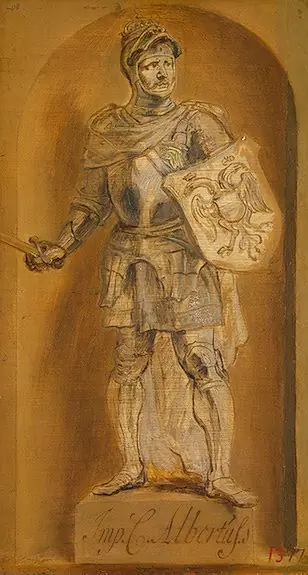
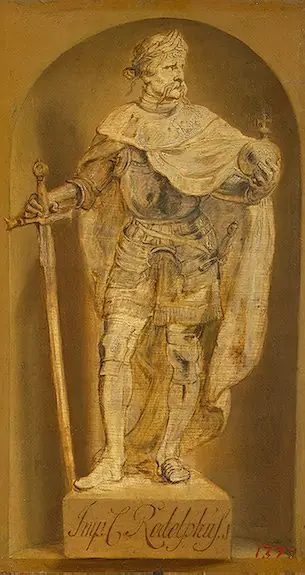
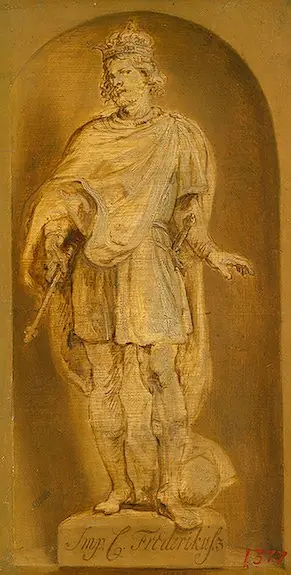
Artwork
Statue of Charles V in a niche
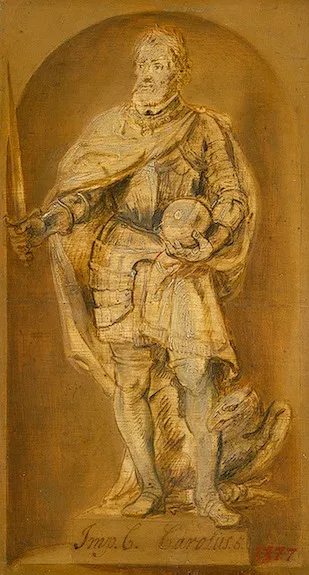
Statue of Charles V in a niche is an oil painting by the Flemish Baroque painting artist Peter Paul Rubens. It dates from 1634 and is held in the collection of the Hermitage Museum.
About this work
Overview
Created in 1634, this oil painting by Peter Paul Rubens portrays a sculptural representation of Emperor Charles V positioned within an architectural niche. The composition emphasizes the ruler’s authority through regal attire, a crown, and the traditional symbols of power—a scepter and an orb—set against a deep, shadowed background that enhances the figure’s three‑dimensional presence.
Subject & Meaning
The work presents Charles V as a monumental figure, his posture and regalia underscoring his status as a sovereign and defender of the empire. By depicting the emperor as a statue, Rubens invokes the timelessness of classical portraiture, suggesting both the political legitimacy and the enduring legacy of the Habsburg ruler.
Technique & Style
Executed in the Flemish Baroque manner, the painting showcases Rubens’s skillful handling of oil paint to render fine textures—fabric folds, metallic surfaces, and stone grain—with vivid coloration and dynamic lighting. The contrast between illuminated details and the surrounding darkness creates depth and a sense of movement typical of Rubens’s mature style.
History & Provenance
Rubens, a leading figure of the 17th‑century Flemish Baroque, produced this piece during his later years, a period marked by numerous portraits, religious altarpieces, and historical scenes. While the painting’s early ownership records are sparse, it remains attributed to Rubens and is catalogued among his works that blend portraiture with allegorical representation.
Artist & collection
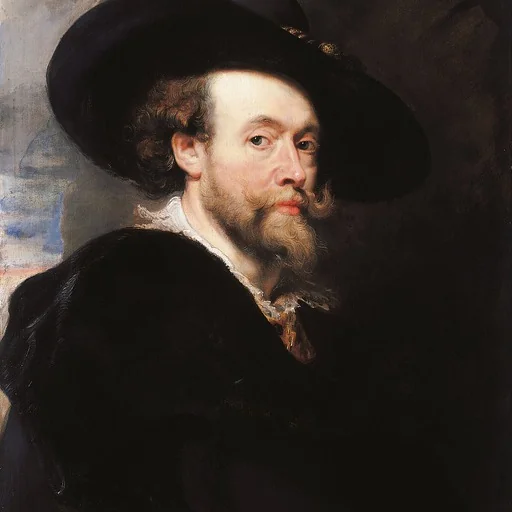
Artist
Sir Peter Paul Rubens ( ROO-bənz; Dutch: ; 28 June 1577 – 30 May 1640) was a Flemish artist and diplomat.