Artwork
STRADĂ VECHE ÎN GALAȚI
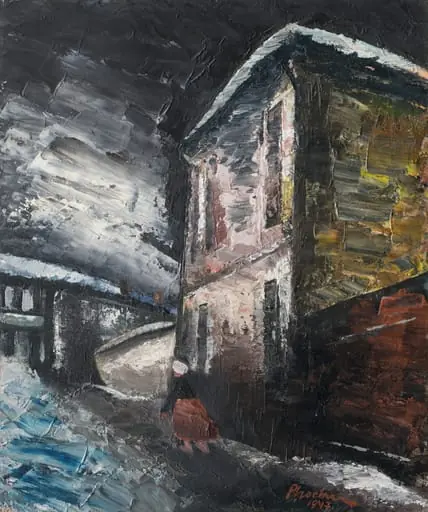
STRADĂ VECHE ÎN GALAȚI is a print by Alexandru Phoebus. It dates from 1947 and is held in the collection of the National Museum of Art of Romania.
About this work
Overview
The composition presents a modest streetscape with modest dwellings and trees, rendered in a restrained palette that reflects the postwar atmosphere.
Stradă Veche în Galați, painted in 1947 by Alexandru Phoebus, captures a quiet urban lane in the Romanian city of Galați. The composition presents a modest streetscape with modest dwellings and trees, rendered in a restrained palette that reflects the postwar atmosphere. The work belongs to a series of Romanian urban scenes Phoebus produced during this period, emphasizing everyday life over dramatic narrative.
Subject & Meaning
The painting portrays a typical residential street in Galați, devoid of human figures, inviting contemplation rather than storytelling. The absence of activity suggests a moment of stillness, possibly reflecting the subdued mood of Romania in the immediate aftermath of World War II. The architecture, neither grand nor ruined, conveys resilience in ordinary structures, hinting at continuity amid national upheaval.
Technique & Style
Phoebus employed soft, blended brushwork to render light and texture, avoiding sharp outlines. The sky is washed in muted blues and greens, while building facades are built from warm earth tones. Subtle contrasts between shadowed alleyways and sunlit window frames create spatial depth without theatricality. The technique favors atmospheric harmony over detailed realism, aligning with regional interwar tendencies in Romanian landscape painting.
History & Provenance
Created in 1947, the painting emerged during Phoebus’s active years in Galați, where he taught and exhibited locally. It remained in private Romanian collections until the late 20th century, with no public exhibition record prior to the 1990s. Its survival through political transitions suggests it was valued as a personal or regional document rather than a politically charged work.
Context
In postwar Romania, artists like Phoebus navigated shifting cultural policies that favored socialist realism but often tolerated quieter, regional subjects. Stradă Veche reflects a compromise: a non-ideological depiction of local life that avoided overt propaganda. Such works provided a quiet space for artistic expression amid state pressure, preserving visual records of everyday Romania beyond official narratives.
Legacy
Though not widely known outside Romania, Stradă Veche în Galați contributes to the understanding of regional modernism in Romanian art. It exemplifies how artists preserved local identity through understated observation. Today, it is referenced in studies of provincial painting during the early communist era, valued for its sincerity and unembellished depiction of urban texture.
Artist & collection