Artwork
Apples and teacup
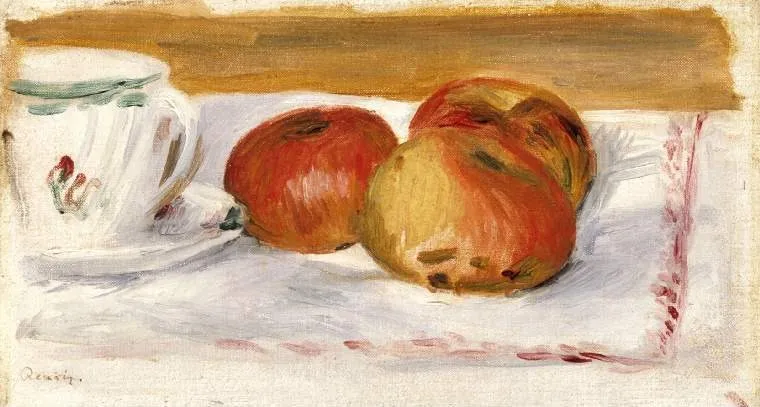
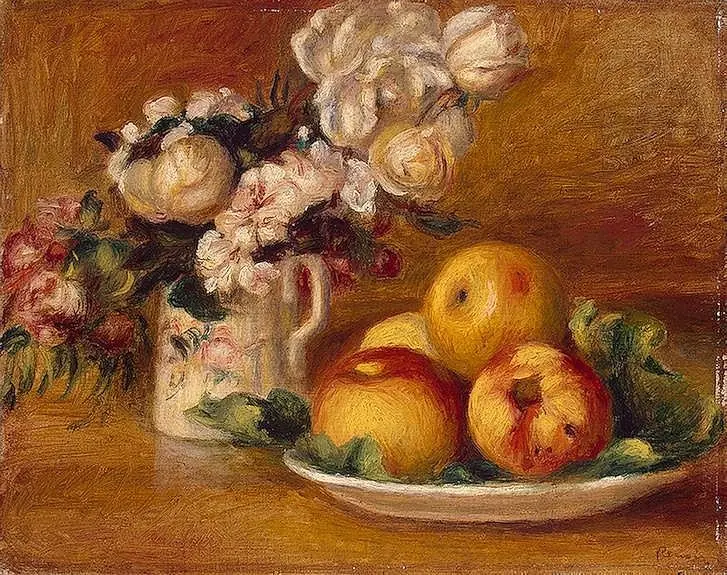
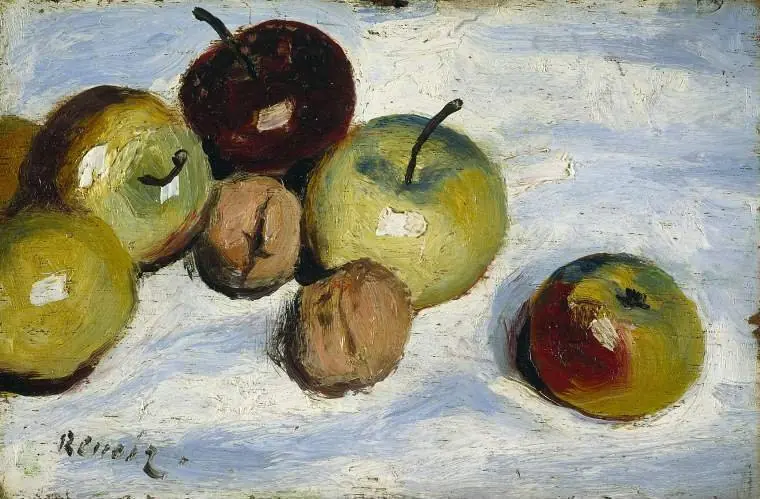
Apples and teacup is an oil painting by Auguste Renoir. It dates from 1919 and is held in the collection of the Fitzwilliam Museum.
About this work
Overview
It features a modest arrangement of two fruit and a ceramic cup on a draped table, rendered with soft brushwork and muted lighting.
Painted in 1919, Apples and Teacup is a late still life by Pierre-Auguste Renoir, executed in oil on canvas. It features a modest arrangement of two fruit and a ceramic cup on a draped table, rendered with soft brushwork and muted lighting. The work resides in the Fitzwilliam Museum, Cambridge, representing one of Renoir’s final explorations of everyday domestic objects, stripped of narrative and focused on form and texture.
Subject & Meaning
The composition centers on two apples—one red, one yellow—and a white teacup with a green rim, arranged with quiet deliberation. No symbolic or narrative intent is evident; instead, the painting elevates ordinary items through careful placement and tonal harmony. The absence of human presence or context invites contemplation of the objects themselves, emphasizing quietude and the dignity of the commonplace.
Technique & Style
Renoir employs loose, tactile brushstrokes to model the surfaces of the fruit and cup, blending color softly without sharp contours. The warm brown background recedes gently, allowing the cooler hues of the apples and ceramic to emerge. The white cloth is rendered with subtle gradations, suggesting texture without detail. His late style favors atmospheric cohesion over precision, prioritizing sensory impression over literal representation.
History & Provenance
Created during the final years of Renoir’s life, the painting reflects his continued engagement with still life despite declining health. It entered the Fitzwilliam Museum’s collection in the 20th century, likely through a private donation or acquisition. No significant exhibition history or documented ownership prior to the museum is recorded, suggesting it remained in private hands until its institutional acquisition.
Context
In 1919, Renoir was largely confined to his home in Cagnes-sur-Mer, his body weakened by arthritis. Still life became a refuge, allowing him to work within limited mobility while maintaining artistic discipline. This period saw a return to simpler subjects, echoing early Impressionist concerns with light and form, yet filtered through decades of technical evolution and physical constraint.
Legacy
Apples and Teacup stands as a quiet testament to Renoir’s enduring focus on sensory experience in art. Though not among his most widely known works, it exemplifies his late commitment to observing the ordinary with tenderness and precision. The painting contributes to a broader understanding of how artists, even in physical decline, sustained creative inquiry through intimate, unadorned subjects.
Artist & collection
Artist
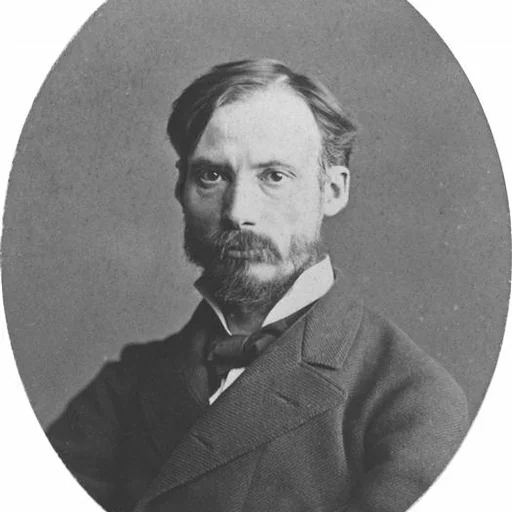
Pierre-Auguste Renoir was born on 25 February 1841 in Limoges, the son of a tailor and a seamstress.