Artwork
Autumn
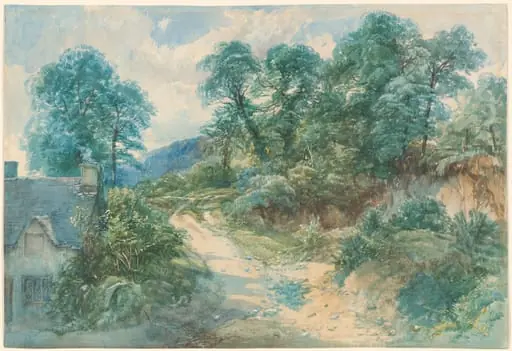
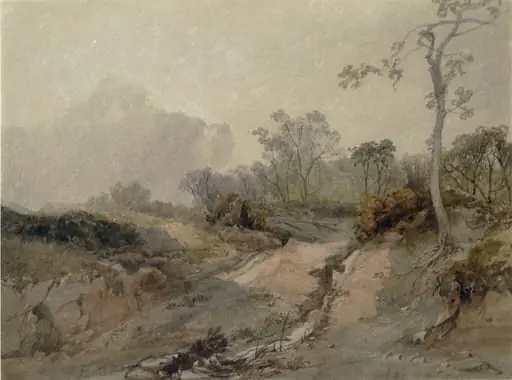
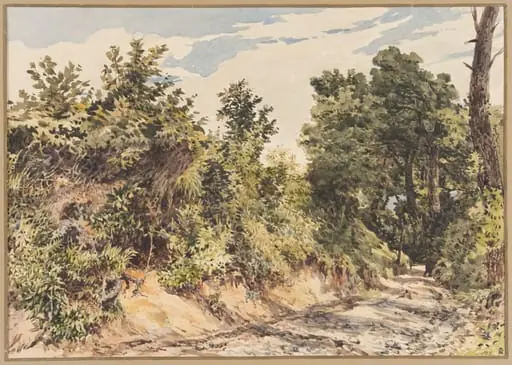
Autumn is a graphite drawing by the Romanticist artist Joseph Rubens Powell. It dates from 1843 and is held in the collection of the National Gallery of Art.
About this work
Overview
Created in 1843, Autumn is a watercolor drawing by Joseph Rubens Powell on wove paper, executed over a graphite underdrawing.
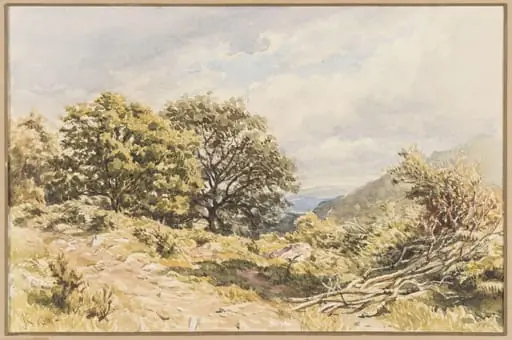
Created in 1843, Autumn is a watercolor drawing by Joseph Rubens Powell on wove paper, executed over a graphite underdrawing. The work captures a quiet woodland path in seasonal transition, rendered with delicate precision. Powell’s use of transparent washes and controlled brushwork conveys the subtle shifts of light and texture characteristic of fall, avoiding overt sentimentality in favor of quiet observation.
Subject & Meaning
The scene depicts an unpopulated forest path blanketed in fallen leaves, framed by tall, bare trees. No human figures or dramatic events interrupt the stillness, emphasizing the quiet rhythm of nature’s cycle. The composition invites contemplation rather than narrative, suggesting a meditation on decay and renewal without romanticizing the season.
Technique & Style
Powell employed thin, layered watercolor glazes over a graphite sketch to build subtle tonal variations and luminous depth. The transparency of the medium allows the paper’s white to suggest light filtering through branches, while controlled washes mimic the soft texture of leaf litter. The technique avoids bold outlines, favoring atmospheric blending to evoke the hazy, cool air of autumn.
History & Provenance
Painted in 1843, Autumn is one of Powell’s known works from his early career, a period when he focused on intimate landscape studies. It remained in private collections until entering institutional holdings in the 20th century. Its survival as a fragile watercolor on paper reflects careful preservation, though little documentation exists regarding its initial reception or exhibition history.
Context
In the 1840s, American artists increasingly turned to native landscapes as subjects, moving away from European traditions. Powell’s work aligns with this shift, reflecting a growing interest in the natural world as worthy of quiet, detailed study. His approach contrasts with the grandeur of Hudson River School paintings, favoring modest, personal observations over heroic scale.
Legacy
Autumn exemplifies a quiet strain in 19th-century American watercolor, where technical restraint and observational fidelity took precedence over dramatic effect. Though Powell is not widely known today, this work contributes to the broader understanding of how artists of the period engaged with nature through intimate, meditative forms of representation.
Own this work as a print
Artist & collection