Artwork
Arab Horse Soldiers
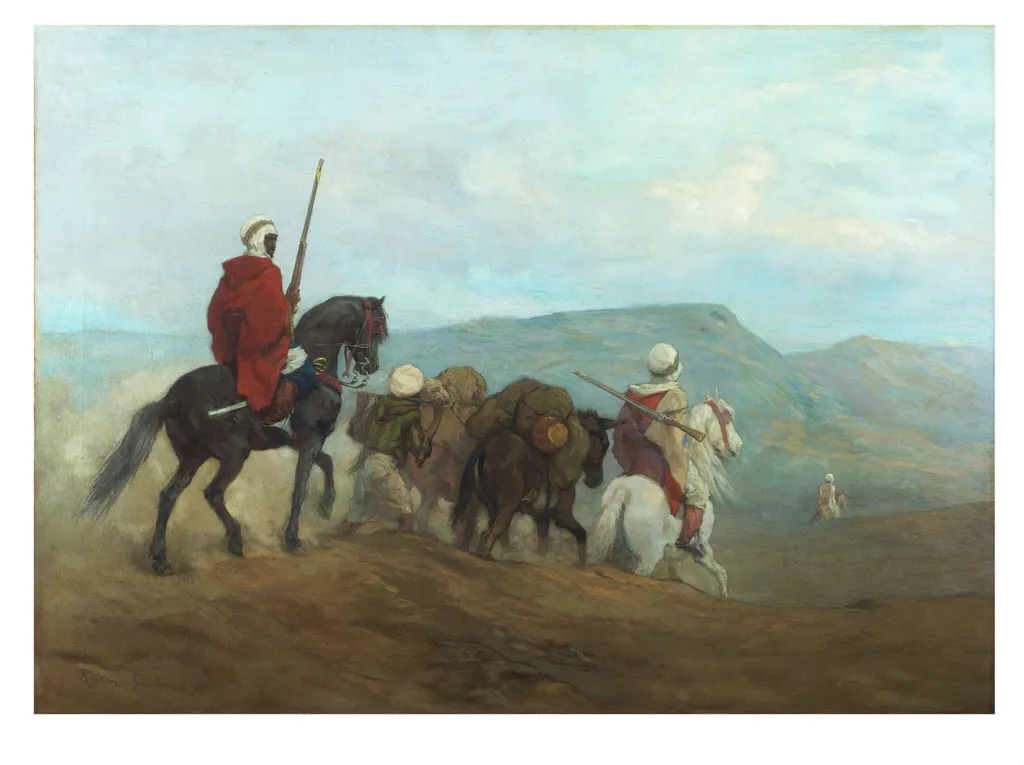
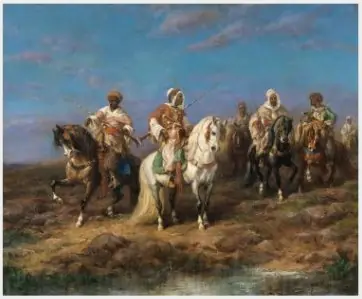
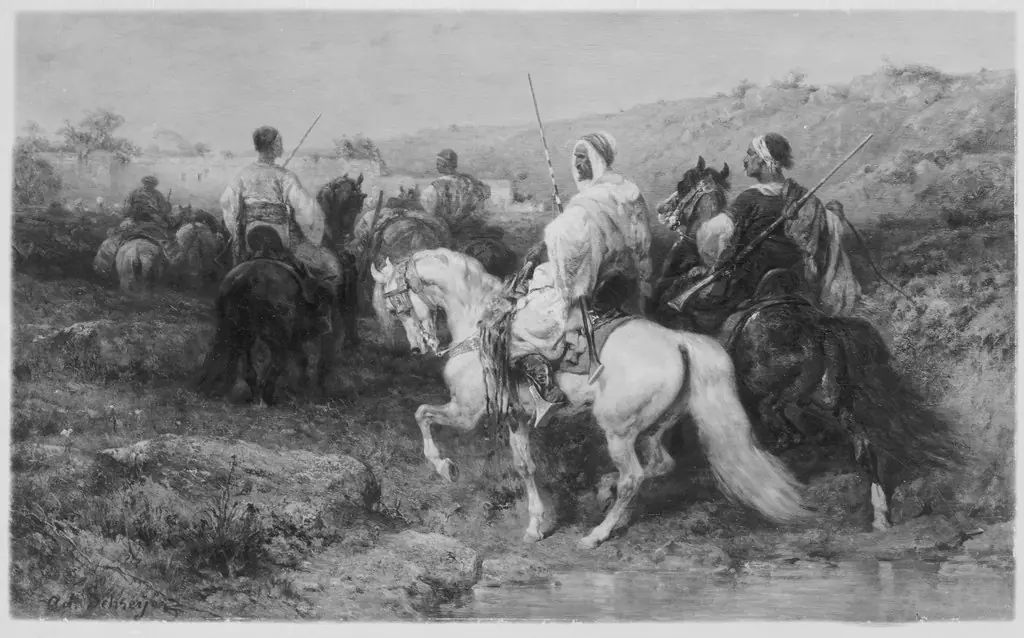
Arab Horse Soldiers is an oil painting by the Impressionist artist Guillaume Régamey. It dates from 1871 and is held in the collection of the Victoria and Albert Museum.
About this work
Overview
He participated in the inaugural Salon des Refusés in 1859, an alternative exhibition for artists excluded by the official Salon.
Guillaume Régamey, a French painter born in Paris in 1837, trained under Horace Lecoq de Boisbaudran and briefly engaged with the avant-garde art scene of the 1850s. He participated in the inaugural Salon des Refusés in 1859, an alternative exhibition for artists excluded by the official Salon. Despite his early death at 37, Régamey developed a focused body of work centered on equestrian subjects, particularly in North African settings, reflecting his interest in military and desert life.
Subject & Meaning
The painting depicts three Arab cavalrymen descending a sandy slope, accompanied by a lone figure guiding two burdened mules. The scene captures a moment of quiet movement across an arid landscape, avoiding dramatic narrative in favor of observed daily life. This aligns with Orientalist tendencies of the period, which portrayed Middle Eastern and North African subjects with a blend of ethnographic detail and romanticized exoticism, without overt political commentary.
Technique & Style
Régamey employed careful observation and controlled chiaroscuro to model forms under harsh desert light. His brushwork is precise, rendering textures of fabric, leather, and sand with restrained realism. The composition emphasizes horizontal rhythms and spatial depth, with figures scaled to suggest distance and terrain. The palette favors warm earth tones, with subtle contrasts that enhance the sense of atmospheric heat and aridity without theatrical exaggeration.
History & Provenance
Régamey’s career was brief but notable for his early involvement with the Salon des Refusés, where he connected with artists like Corot. After his death in 1875, a retrospective was held at the École des Beaux-Arts in 1876, consolidating his reputation among peers. His works remained largely within French collections, with few public records of early ownership. The painting’s current location reflects its continued presence in institutional holdings focused on 19th-century Orientalist art.
Context
Régamey worked during a period when French artists increasingly turned to North Africa as a subject, influenced by colonial expansion and romantic fascination with the Orient. His focus on cavalry and desert travel mirrored military interests and travel literature of the time. Unlike some Orientalists who emphasized spectacle, Régamey’s approach leaned toward quiet observation, aligning him with realist tendencies even as he engaged with exotic themes.
Legacy
Though his career ended prematurely, Régamey’s consistent focus on equestrian subjects contributed to a niche within 19th-century French painting. His work is remembered for its understated realism and technical discipline, distinguishing it from more flamboyant Orientalist productions. Retrospectives and scholarly attention have preserved his place as a minor but distinctive voice in the broader movement of Orientalist art.
Own this work as a print
Artist & collection
Artist
French painter Guillaume Régamey captured 19th-century military life and animal power in bold oils.