Artwork
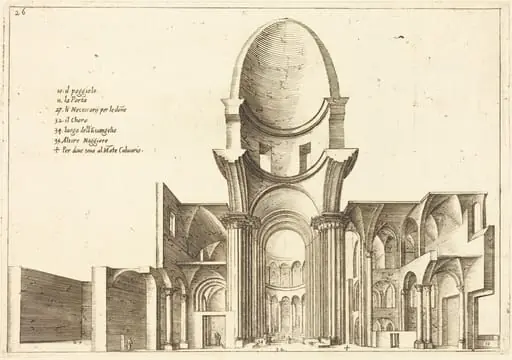
Section of the Church of Saint John the Baptist
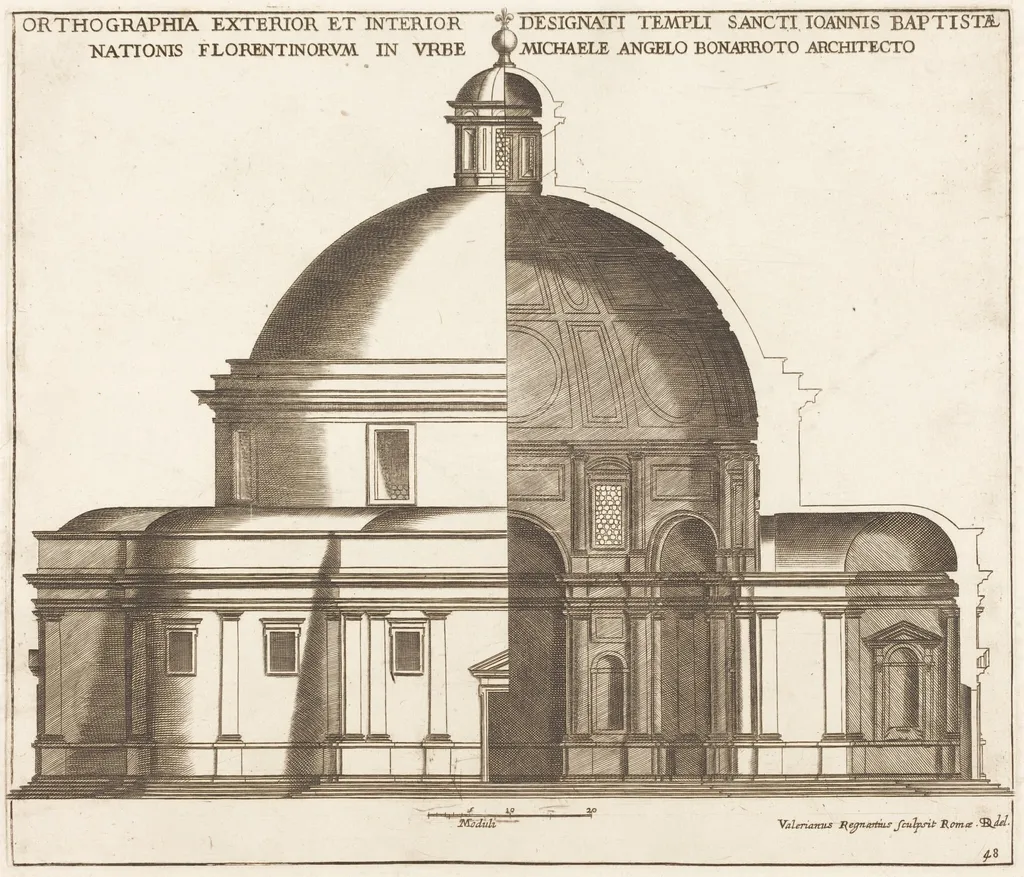
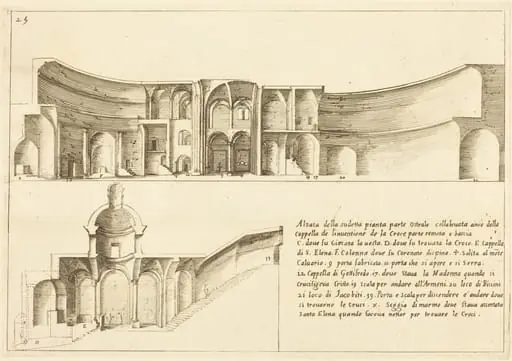
Section of the Church of Saint John the Baptist is an ink print by the Baroque artist Valerien Regnard. It dates from 1650 and is held in the collection of the National Gallery of Art. Valérien Regnard’s 1650 engraving presents a detailed representation of the Church of Saint John the Baptist.
About this work
Overview
Valérien Regnard’s 1650 engraving presents a detailed representation of the Church of Saint John the Baptist. Executed on laid paper, the print captures the façade’s towering columns, a dominant dome, and a smaller cupola rising above the roofline. The composition is rendered in stark black‑and‑white line work, giving the image a schematic, almost architectural quality.
Subject & Meaning
The image focuses on the exterior architecture of the church, emphasizing its monumental dome and the rhythmic arrangement of columns that frame the entrance.
The image focuses on the exterior architecture of the church, emphasizing its monumental dome and the rhythmic arrangement of columns that frame the entrance. Small windows punctuate the façade, while the interior of the dome is suggested by stepped arches, hinting at the spatial depth of the sacred space. An inscription at the top attributes the design to Michelangelo, linking the structure to the legacy of Renaissance architecture.
Technique & Style
Regnard employed fine engraving techniques, incising precise, linear strokes into a copper plate before transferring the image onto laid paper. The crispness of the lines and the careful rendering of perspective convey a technical, almost draft‑like quality, reminiscent of architectural plans. The monochrome palette underscores the emphasis on form and proportion rather than decorative coloration.
History & Provenance
Created in the mid‑17th century, the print reflects the period’s interest in documenting notable ecclesiastical buildings. Regnard’s signature appears in the lower corner, confirming authorship. While the original plate’s whereabouts are unknown, surviving impressions are held in several European print collections, attesting to the work’s circulation among connoisseurs of architectural engraving.
Context
The engraving emerges at a time when prints served both as artistic works and as visual records of important monuments. By referencing Michelangelo, the image situates the church within a broader narrative of Renaissance influence on later Baroque architecture, illustrating how architects and patrons continued to invoke classical ideals in their designs.
Artist & collection


![Orthographia Partis Interioris Templi Divi Petri [Interior View of Saint Peter's Basilica], by Étienne Dupérac](https://artifactworldgallery.com/img/etienne-duperac--orthographia-partis-interioris-templi-divi-petri-interior-vi--59b448ec2f3049cc-w320.webp) Orthographia Partis Interioris Templi Divi Petri [Interior View of Saint Peter's Basilica]
Orthographia Partis Interioris Templi Divi Petri [Interior View of Saint Peter's Basilica]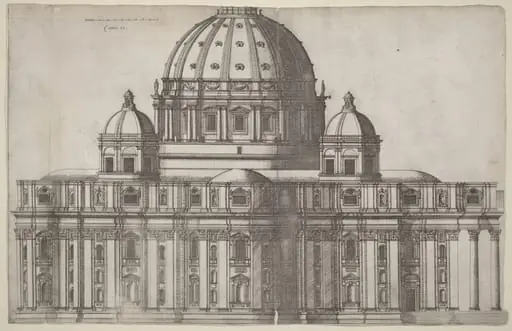 Longitudinal View of Saint Peter's, Rome
![Orthographia Partis Exterioris Templi Divi Petri [Exterior View of Saint Peter's Basilica], by Étienne Dupérac](https://artifactworldgallery.com/img/etienne-duperac--orthographia-partis-exterioris-templi-divi-petri-exterior-vi--97a194b60abe7fac-w320.webp) Orthographia Partis Exterioris Templi Divi Petri [Exterior View of Saint Peter's Basilica]
Orthographia Partis Exterioris Templi Divi Petri [Exterior View of Saint Peter's Basilica]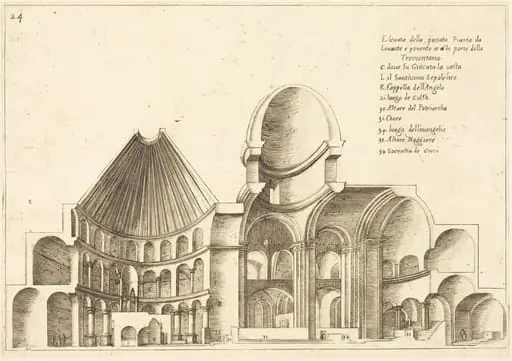 Cross-Section of the Church of the Holy Sepulchre
![Forma Partis Templi Divi Petri [Exterior Section of Saint Peter's Basilica], by Italian 16th Century](https://artifactworldgallery.com/img/italian-16th-century--forma-partis-templi-divi-petri-exterior-section-of-saint-pet--37837cc262581d9e-w320.webp) Forma Partis Templi Divi Petri [Exterior Section of Saint Peter's Basilica]
Forma Partis Templi Divi Petri [Exterior Section of Saint Peter's Basilica]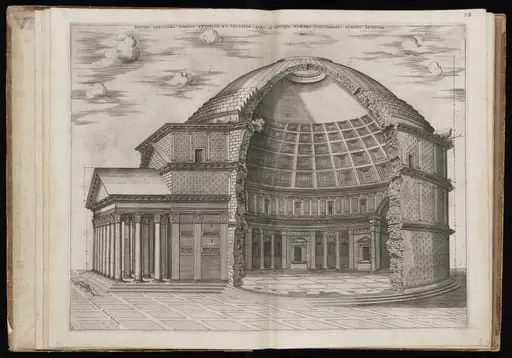 The Pantheon
 Cross-Section of a Church
 Section and Interior of the Sanctuary of San Lorenzo de El Escorial
 Elevation of a Church
![Pantheum Romanum [The Roman Pantheon], by Nicolas Beatrizet](https://artifactworldgallery.com/img/nicolas-beatrizet--pantheum-romanum-the-roman-pantheon--8069db7dd8e6f190-w320.webp) Pantheum Romanum [The Roman Pantheon]
Pantheum Romanum [The Roman Pantheon] Interior of a Palazzo with Classical Sculptures in Niches and above a Door
 Elevation of the Chapel of the Invention of the Cross