Artwork
The Pantheon
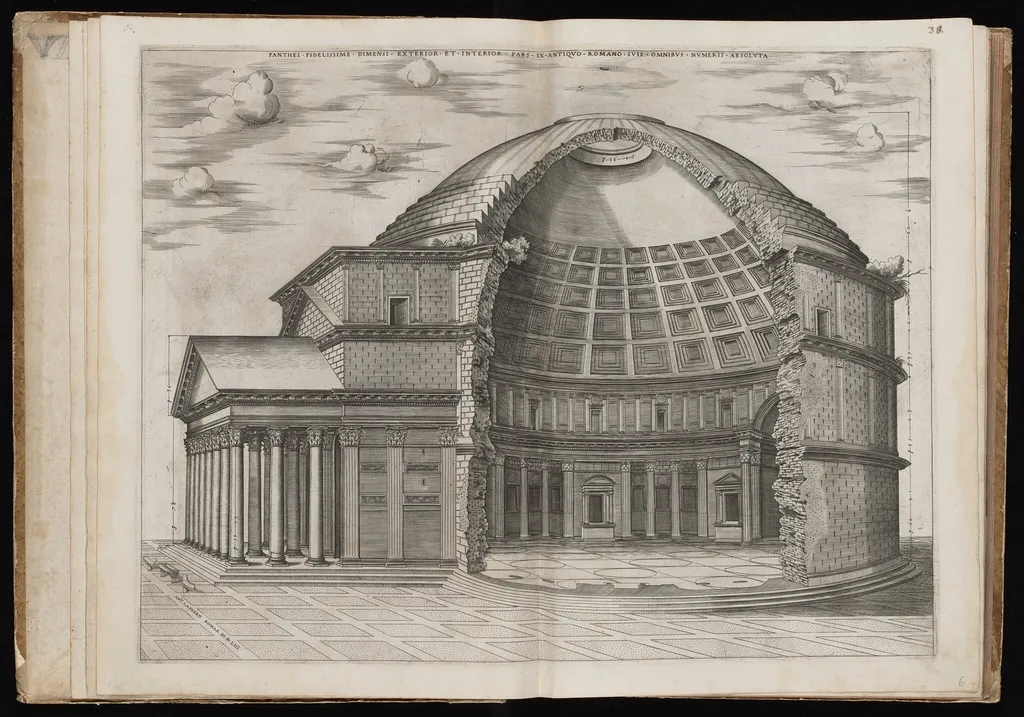
The Pantheon is an ink print by the Renaissance artist Italian 16th Century. It dates from 1553 and is held in the collection of the National Gallery of Art.
About this work
You see a detailed image of the Pantheon in this engraving.
The artist included many architectural details, like the grand dome and oculus.
The Pantheon was built as a Roman temple and later became a church, which is interesting because it shows how old buildings can be used in new ways.
Check out the work of artist: Italian 16th Century.
Overview
This 16th‑century Italian engraving presents a meticulous view of Rome’s Pantheon, emphasizing its massive dome and the circular opening at its apex. The print captures the building’s imposing silhouette and the surrounding architectural elements with fine line work, offering a historic visual record of the monument as it appeared in the early modern period.
Subject & Meaning
The image depicts the Pantheon, originally erected as a Roman temple during Emperor Hadrian’s reign and subsequently consecrated as a Christian church. The engraving highlights the adaptive reuse of the ancient structure, illustrating how its monumental form continued to serve religious and civic purposes across centuries.
Technique & Style
Executed in fine engraving, the work relies on delicate hatching and cross‑hatching to convey depth, texture, and the play of light on the dome’s curvature. The artist’s attention to architectural detail reflects the Renaissance fascination with classical antiquity and the precision of printmaking as a means of disseminating scholarly images.
History & Provenance
The Pantheon’s construction dates to the early 2nd century CE, with major restorations undertaken in the early 1700s that addressed structural wear. The engraving itself, produced in the 1500s, predates these later repairs, providing a visual reference for the building’s condition prior to the 18th‑century interventions.
Context
During the 16th century, Italian artists frequently reproduced ancient monuments to satisfy the growing interest in classical architecture among scholars and patrons. This print aligns with that trend, serving both as an educational tool and as a testament to the enduring prestige of Roman engineering.
Artist & collection

Artist
A 16th-century Italian sculptor left us small bronze works in dark brown and gold.


![Orthographia Partis Interioris Templi Divi Petri [Interior View of Saint Peter's Basilica], by Étienne Dupérac](https://artifactworldgallery.com/img/etienne-duperac--orthographia-partis-interioris-templi-divi-petri-interior-vi--59b448ec2f3049cc-w320.webp) Orthographia Partis Interioris Templi Divi Petri [Interior View of Saint Peter's Basilica]
Orthographia Partis Interioris Templi Divi Petri [Interior View of Saint Peter's Basilica]![Orthographia Partis Exterioris Templi Divi Petri [Exterior View of Saint Peter's Basilica], by Étienne Dupérac](https://artifactworldgallery.com/img/etienne-duperac--orthographia-partis-exterioris-templi-divi-petri-exterior-vi--97a194b60abe7fac-w320.webp) Orthographia Partis Exterioris Templi Divi Petri [Exterior View of Saint Peter's Basilica]
Orthographia Partis Exterioris Templi Divi Petri [Exterior View of Saint Peter's Basilica]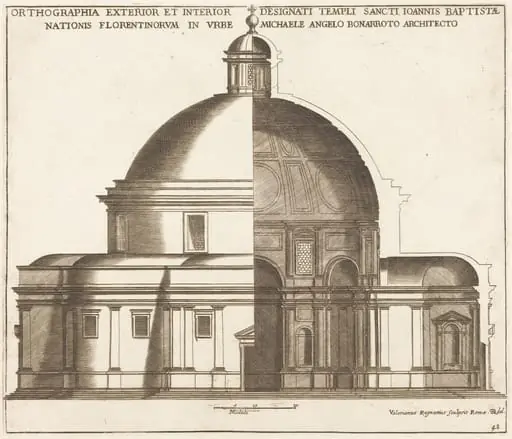 Section of the Church of Saint John the Baptist
![Forma Partis Templi Divi Petri [Exterior Section of Saint Peter's Basilica], by Italian 16th Century](https://artifactworldgallery.com/img/italian-16th-century--forma-partis-templi-divi-petri-exterior-section-of-saint-pet--37837cc262581d9e-w320.webp) Forma Partis Templi Divi Petri [Exterior Section of Saint Peter's Basilica]
Forma Partis Templi Divi Petri [Exterior Section of Saint Peter's Basilica]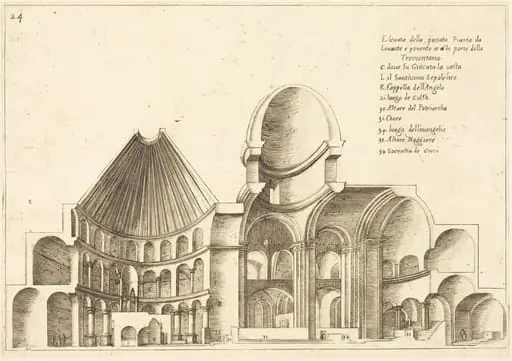 Cross-Section of the Church of the Holy Sepulchre
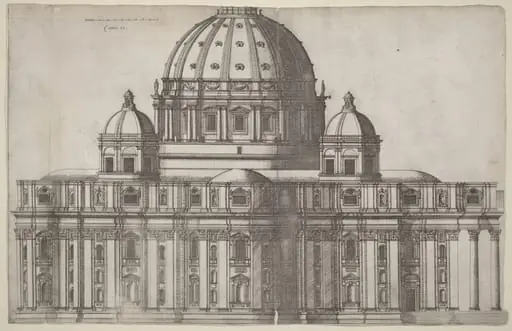 Longitudinal View of Saint Peter's, Rome
![Balnei Laterani [The Lateran Baptistry], by Italian 16th Century](https://artifactworldgallery.com/img/italian-16th-century--balnei-laterani-the-lateran-baptistry--7b73728472928663-w320.webp) Balnei Laterani [The Lateran Baptistry]
Balnei Laterani [The Lateran Baptistry]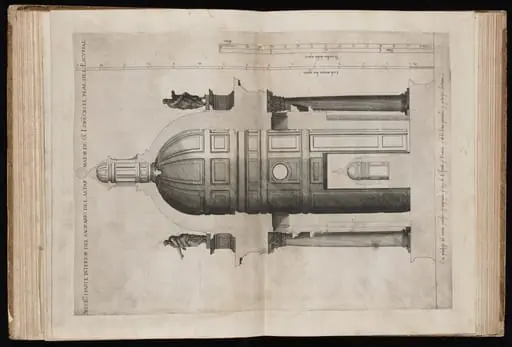 Section and Interior of the Sanctuary of San Lorenzo de El Escorial