Artwork
Beggar Man and Woman
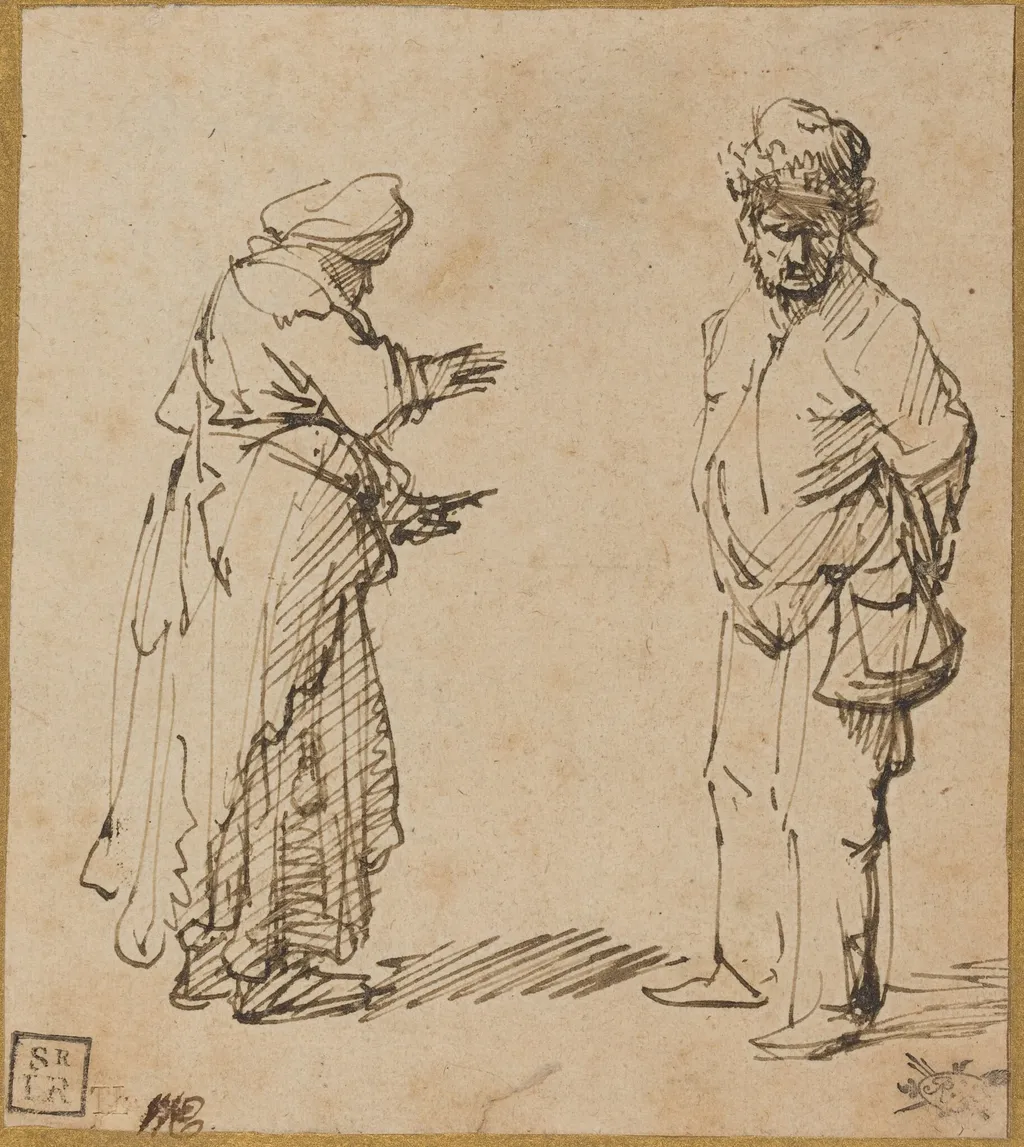
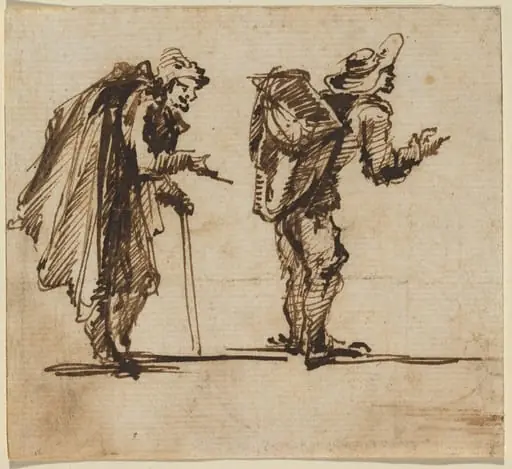
Beggar Man and Woman is an ink drawing by the Baroque artist Rembrandt. It dates from 1630 and is held in the collection of the National Gallery of Art.
About this work
Overview
Rembrandt van Rijn produced the drawing Beggar Man and Woman around 1630. Executed in pen and brown ink on laid paper, the work is a compact study that captures a pair of itinerant figures in a moment of interaction. The medium and scale reflect the artist’s practice of quick, observational sketches during this early period of his career.
Subject & Meaning
The figure on the left, draped in a long, flowing robe and a brimmed hat, extends a hand outward, suggesting a gesture of pleading or request.
The composition presents two beggars standing close together. The figure on the left, draped in a long, flowing robe and a brimmed hat, extends a hand outward, suggesting a gesture of pleading or request. The companion on the right, dressed in a loose coat and tall hat, folds his arms and looks downward, conveying resignation or contemplation. The pairing invites reflection on poverty and human connection in 17th‑century Dutch society.
Technique & Style
Rembrandt employs swift, dark lines to delineate the folds of clothing and the contours of the faces. Shadows are built up through dense, criss‑crossed hatching, creating tonal depth without the use of color. The handling of ink demonstrates the artist’s mastery of line work, allowing texture and volume to emerge from simple monochrome strokes.
History & Provenance
Created in the early 1630s, the drawing belongs to a group of studies Rembrandt made while exploring everyday subjects. Its provenance traces through several private collections before entering the museum’s holdings in the mid‑20th century, where it has been conserved as an example of the master’s formative drawing practice.
Context
During the 1630s Rembrandt was establishing his reputation in Amsterdam, turning to genre scenes and portraiture that highlighted ordinary people. This sketch aligns with his interest in depicting the lower classes, a theme also evident in his later paintings such as The Beggar and other social‑realist works.
Legacy
The drawing illustrates Rembrandt’s early ability to convey narrative and emotion through minimal means, influencing subsequent generations of draughtsmen. Its study of line and shading continues to be referenced in discussions of Baroque drawing techniques and the artist’s development of chiaroscuro on paper.
Own this work as a print
Artist & collection
Artist
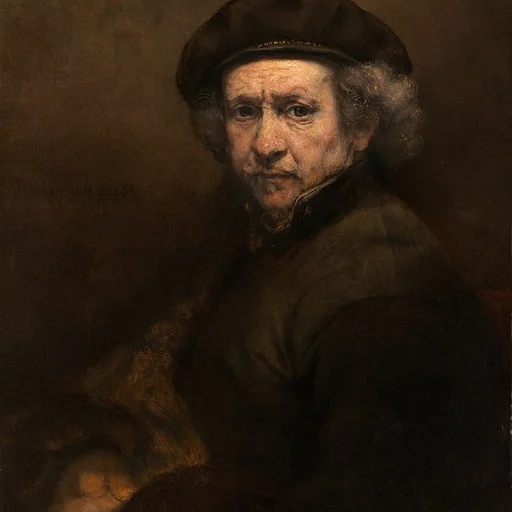
Rembrandt Harmenszoon van Rijn (15 July 1606 – 4 October 1669), known mononymously as Rembrandt, was a Dutch Golden Age painter, printmaker, and draughtsman.