Artwork
Faust
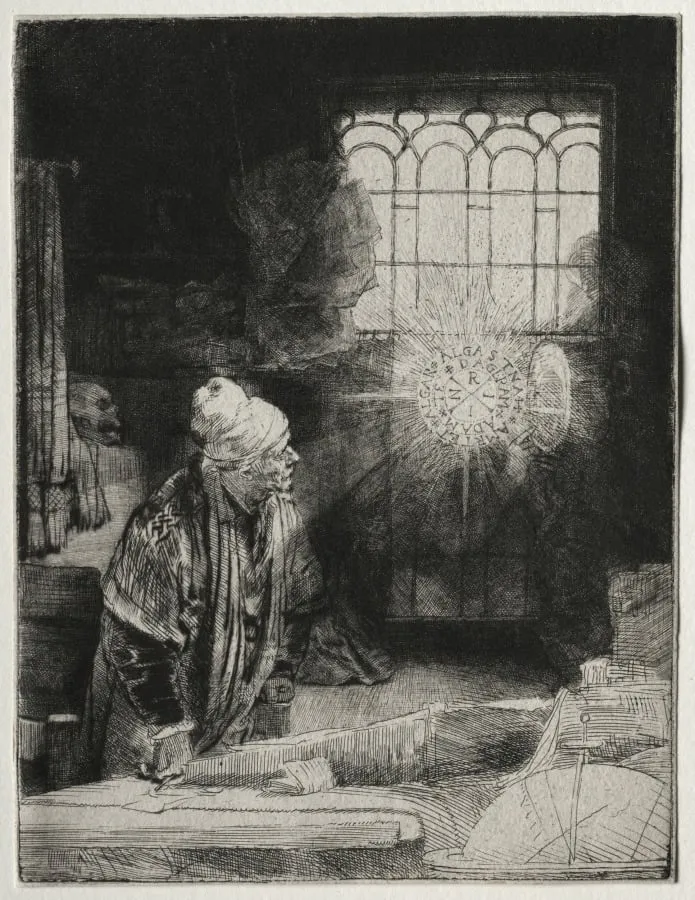
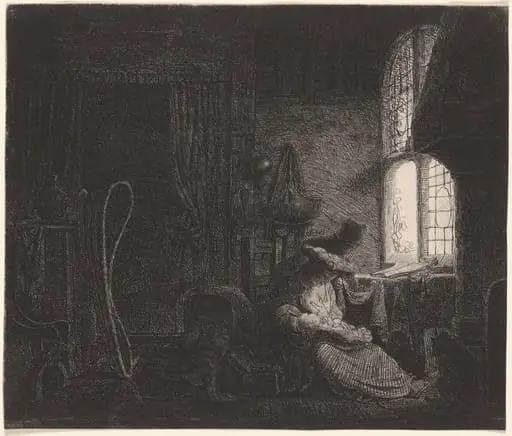
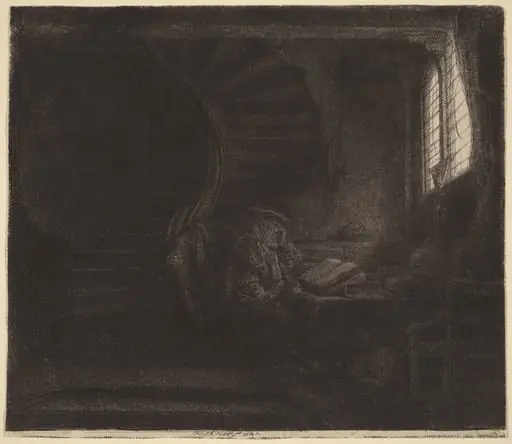
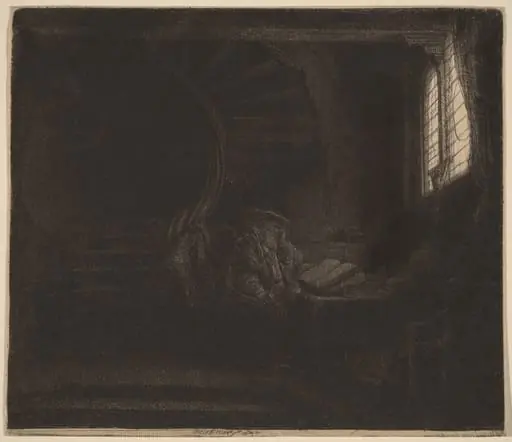
Faust is a print by the Baroque artist Rembrandt. It dates from 1652 and is held in the collection of the Cleveland Museum of Art.
About this work
Overview
A luminous starburst above him bears the word 'FAUST,' subtly linking the image to literary tradition without literal illustration.
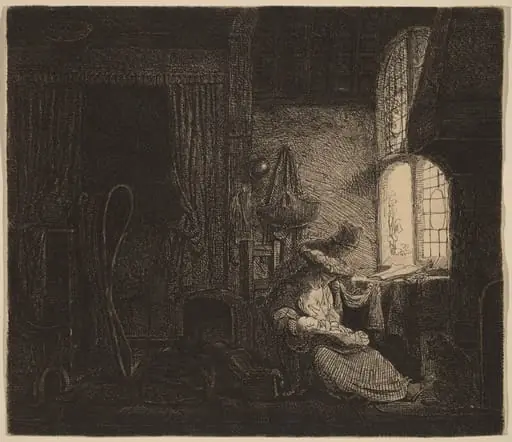
Created around 1652, this etching by Rembrandt van Rijn depicts a solitary figure in a dimly lit interior. Rendered in monochrome, the print captures a moment of intense concentration. The composition centers on a man kneeling before a table, surrounded by shadows and faint architectural details. A luminous starburst above him bears the word 'FAUST,' subtly linking the image to literary tradition without literal illustration.
Subject & Meaning
The figure, cloaked and absorbed in study, evokes the archetype of the scholar-engaged-with-forces-beyond-himself. Though not a direct portrait of Goethe’s Faust, the inscription and posture suggest a man in communion with forbidden knowledge. The quiet tension between earthly study and unseen powers is conveyed through posture and lighting, inviting contemplation rather than narrative clarity.
Technique & Style
Rembrandt employed etching with meticulous control of line and tone, exploiting the medium’s capacity for deep shadow and delicate gradation. The contrast between the illuminated word and the surrounding gloom exemplifies chiaroscuro, a hallmark of his printmaking. Textural variety in the robe, book, and window frame adds depth, while the sparse details suggest rather than define the space.
History & Provenance
The print entered the collection of The Cleveland Museum of Art through established channels of early 20th-century acquisitions. Its attribution to Rembrandt has been consistently supported by scholars, though its exact provenance prior to modern collection records remains partially undocumented. It is one of many etchings from his later period, when he increasingly explored psychological depth over narrative detail.
Context
In the 1650s, Rembrandt turned toward introspective subjects, often drawing from biblical, mythic, or literary sources filtered through personal reflection. The Faust motif, though not widely depicted in visual art at the time, resonated with contemporary intellectual currents around knowledge, ambition, and the occult. This print reflects his interest in inner states over external drama.
Legacy
This etching stands as an example of Rembrandt’s mature approach to printmaking—economical, emotionally resonant, and rich in symbolic suggestion. It influenced later artists drawn to psychological portraiture and the expressive potential of light and shadow. While not widely reproduced, it remains a key work in understanding his late stylistic evolution.
Artist & collection
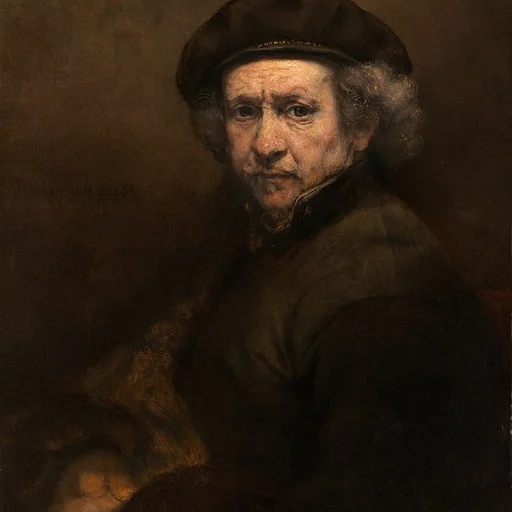
Artist
Rembrandt Harmenszoon van Rijn (15 July 1606 – 4 October 1669), known mononymously as Rembrandt, was a Dutch Golden Age painter, printmaker, and draughtsman.