Artwork
The Three Trees
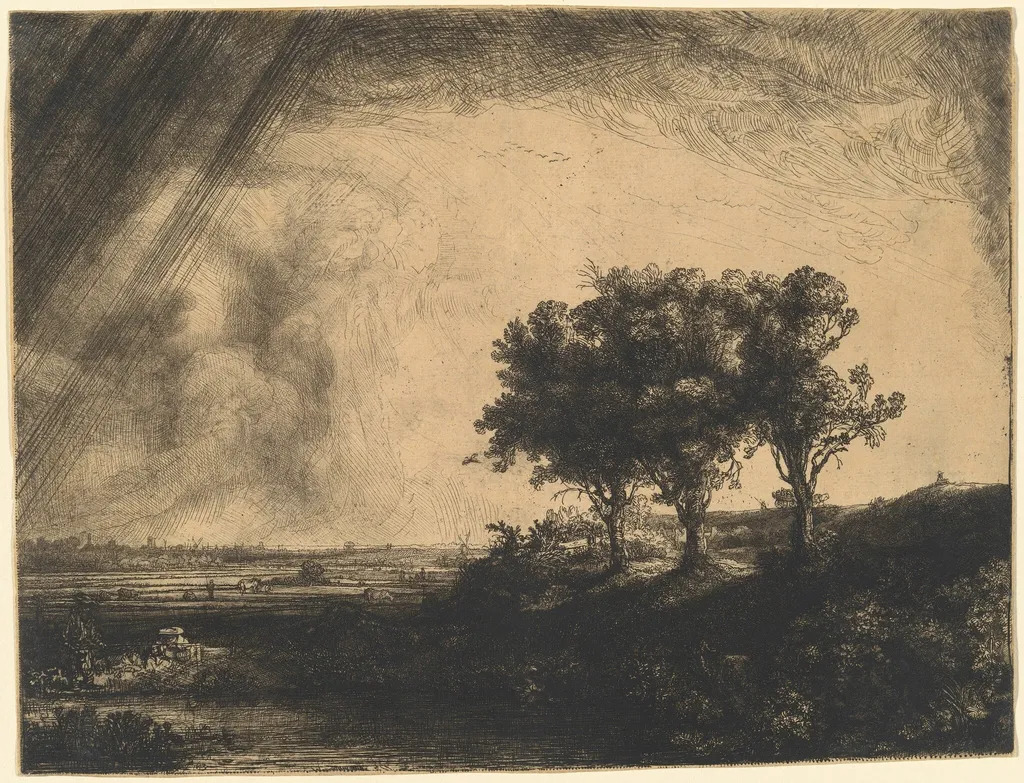
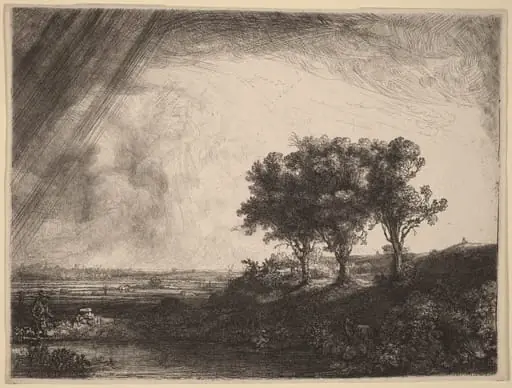
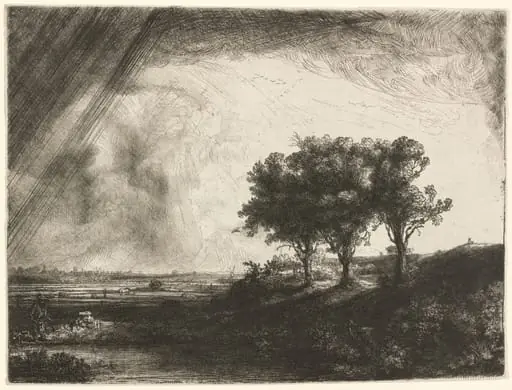
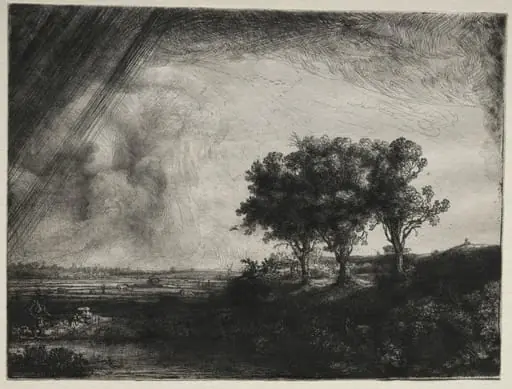
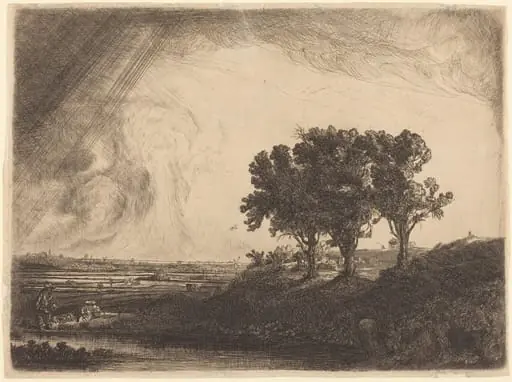
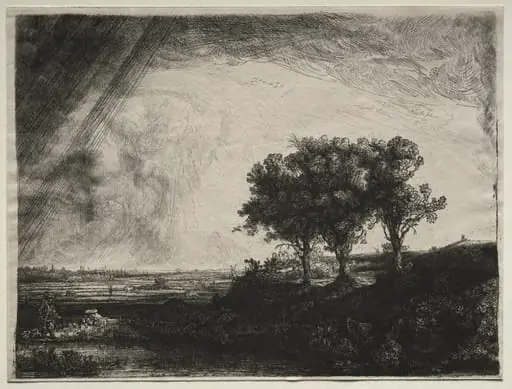
The Three Trees is an ink print by the Baroque artist Rembrandt. It dates from 1643 and is held in the collection of the National Gallery of Art.
About this work
Overview
Created in 1643, The Three Trees is a print by Rembrandt van Rijn, executed in etching with drypoint and burin on toned laid paper.
Created in 1643, The Three Trees is a print by Rembrandt van Rijn, executed in etching with drypoint and burin on toned laid paper. Unlike painted landscapes, this work relies on the nuanced interplay of ink and paper tone to evoke atmosphere. The composition centers on three robust trees in the foreground, their forms rendered with dense, expressive lines that contrast against the open sky and distant horizon.
Subject & Meaning
The scene presents a quiet, unidealized Dutch countryside, with three trees as the sole structural anchors. Beyond them, a stretch of water and faint architectural elements suggest human presence without narrative focus. The trees, neither symbolic nor allegorical, function as natural monuments—emblems of endurance and quiet observation, inviting contemplation rather than interpretation.
Technique & Style
Rembrandt combined etching, drypoint, and burin to achieve varied textures: fine lines define foliage, while drypoint’s burr creates soft, velvety shadows. The paper’s warm tone serves as mid-gray, allowing highlights to emerge through selective wiping and deep blacks through heavy ink accumulation. This method generates atmospheric depth without color, relying on tonal gradation to suggest light and distance.
History & Provenance
The print was made during Rembrandt’s most experimental phase in printmaking, shortly after he acquired his famous house on Sint Antoniesbreestraat. Few impressions survive from the earliest states, and most known versions were pulled later, often with reworking. Its circulation among collectors in the 17th century helped establish Rembrandt’s reputation as a printmaker of exceptional technical command.
Context
In the 1640s, Dutch landscape art shifted from idealized vistas to intimate, observed scenes. Rembrandt’s approach diverged from contemporaries by emphasizing mood over topographical accuracy. The Three Trees reflects this trend, aligning with a growing interest in nature’s quiet rhythms, while its technical ambition set it apart from more conventional landscape prints of the period.
Legacy
The print became a touchstone for later artists studying tonal control and expressive line. Its influence extended beyond the Netherlands, particularly to 19th-century etchers who admired its emotional resonance and technical economy. Unlike many of Rembrandt’s narrative works, this landscape endures for its restraint—offering no moral or mythological lesson, only presence.
Own this work as a print
Artist & collection
Artist
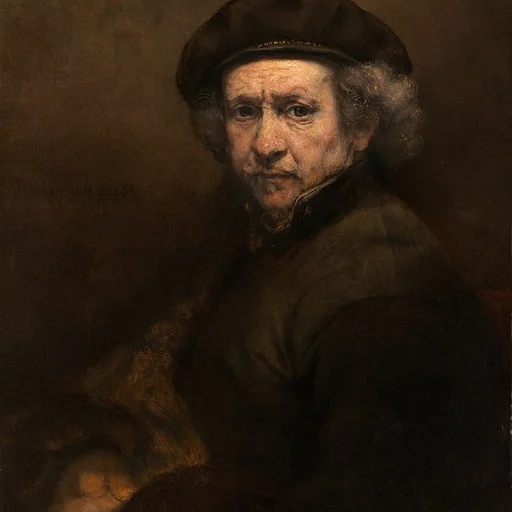
Rembrandt Harmenszoon van Rijn (15 July 1606 – 4 October 1669), known mononymously as Rembrandt, was a Dutch Golden Age painter, printmaker, and draughtsman.