Artwork
Statue of Alexander and Bucephalus [recto]
![Statue of Alexander and Bucephalus [recto], by Hubert Robert, chalk, 1760](https://artifactworldgallery.com/img/hubert-robert--statue-of-alexander-and-bucephalus-recto--d9a688cc8df08f18-w1024.webp)
Statue of Alexander and Bucephalus [recto] is a chalk drawing by the Romanticist artist Hubert Robert. It dates from 1760 and is held in the collection of the National Gallery of Art.
About this work
Overview
Unlike finished compositions, this piece reads as a spontaneous study, emphasizing motion over detail, and lacks any contextual background or finish.
Created around 1760 by French artist Hubert Robert, this drawing in black chalk on laid paper captures a dynamic moment between Alexander the Great and his horse Bucephalus. Executed with rapid, expressive strokes, the work reflects Robert’s habit of sketching classical themes with a loose, observational hand. Unlike finished compositions, this piece reads as a spontaneous study, emphasizing motion over detail, and lacks any contextual background or finish.
Subject & Meaning
The drawing depicts Alexander and Bucephalus in a moment of struggle, the horse rearing with its legs entangled in the rider’s cloak. Alexander leans backward, one arm raised as if to maintain balance. This scene references the legendary taming of Bucephalus, symbolizing mastery over wild force. Robert’s focus on instability suggests not triumph, but the precariousness of control—a theme resonant with his interest in the fragility of antiquity.
Technique & Style
Robert employed black chalk on textured laid paper to achieve a sense of immediacy and movement. The lines are fluid and unrefined, with overlapping strokes suggesting form through suggestion rather than definition. The absence of shading or background isolates the figures, heightening their kinetic tension. This approach aligns with Robert’s broader practice of using sketching as a tool for exploring composition and gesture before larger works.
History & Provenance
The drawing originates from Robert’s early career, likely produced during his formative years in Rome, where he studied classical sculpture and ruins. It was not intended for public display but served as a personal exercise in capturing motion and anatomy. Its survival suggests it was retained by the artist or a close associate, possibly as a reference for later compositions involving equestrian or antiquarian subjects.
Context
In the mid-18th century, European artists increasingly turned to classical antiquity as a source of inspiration, often reinterpreting it through a romantic lens. Robert, influenced by the ruins of Rome and the writings of antiquarians, favored scenes that evoked time’s decay and human struggle. This drawing fits within that trend, treating myth not as idealized history but as a moment of raw, transient action.
Legacy
Though not widely exhibited, the drawing exemplifies Robert’s distinctive approach to classical subjects: unpolished, emotionally charged, and grounded in observation. It anticipates later Romantic interests in movement and psychological tension, distinguishing his work from more formal neoclassical treatments. As a surviving sketch, it offers insight into his creative process and the informal studies that underpinned his larger oeuvre.
Artist & collection
Artist
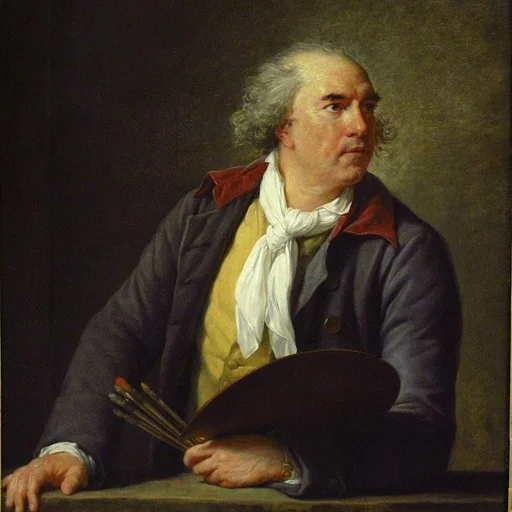
Hubert Robert (French pronunciation: ; 22 May 1733 – 15 April 1808) was a French painter in the school of Romanticism, noted especially for his landscape paintings and capricci, or semi-fictitious picturesque depictions of ruins in Italy…

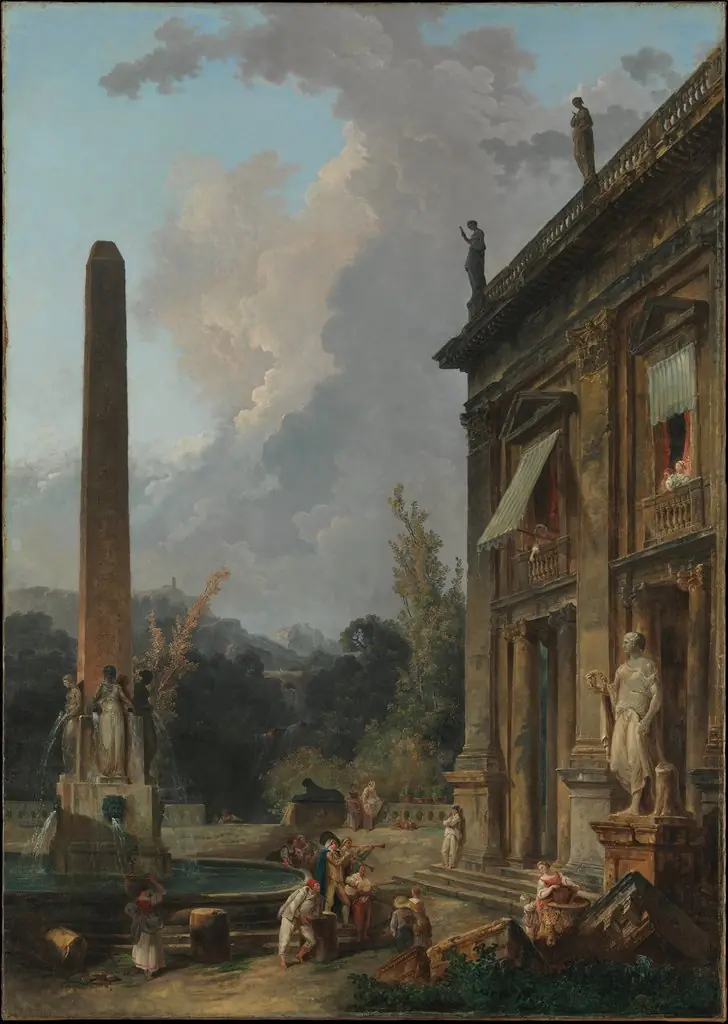
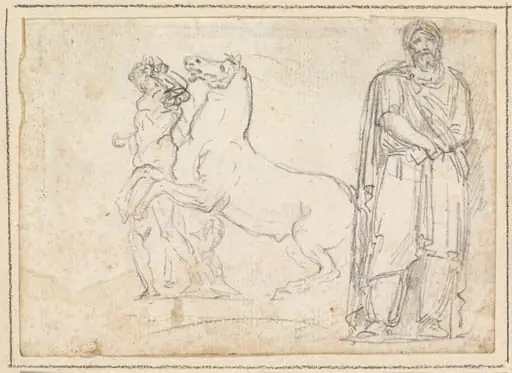 One of the "Dioscuri" and a Barbarian Prisoner
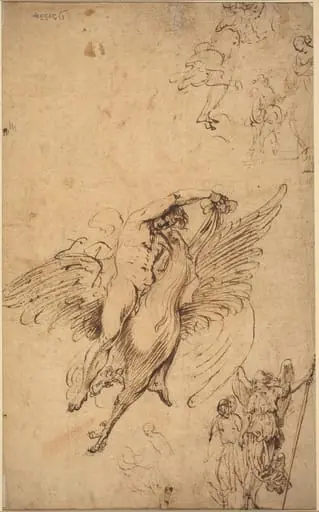 Ganymede
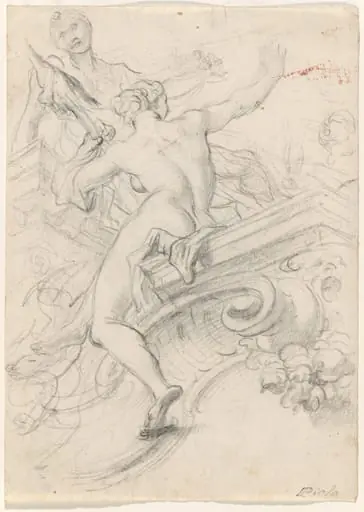 A Female Figure Seated on an Entablature, Holding a Distaff
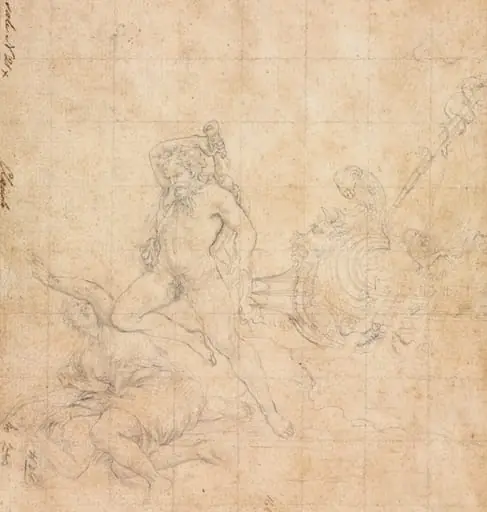 Hercules and the Girdle of Hippolyta
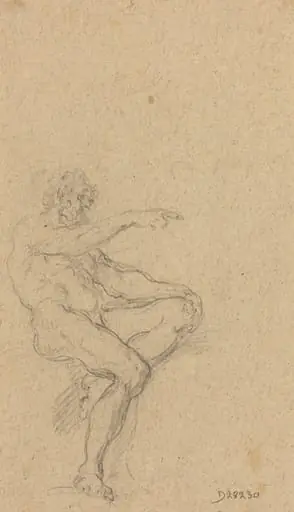 A Seated Nude Man Pointing to the Right
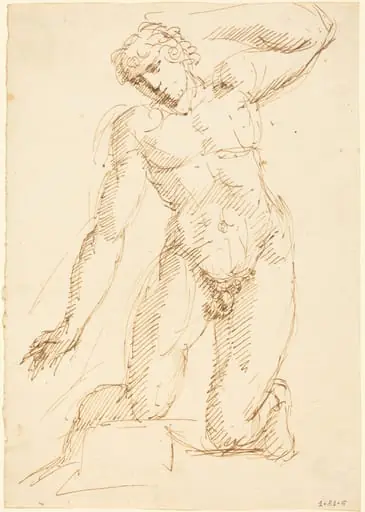 A Male Nude Kneeling
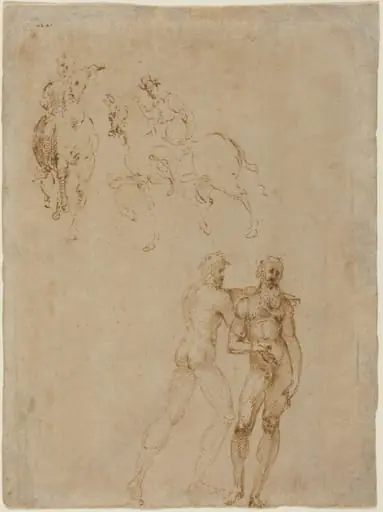 Two Horsemen and Two Male Nudes
 Two Sketches of a Mother and Child (verso)
 Mercury and Pegasus
![Apollo and Studies of the Artist's Own Hand [recto], by Francesco Fontebasso](https://artifactworldgallery.com/img/francesco-fontebasso--apollo-and-studies-of-the-artist-s-own-hand-recto--ee93288e84456aea-w320.webp) Apollo and Studies of the Artist's Own Hand [recto]
Apollo and Studies of the Artist's Own Hand [recto] The Sacrifice of Marcus Curtius
![Two Studies of the Statue of Alexander and Bucephalus [verso], by Hubert Robert](https://artifactworldgallery.com/img/hubert-robert--two-studies-of-the-statue-of-alexander-and-bucephalus-verso--c8baec3f622cceea-w320.webp) Two Studies of the Statue of Alexander and Bucephalus [verso]
Two Studies of the Statue of Alexander and Bucephalus [verso]