Artwork
One of the "Dioscuri" and a Barbarian Prisoner
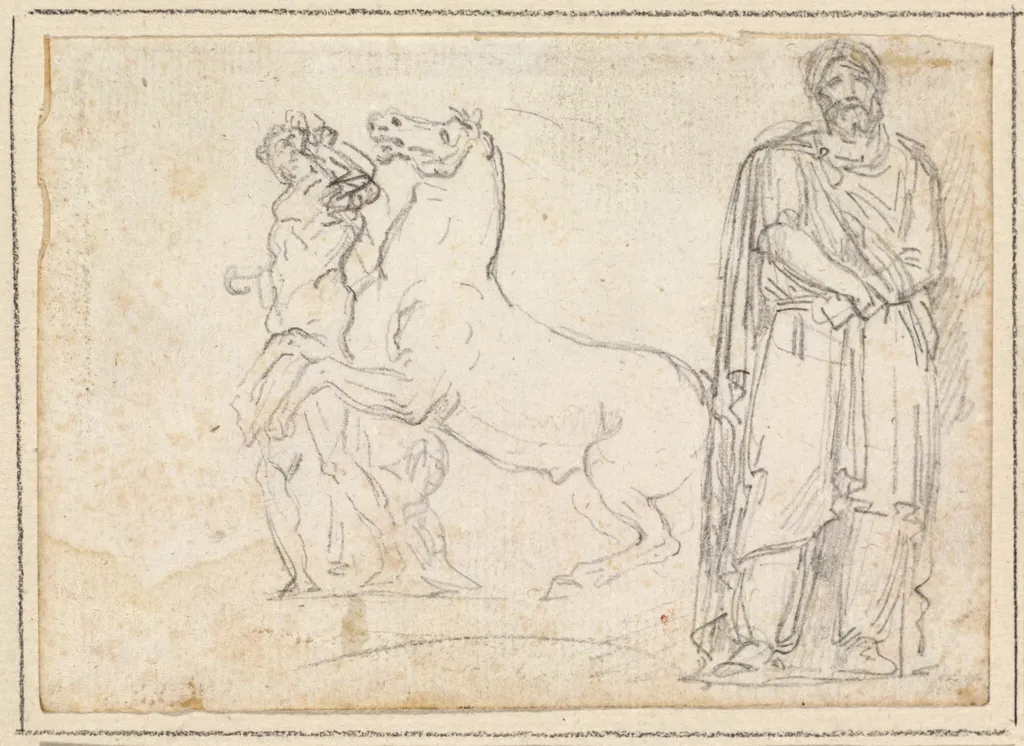
One of the "Dioscuri" and a Barbarian Prisoner is a chalk drawing by the Romanticist artist Hubert Robert. It dates from 1760 and is held in the collection of the National Gallery of Art.
About this work
The painting is titled "One of the 'Dioscuri' and a Barbarian Prisoner".
This work is interesting because it was created over a period of time, with the exact dates ranging from 1754 to 1765. The use of black chalk and graphite on laid paper is also notable, as it suggests a level of detail and precision.
To learn more about this style, look into the movement: Romanticism.
Overview
Hubert Robert, a French artist linked to the Romantic movement, produced a drawing titled *One of the “Dioscuri” and a Barbarian Prisoner* in the mid‑1750s to mid‑1760s, most commonly dated to 1760. Executed in black chalk and graphite on laid paper, the work measures a modest size and reflects Robert’s fascination with classical subjects rendered through a romantic lens.
Subject & Meaning
The composition juxtaposes a single figure from the mythic twin brothers Castor and Pollux—collectively known as the Dioscuri—with a captive barbarian bound at his feet. The pairing evokes themes of civilised triumph over the uncivilised, a motif often explored in 18th‑century neoclassical and romantic art, while also allowing the artist to display his interest in antiquarian narrative.
Technique & Style
Robert employs fine black chalk lines complemented by graphite shading to achieve a delicate modelling of flesh and drapery.
Robert employs fine black chalk lines complemented by graphite shading to achieve a delicate modelling of flesh and drapery. The laid‑paper support provides a subtle texture that enhances the atmospheric depth. The drawing balances precise anatomical rendering with a slightly idealised, romanticised treatment of the figures, characteristic of Robert’s capriccio approach to historic and mythic scenes.
History & Provenance
The work was likely executed during Robert’s early career, a period when he was developing his reputation for imaginative landscapes and classical fantasies. Though specific ownership records are sparse, the drawing has appeared in several 19th‑century catalogues of Robert’s oeuvre and is now held in a public collection, illustrating the artist’s enduring relevance to studies of Romantic historicism.
Artist & collection
Artist
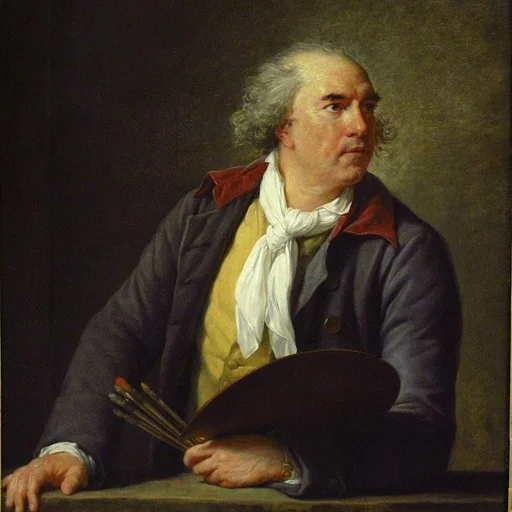
Hubert Robert (French pronunciation: ; 22 May 1733 – 15 April 1808) was a French painter in the school of Romanticism, noted especially for his landscape paintings and capricci, or semi-fictitious picturesque depictions of ruins in Italy…

![Statue of Alexander and Bucephalus [recto], by Hubert Robert](https://artifactworldgallery.com/img/hubert-robert--statue-of-alexander-and-bucephalus-recto--d9a688cc8df08f18-w320.webp) Statue of Alexander and Bucephalus [recto]
Statue of Alexander and Bucephalus [recto]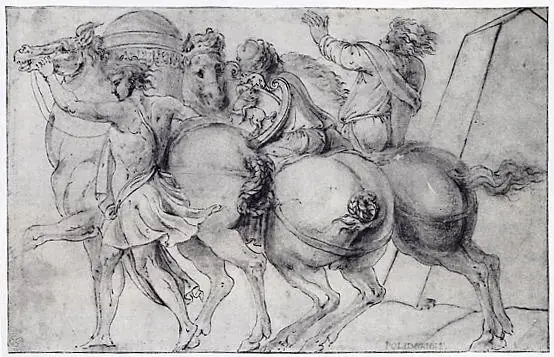 Frieze with Three Horsemen
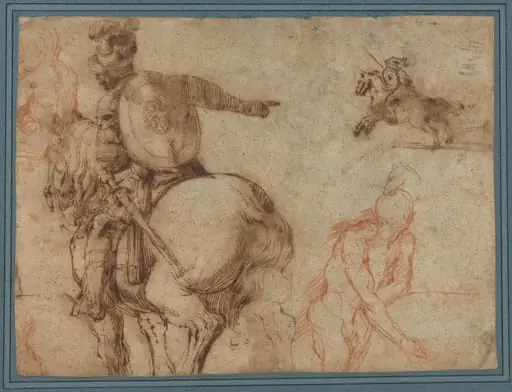 A Soldier on Horseback and Other Studies
![Two Studies of the Statue of Alexander and Bucephalus [verso], by Hubert Robert](https://artifactworldgallery.com/img/hubert-robert--two-studies-of-the-statue-of-alexander-and-bucephalus-verso--c8baec3f622cceea-w320.webp) Two Studies of the Statue of Alexander and Bucephalus [verso]
Two Studies of the Statue of Alexander and Bucephalus [verso] Riders Carrying Bows and Javelins
 The Herald of Murcia and Other Studies (recto)
![Figures on Horseback [verso], by Unknown](https://artifactworldgallery.com/img/unknown--figures-on-horseback-verso--014ce85ac0e4d9d4-w320.webp) Figures on Horseback [verso]
Figures on Horseback [verso] Four Standing Warriors
 Sketches of Animals (verso)
 Three Soldiers Discovering a Sleeping Woman
 A team of four horses drawing a chariot
 The Sacrifice of Marcus Curtius