Artwork
Print Collection
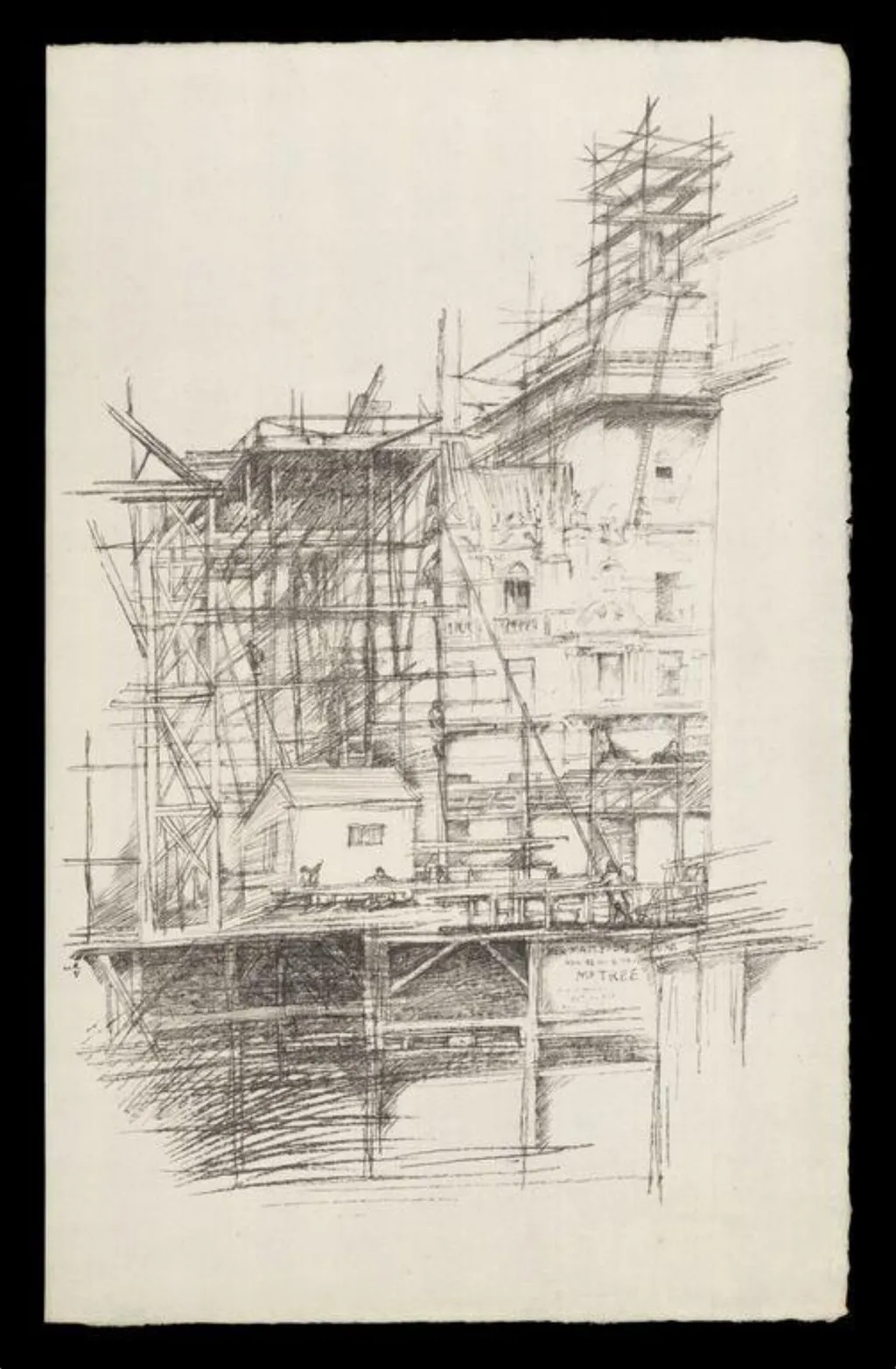
Print Collection is a print by the Impressionist artist William Rothenstein. It dates from 1897 and is held in the collection of the Victoria and Albert Museum.
About this work
This is a print by William Rothenstein from 1897. It shows the rebuilding of Her Majesty’s Theatre. The artist worked in two styles at once—Impressionism and Realism.
The print captures a moment when London’s theaters were changing. It’s a quiet look at progress, not a big celebration.
Check out the Victoria and Albert Museum to see more of Rothenstein’s work.
Overview
Created in 1897, this print by William Rothenstein documents the reconstruction of Her Majesty’s Theatre in London.
Created in 1897, this print by William Rothenstein documents the reconstruction of Her Majesty’s Theatre in London. Executed in a mixed style blending Impressionist sensitivity with Realist detail, it captures the quiet transformation of the urban landscape rather than grand ceremonial moments. The work belongs to a series of observations on London’s architectural evolution during the late Victorian era.
Subject & Meaning
The scene portrays the ongoing rebuilding of the theatre after a fire, focusing on scaffolding, workers, and partial structures rather than the finished building. Rothenstein avoids spectacle, instead emphasizing the mundane rhythms of urban renewal. The image reflects a broader cultural shift—London’s theatres adapting to modern needs—without overt commentary or heroism.
Technique & Style
Rothenstein employed a nuanced interplay of soft tonal gradients and precise linear detail. His use of ink and wash suggests Impressionist immediacy, while the careful rendering of architectural elements and figures aligns with Realist tradition. The composition avoids dramatic lighting, favoring subdued, naturalistic tones that enhance the work’s contemplative mood.
History & Provenance
The print was produced shortly after the 1897 fire that destroyed the original theatre, during the early stages of its reconstruction. It was likely made for private circulation or as part of Rothenstein’s broader documentation of London’s changing streetscapes. The Victoria and Albert Museum holds several of his related works, indicating institutional recognition of his observational approach.
Context
In the late 19th century, London’s theatre district underwent significant modernization, driven by safety reforms and shifting public tastes. Rothenstein’s print contributes to a growing body of work by artists who recorded these transitions with quiet attention, contrasting with the more sensationalist imagery of the period. His focus on process, not spectacle, reflects a broader artistic interest in everyday change.
Legacy
Rothenstein’s print remains a modest but significant record of urban transformation in Victorian London. Though not widely exhibited at the time, its restrained aesthetic has since been valued for its authenticity and sensitivity to architectural evolution. It stands as an example of how artists documented modernization without romanticizing it.
Artist & collection
Artist
William Rothenstein made prints and portraits around the turn of the 20th century.

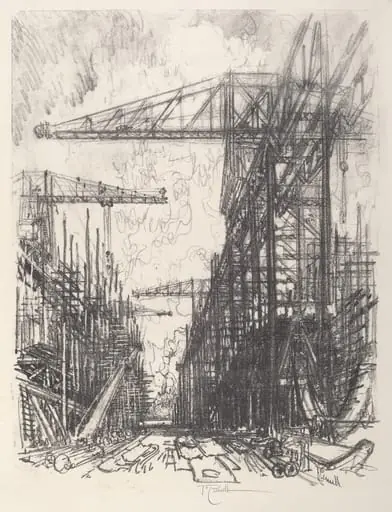 Building Destroyers, No.I
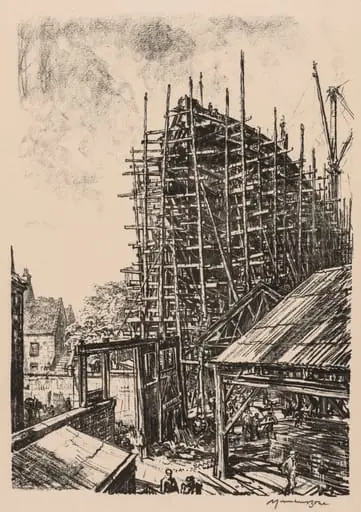 On the Clyde, 1917-1918: Building a Liner at Greenock
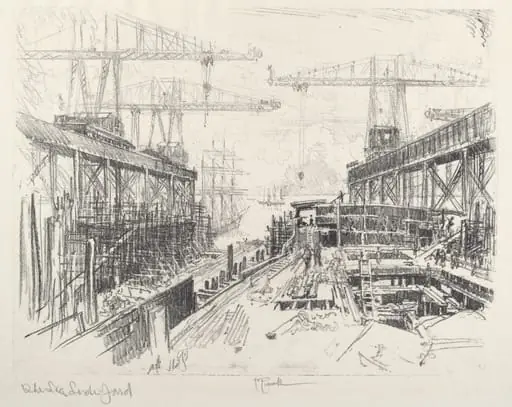 The Sea Lord's Yard
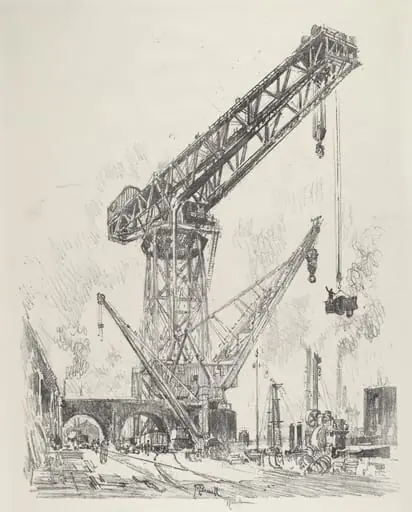 Made in Germany, the Great Crane
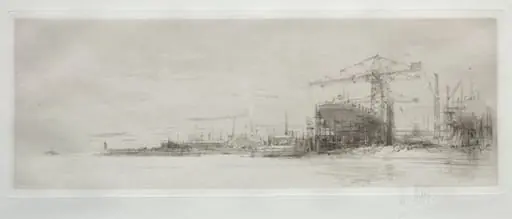 Arteries of Great Britain: The Clyde
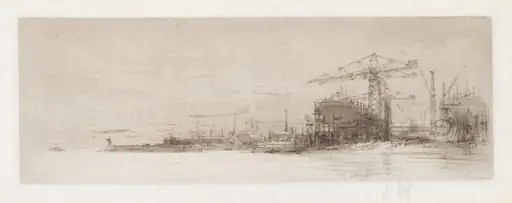 The Clyde from the series The Arteries of Great Britain
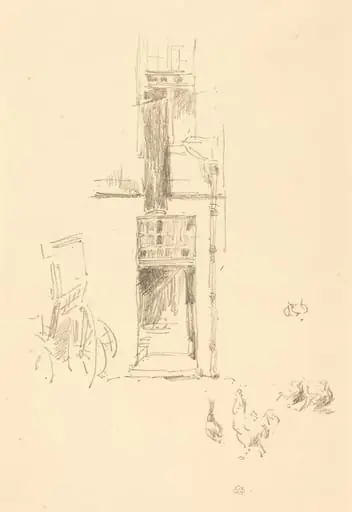 Cocks and Hens, Hôtel Colbert
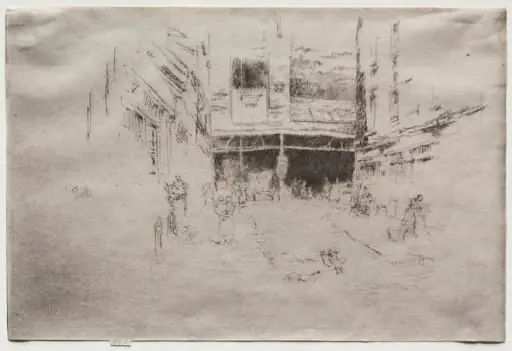 Clothes Exchange, No. 1
 On the Ways
 Rue Furstenburg
 Tall Houses, Menton
 Churchyard