Artwork
Le vautour (The Vulture)
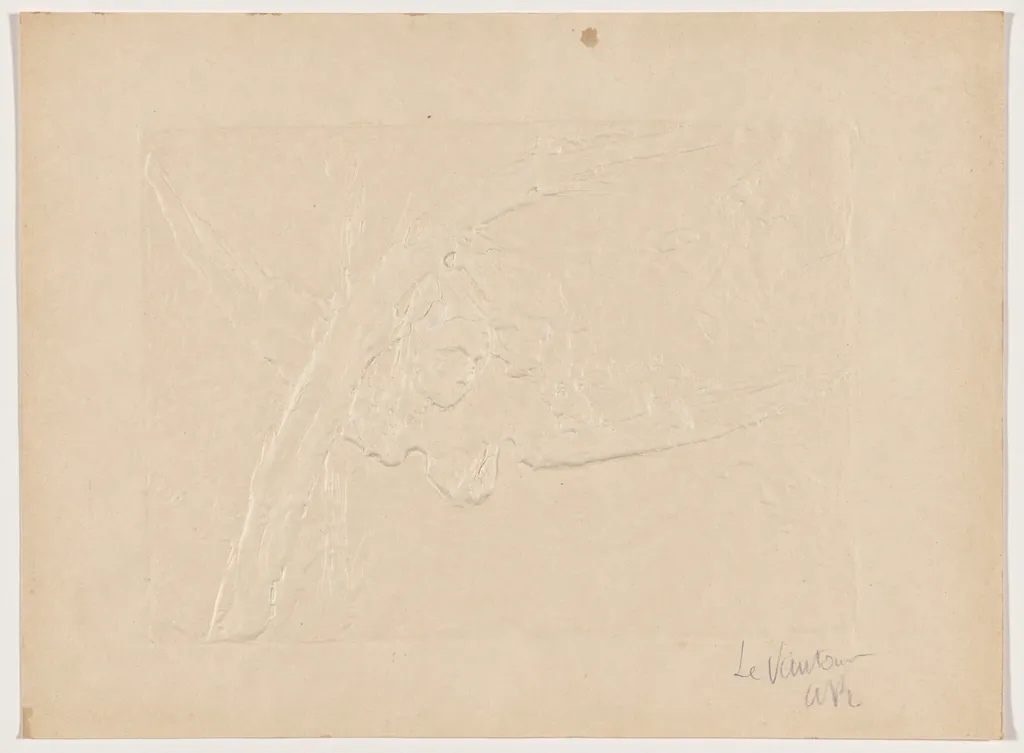
Le vautour (The Vulture) is an ink print by the Impressionist artist Aristide Rouseaud. It dates from 1895 and is held in the collection of the National Gallery of Art.
About this work
Overview
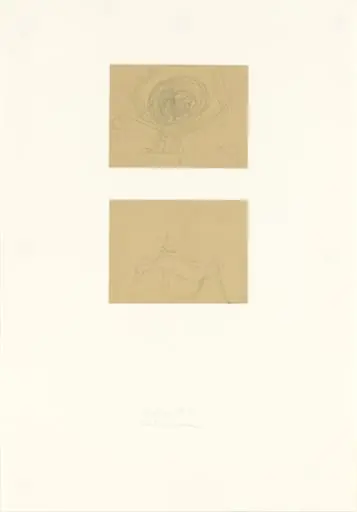
Le vautour, created in 1895 by Aristide Rouseaud, is a print made using cerograph, a rare technique that embosses lines into paper without ink. Executed on heavy Japan paper with a light beige tone, the work relies on raised textures to define its form. The absence of pigment shifts focus to the physicality of the mark-making, producing a tactile surface that invites close observation.
Subject & Meaning
The subject is a solitary vulture, rendered with minimal detail—wings, body, and beak suggested through fragmented, uneven strokes. The bird’s posture is ambiguous, neither soaring nor perched, evoking a sense of stillness or decay. The roughness of the lines resists idealization, suggesting a raw, unembellished encounter with nature, perhaps reflecting themes of survival or solitude.
Technique & Style
Rouseaud employed cerograph, a process that presses lines into paper using a stylus, creating subtle ridges rather than inked marks.
Rouseaud employed cerograph, a process that presses lines into paper using a stylus, creating subtle ridges rather than inked marks. The resulting texture is tactile, with lines appearing carved rather than drawn. The scratchy, irregular strokes avoid refinement, favoring immediacy and gesture. This method distinguishes the work from traditional engraving or cross-hatching, emphasizing material presence over tonal gradation.
History & Provenance
The work dates from 1895, a period when Rouseaud experimented with non-traditional print methods. Cerograph was seldom used by artists, making this piece an uncommon example of its kind. Its survival on fragile Japan paper suggests careful handling, though its early provenance remains undocumented. It likely circulated within small artistic circles rather than public exhibitions.
Context
In late 19th-century France, printmakers increasingly explored alternatives to ink-based techniques, seeking intimacy and directness. Rouseaud’s use of cerograph aligns with broader interests in tactile expression and artisanal processes, paralleling developments in Japanese woodblock and early modernist drawing. The vulture, a symbol often associated with death or scavenging, appears here stripped of allegory, reduced to form and texture.
Legacy
Le vautour remains a rare testament to Rouseaud’s engagement with experimental printmaking. While not widely known, it contributes to the understudied history of inkless embossment in European art. Its emphasis on materiality and gesture anticipates later 20th-century interests in process-driven art, though it has not entered mainstream art historical discourse.
Artist & collection

![Study for "Shoeing Calvary Horses at the Front" [verso], by John Singer Sargent](https://artifactworldgallery.com/img/john-singer-sargent--study-for-shoeing-calvary-horses-at-the-front-verso--6f6d1a163e84e9ab-w320.webp)
![Sketch for the Flight into Egypt [verso], by Giovanni Domenico Tiepolo](https://artifactworldgallery.com/img/giovanni-domenico-tiepolo--sketch-for-the-flight-into-egypt-verso--c1883479f90269fc-w320.webp)