Artwork
Saint George
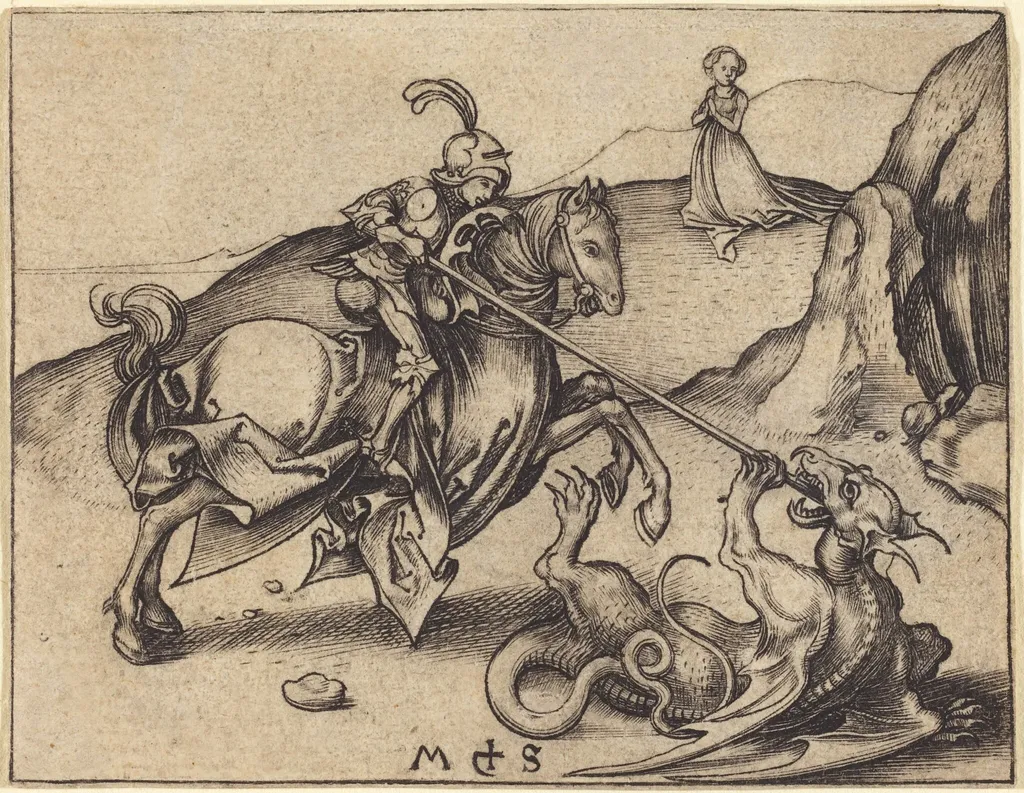
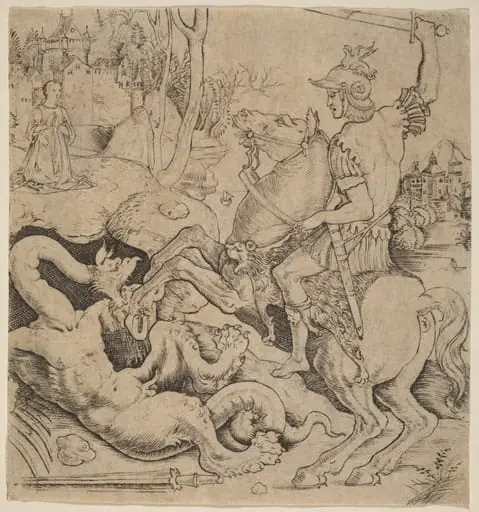
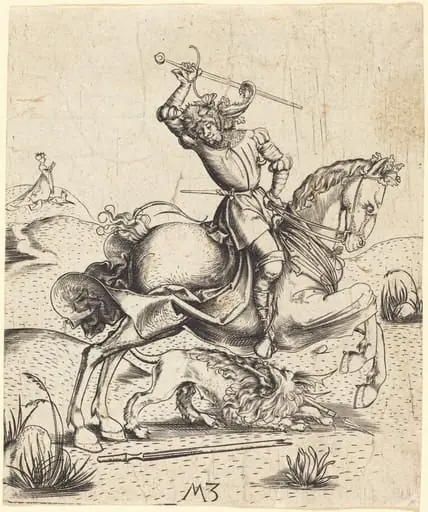
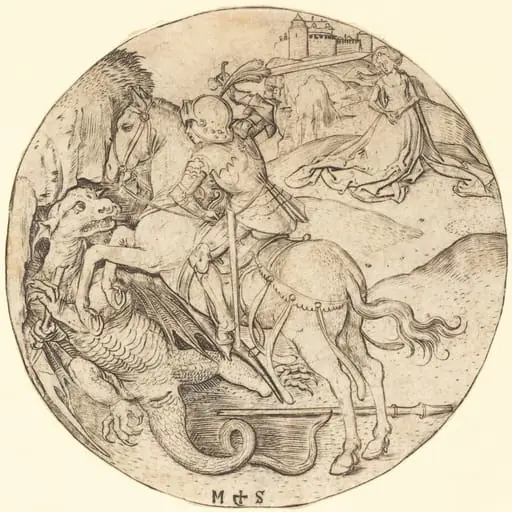
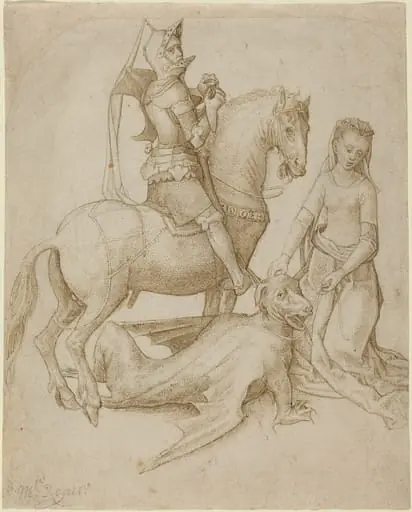
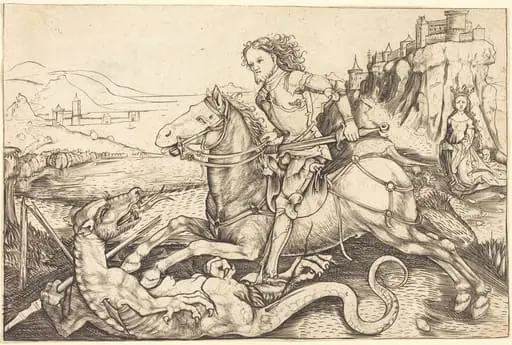
Saint George is an ink print by the Renaissance artist Martin Schongauer. It dates from 1485 and is held in the collection of the National Gallery of Art.
About this work
Overview
His technical precision and compositional clarity set a standard for Northern European printmakers before Dürer’s rise.
Martin Schongauer’s engraving of Saint George, dated circa 1485, is a finely detailed black-and-white print depicting the legendary Christian martyr in combat with a dragon. As one of the earliest and most accomplished German engravers, Schongauer elevated printmaking to a refined art form, using incised metal plates to produce intricate images. His technical precision and compositional clarity set a standard for Northern European printmakers before Dürer’s rise.
Subject & Meaning
The scene illustrates Saint George’s legendary victory over a dragon, a symbol of evil subdued by faith and courage. The knight, fully armored and mounted, thrusts his spear into the beast, while a distant figure—a princess—watches from the hillside, representing the saved innocent. The inclusion of a small structure behind them suggests a besieged town, reinforcing the narrative’s moral and spiritual stakes: divine intervention rescuing the vulnerable from chaos.
Technique & Style
Schongauer employed fine, controlled lines to render texture and volume, using cross-hatching to model the dragon’s scaled hide and the knight’s articulated armor. The engraving’s tonal gradations emerge not from wash or ink, but from the density of incised grooves on a copper plate. His handling of space is deliberate: the dragon’s coiled form dominates the foreground, while the background remains sparse, focusing attention on the central struggle and its symbolic weight.
History & Provenance
Created in the late 15th century in the Upper Rhine region, the print likely circulated among religious communities and collectors who valued devotional imagery. Schongauer’s engravings were widely distributed, influencing artists across Europe. Though no early ownership records survive for this specific impression, its survival in multiple copies attests to its popularity and the growing market for printed religious subjects in pre-Reformation Europe.
Context
In the decades before the Reformation, religious narratives were frequently reproduced in print to reach a broader audience. Schongauer’s work emerged alongside growing literacy and the spread of movable type, allowing images like Saint George to serve both spiritual and educational roles. His background in goldsmithing informed his precision, bridging craft traditions with emerging artistic practices in printmaking.
Legacy
Schongauer’s engraving of Saint George became a model for later Northern artists, including Dürer, who studied his techniques. The work exemplifies how engraving could convey complex narratives with minimal color, relying on line and contrast. Its enduring presence in collections underscores its role in establishing printmaking as a serious artistic medium, distinct from mere illustration.
Artist & collection

Artist
Martin Schongauer, also known as Martin Schön or Hübsch Martin by his contemporaries, was an Alsatian engraver and painter.