Artwork
Schuldhess, Jörg Shimon - Gemälde, The Mahdi will die
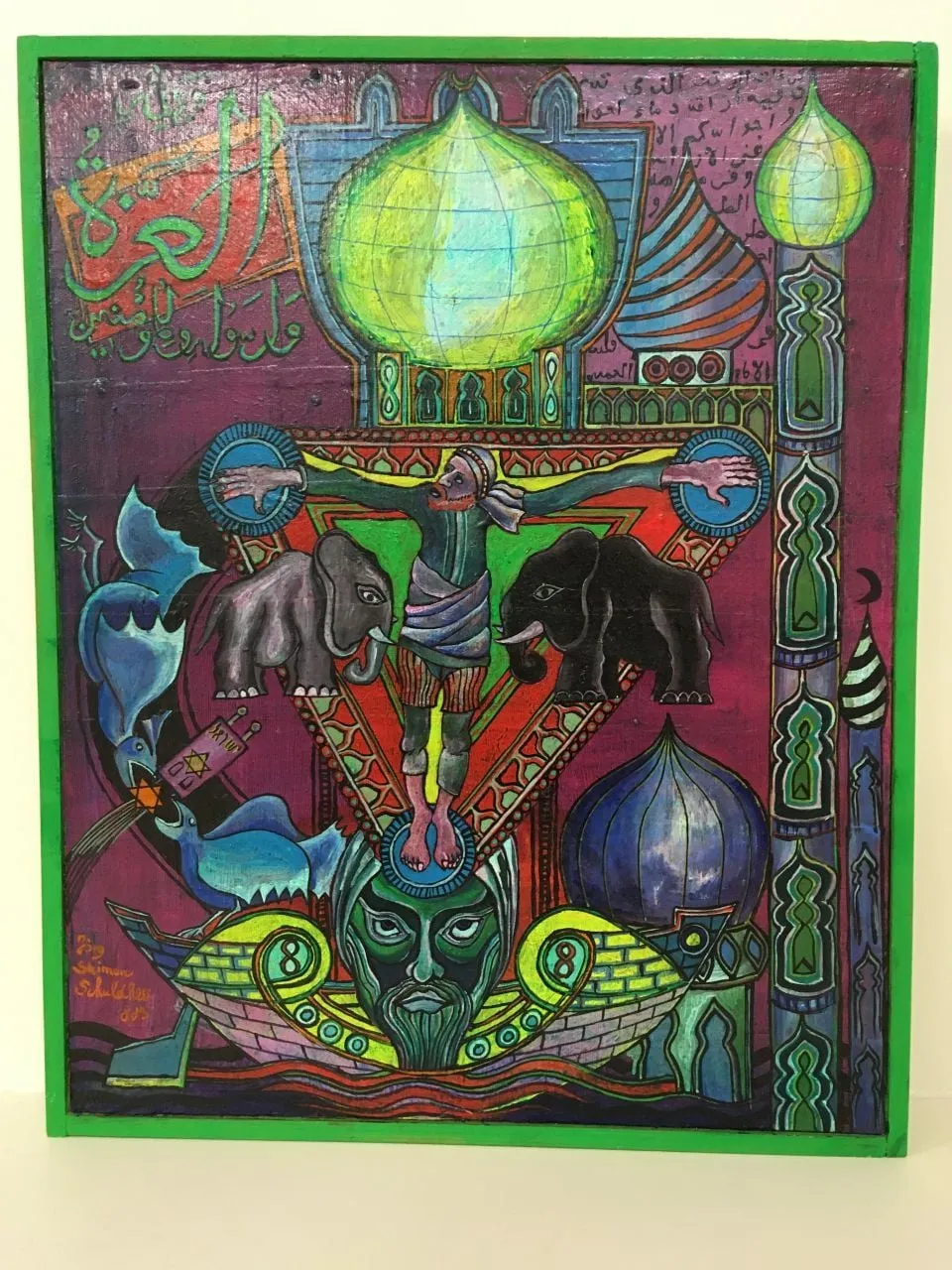
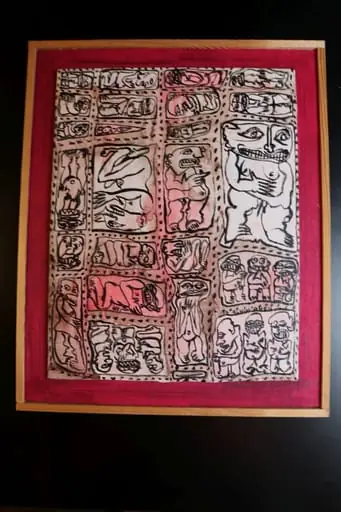
Schuldhess, Jörg Shimon - Gemälde, The Mahdi will die is a drawing by Jörg Shimon Schuldhess. It dates from 1985 and is held in the collection of the Poets and City Museum Liestal.
About this work
Overview
It is part of the collection at the Museum of Ethnography and reflects the artist’s interest in mythic narratives and non-Western cosmologies.
Created in 1985 by Jörg Shimon Schuldhess, this painted work combines symbolic imagery with a surreal visual language. It is part of the collection at the Museum of Ethnography and reflects the artist’s interest in mythic narratives and non-Western cosmologies. The composition resists literal interpretation, instead presenting a layered scene where reality and imagination intersect through vivid color and distorted forms.
Subject & Meaning
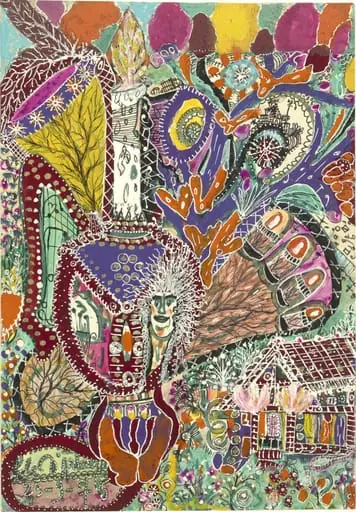
The title references the Mahdi, a messianic figure in Islamic eschatology, suggesting themes of prophecy and mortality. A figure suspended upside down between two elephants, alongside a green-faced observer and floating lamps, evokes ritual, inversion, and celestial intervention. The scene does not illustrate a specific event but constructs a symbolic space where power, fate, and the supernatural converge in ambiguous relation.
Technique & Style
Schuldhess employs thick outlines and saturated, non-naturalistic hues to construct a dense, almost hallucinatory surface. The composition is crowded with hybrid elements—birds, fish, domed architecture, and floating lights—arranged without perspectival logic. Brushwork is deliberate yet expressive, prioritizing emotional resonance over realism. The effect is one of visual overload, inviting contemplation rather than narrative clarity.
History & Provenance
The work entered the Museum of Ethnography’s collection shortly after its creation. Schuldhess, known for his engagement with cross-cultural symbolism, produced this piece during a period of intense exploration into religious iconography and colonial narratives. Its acquisition reflects the museum’s interest in contemporary artworks that reinterpret traditional mythologies through modern visual strategies.
Context
Emerging from post-1960s European art movements that questioned linear storytelling, Schuldhess’s painting aligns with artists who blended ethnographic motifs with surrealist techniques. The Tigris River, a historical axis of Mesopotamian civilization, anchors the scene in a region rich with layered religious traditions. The work responds to 1980s debates around cultural representation, avoiding exoticism by internalizing its symbols rather than displaying them as spectacle.
Legacy
Though not widely exhibited, the painting remains a significant example of how contemporary European artists engaged with non-Western mythologies without appropriation. Its inclusion in an ethnographic museum underscores a shift toward recognizing art that challenges Western epistemologies. Schuldhess’s approach continues to inform discussions on the ethics and possibilities of cross-cultural visual storytelling.
Artist & collection
Artist
Swiss artist Jörg Shimon Schuldhess painted everyday scenes and objects with a quiet, offbeat focus.
 Icoa
Icoa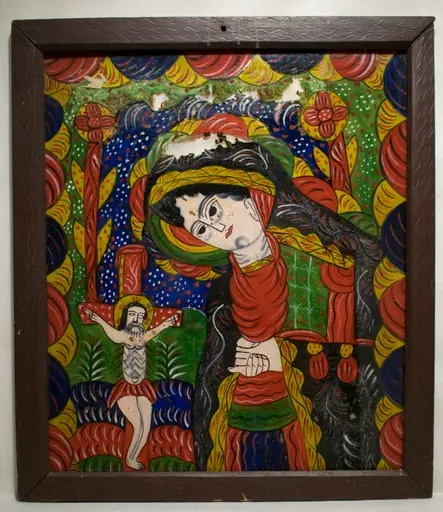 Icoată.
 Untitled
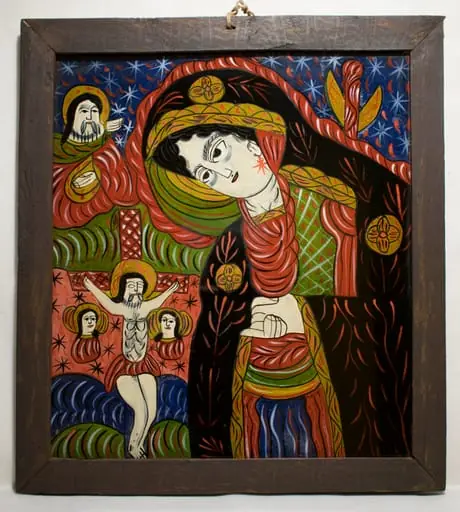
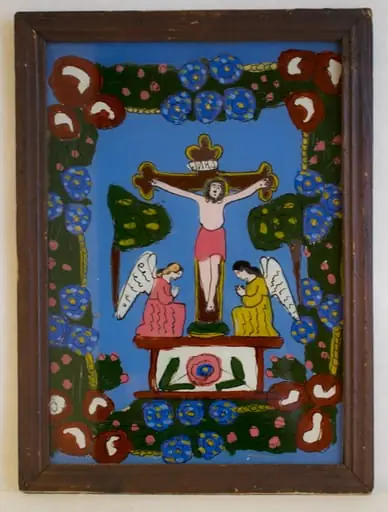 Icoana redă tema Răstignirii combinată cu Plângerea de influență apuseană, catolică. Desenul este executat probabil fără tipar, cu un instrument de scris cu cerneala sau tuș. Isus răstignit pe cruce plasată deasupra pietrei mormântului, plâns de doi îngeri cu profiluri diforme, este încadat de un chenar greoi compus din ramuri groase și elemente florale divers colorate(roz, roșu, albastru, galben). De o parte și de alta a lui Isus doi copaci cu coroane globulare, diforme..Desenul este foarte naiv. Isus are ochii deschiși, părul este bogat, mânile și picioarele diforme.Aureola se "scurge" pe lângă capul lui Isus. În jurul mijlocului veșmânt roz. Crucea treflată, pictată cu brun, chenar ocru galben și inscripția INRI pe fond alb. Îngerii au părul ondulat,(unul blond, unul brunet) sunt înveșmântați în roz și galben, veșminte de inspirație catolică.. Mormântul decorat cu o floare roz. Câmul icoanei bleu închis. Pe spate a avut lipită o hârtie mai groasă care servea drept dos. Rama este profilată, lăcuită, de culoare cafeniu închis.
 Icoa
Icoa Untitled
 Ερωτική επιστολή
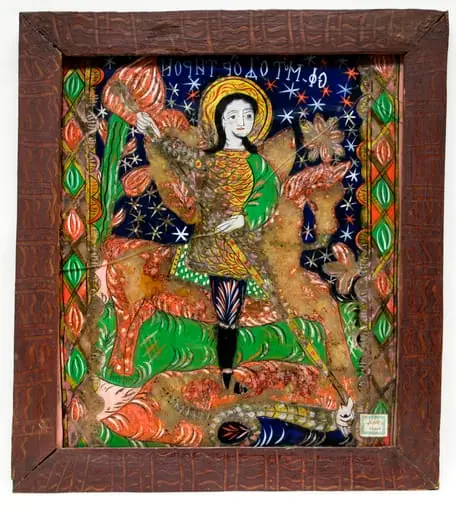 Icoana îl reprezintă pe sfântul mucenic Teodor Tiron . Sfântul, în centrul compoziției, călare pe cal , înfige o suliță lungă(ce marchează diagonala compoziției)în gura balaurului plasat inferior, dimensiuni reduse. Foarte asemănătoare cu reprezentarea sf Gheorghe, calul este roșu. Veșmintele sunt asemănătoare celor ale soldaților chezaro-crăiești, cizme înalte, negre, pantaloni bufanți cu motive fitomorfe, lorică, tunică scurtă, verde, mantie roșu-cărămiziu. Poziționarea neanatomică. trăsăturile butucănoase, ochii mari, negri, părul lung, negru închis lăsat pe umeri. Nimb cu decor fitomorf. Câmp albastru ultramarin cu decor floral(o floare pe o tulpină uriașă, două flori mai mici) și astral(steluțe albe și roșii). Chenar dublu pe laturile verticale(lanț vertical de romburi alternând cromatic) și semicercuri. Relief din benzi orizontale vălurite, diferite culori(verde, roșu, roz) Foiță de aur. Rama brun roșcat, decorată cu linii vălurite dispuse orizontal, întrerupte ritmic de linii drepte transversale. În colțul din stânga jos o etichetă cu numele Prof Gusti, bătut la mașină. Suportul pictural crăpat, stratul pictural exfoliat, temă rară.
 Compoziție 11