Artwork
The Stone Breaker
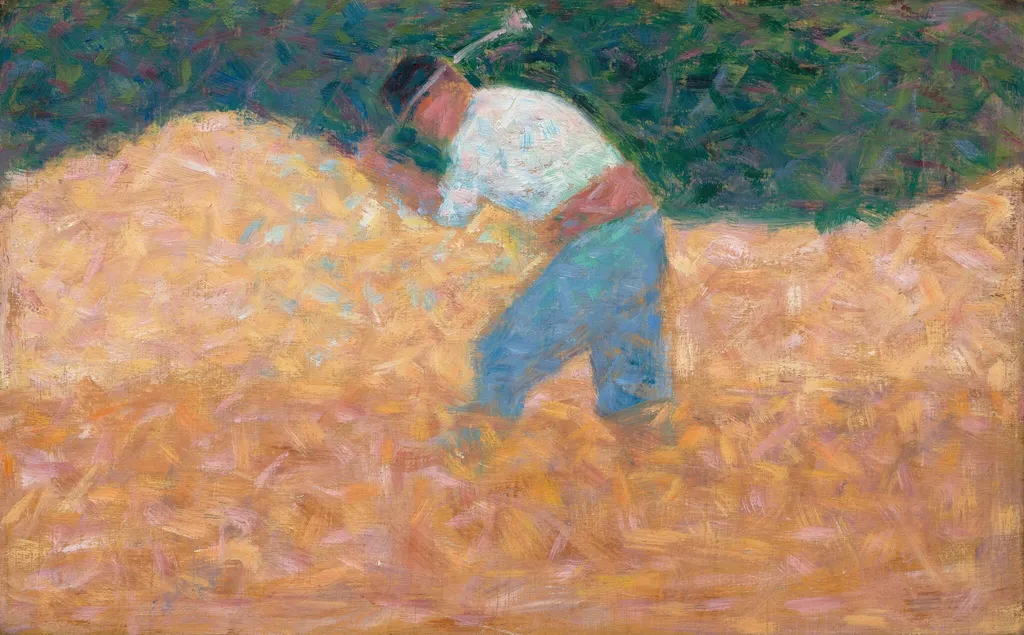
The Stone Breaker is an oil painting by the Impressionist artist Georges Seurat. It dates from 1882 and is held in the collection of the National Gallery of Art.
About this work
Overview
Georges Seurat’s oil painting titled The Stone Breaker was executed around 1882 on a wooden panel. The work presents a solitary figure engaged in manual labor, set against a muted landscape of greens and browns. Its modest dimensions and subdued palette place the piece within Seurat’s early explorations of everyday subjects.
Subject & Meaning
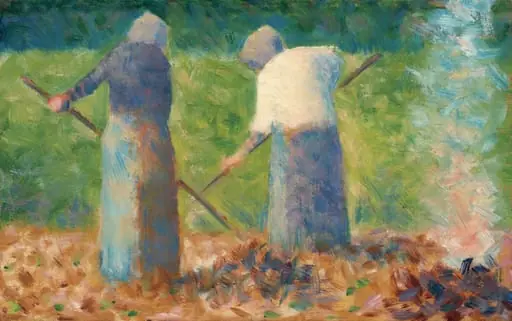
The composition centers on a bent laborer who is breaking rocks on a dusty road. He is dressed in a white cap, a blue apron, and a red cloth tied around his head, emphasizing his working attire. The portrayal of a humble, physically demanding task reflects an interest in the dignity of ordinary life.
Technique & Style
Seurat applied the paint thickly, creating a textured surface that mirrors the roughness of the scene. The brushwork is heavy and uneven, producing an impasto effect that adds tactile depth. This approach departs from his later pointillist method, offering a more direct, tactile realism.
History & Provenance
Created circa 1882, The Stone Breaker belongs to the early period of Seurat’s career, before his development of the systematic dot technique. The work remains documented as an oil on wood, though details of its subsequent ownership and exhibition history are limited in the record.
Own this work as a print
Artist & collection