Artwork
At Flushing (A Flessingue)
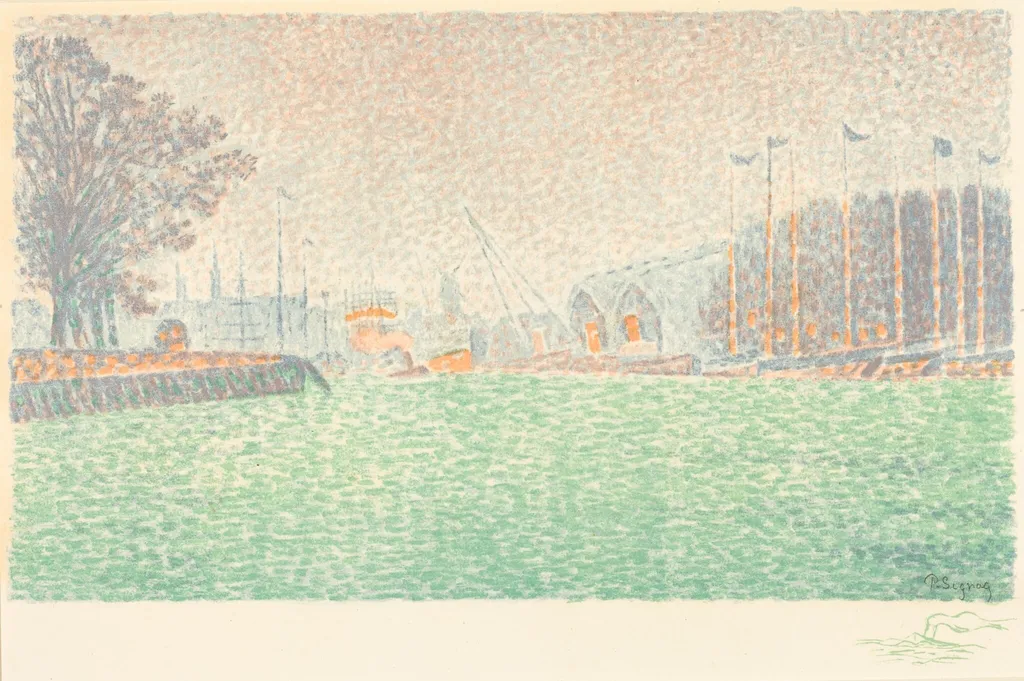
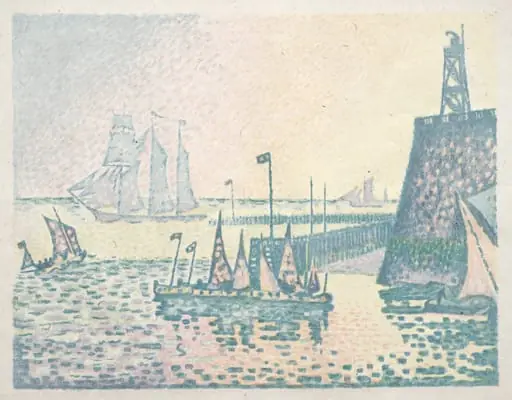
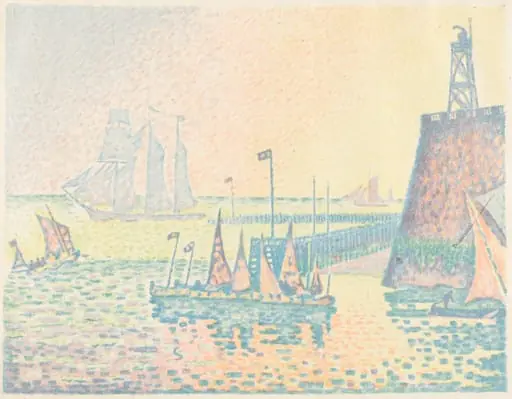
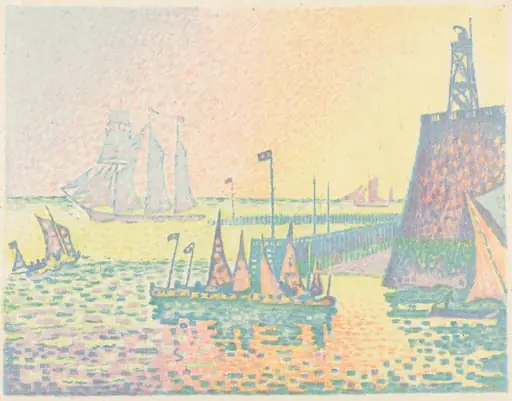
At Flushing (A Flessingue) is an ink print by the Impressionist artist Paul Signac. It dates from 1895 and is held in the collection of the National Gallery of Art.
About this work
Overview
Created in 1895, *At Flushing (A Flessingue)* is a five-color lithograph by Paul Signac, capturing a tranquil riverside scene in the Dutch town of Vlissingen.
Created in 1895, *At Flushing (A Flessingue)* is a five-color lithograph by Paul Signac, capturing a tranquil riverside scene in the Dutch town of Vlissingen. Unlike his more structured Pointillist canvases, this print employs a looser, more atmospheric approach, reflecting Signac’s interest in the expressive potential of printmaking. The work belongs to a series of coastal and harbor views he produced during his travels along the North Sea.
Subject & Meaning
The scene depicts a quiet riverbank with a moored boat, a horse-drawn cart beneath trees, and a building with arched windows near the water’s edge. There is no human activity visible, emphasizing stillness and solitude. The composition suggests a moment of pause in daily life, evoking the rhythm of coastal towns without narrative drama. Signac’s focus on ordinary, unidealized settings aligns with his broader interest in the harmony between labor and landscape.
Technique & Style
Signac used lithography to achieve soft tonal transitions and muted color harmonies, applying five ink layers to build subtle gradations. The lines are fluid and the forms loosely defined, departing from the precise dots of Pointillism. This approach prioritizes mood over detail, using the lithographic stone’s natural grain to enhance the dreamlike quality of the scene. The technique allowed him to explore the interplay of light and atmosphere in a more immediate, spontaneous manner.
History & Provenance
The print was made during Signac’s travels in the Netherlands in 1895, a period when he was experimenting with print media after years focused on oil painting. It was likely produced in a small edition for collectors and fellow artists, reflecting his engagement with the contemporary print revival. No definitive record of its early ownership exists, but it entered public collections in the 20th century as interest in Neo-Impressionist prints grew.
Context
In the mid-1890s, lithography experienced a resurgence among European artists seeking alternatives to traditional painting. Signac, influenced by Japanese woodcuts and the broader Arts and Crafts movement, embraced the medium for its accessibility and tonal range. His Flushing series reflects a broader trend among Post-Impressionists to document everyday environments with quiet reverence, away from urban bustle and academic convention.
Legacy
Though less celebrated than his large-scale Pointillist works, *At Flushing* exemplifies Signac’s adaptability and his commitment to exploring new techniques. The print influenced later generations of printmakers interested in atmospheric effects and non-traditional color applications. Its restrained palette and contemplative mood helped redefine lithography as a vehicle for poetic observation rather than mere reproduction.
Own this work as a print
Artist & collection

Artist
Paul Victor Jules Signac ( seen-YAHK, French: ; 11 November 1863 – 15 August 1935) was a French Neo-Impressionist painter who, with Georges Seurat, helped develop the artistic technique Pointillism.