Artwork
Le glouton
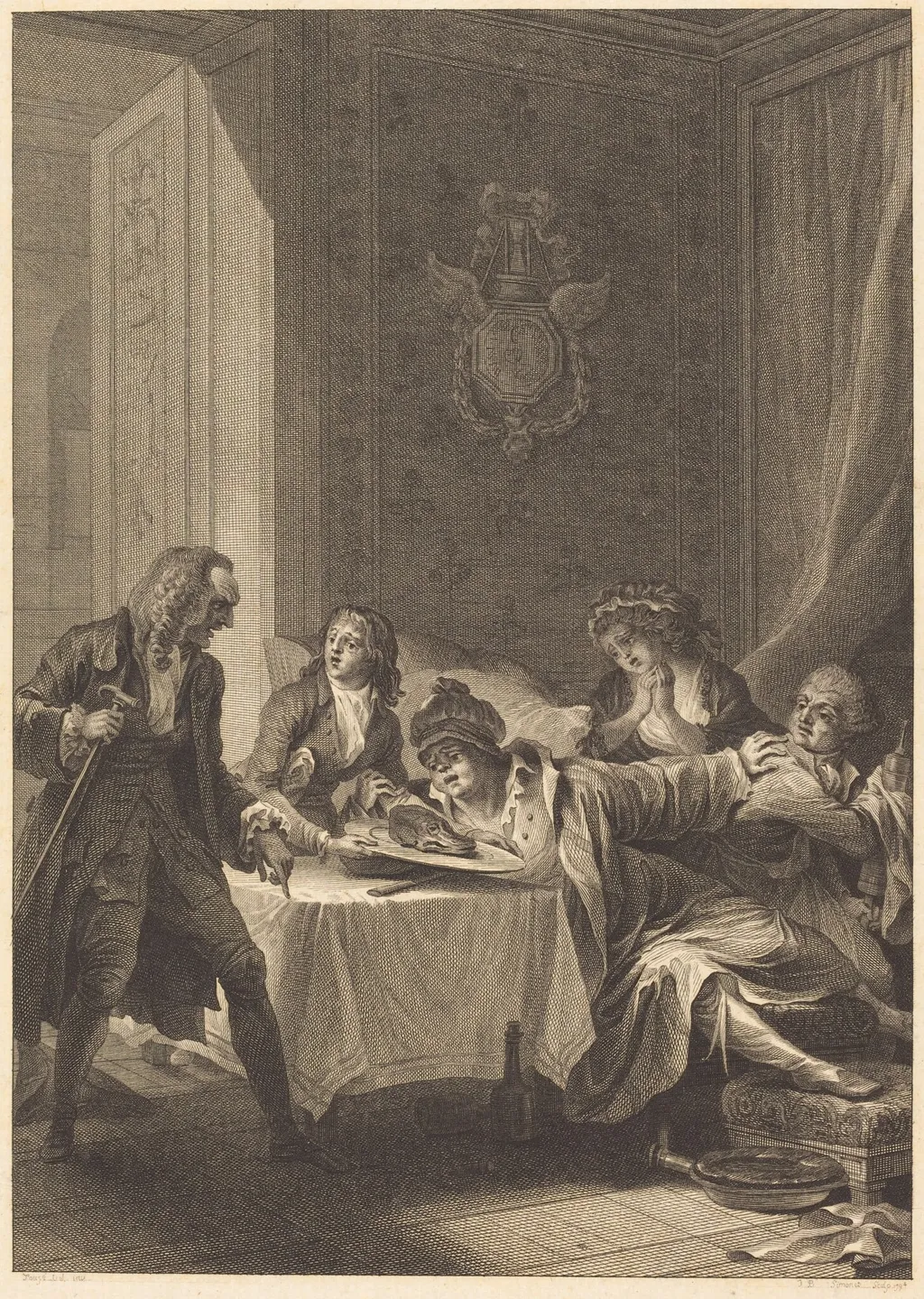
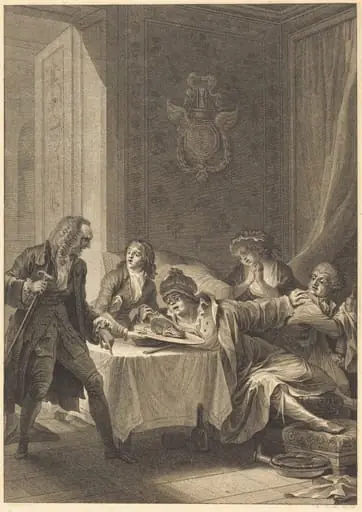
Le glouton is an ink print by the Romanticist artist Jean-Baptiste Blaise Simonet. It dates from 1794 and is held in the collection of the National Gallery of Art.
About this work
Overview
The scene is set in a modestly furnished interior with draped curtains and a heraldic emblem on the wall, suggesting a domestic or bourgeois setting.
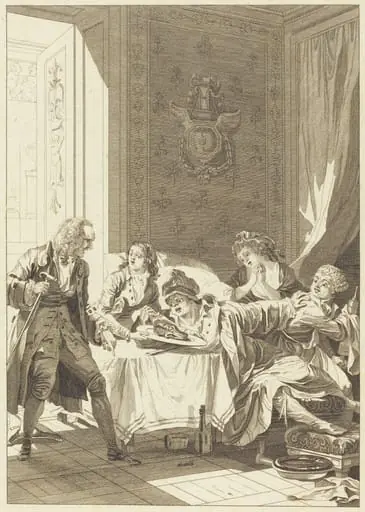
Le glouton is an 1794 print by Jean-Baptiste Blaise Simonet, executed in etching and engraving. It depicts a group of five individuals gathered at a dining table, engaged in quiet, unguarded moments of consumption and conversation. The scene is set in a modestly furnished interior with draped curtains and a heraldic emblem on the wall, suggesting a domestic or bourgeois setting. The composition captures a moment of informal intimacy rather than formal celebration.
Subject & Meaning
The title, meaning 'the glutton,' invites interpretation of excess, yet the figures appear more weary than indulgent. One man leans on a cane, another slumps in his chair, and a woman rests passively nearby—each seems absorbed in private fatigue. The modest fare and disarray suggest not luxury, but the quiet erosion of appetite or social ritual. The work may critique or observe the mundane realities of eating, rather than glorify gluttony.
Technique & Style
Simonet employs fine, controlled lines typical of etching and engraving to render textures: the weave of fabric, the grain of wood, and the soft shadows on faces. The interplay of light and dark enhances the three-dimensionality of forms without dramatic contrast. Details like the folds of clothing and the texture of tableware are rendered with precision, reflecting a quiet attention to everyday surfaces rather than theatrical effect.
History & Provenance
Created in 1794, during the turbulent years of the French Revolution, the print emerged from a period when social hierarchies were being questioned. Simonet, a lesser-known artist of the era, produced works that documented ordinary life. While its early ownership is undocumented, the print survives as part of a broader tradition of 18th-century graphic art that recorded domestic scenes with observational clarity.
Context
In late 18th-century France, prints like this circulated among the middle class as affordable art. While grand historical or mythological subjects dominated official art, etchings such as Le glouton offered intimate glimpses into private life. The absence of overt satire or moralizing aligns it with a growing interest in realism, reflecting a cultural shift toward observing the everyday rather than idealizing it.
Legacy
Le glouton remains a quiet example of pre-Romantic observational printmaking. It does not seek to shock or elevate but to record a moment of human stillness amid routine. Though Simonet’s broader oeuvre is largely forgotten, this work endures as a subtle document of domestic life during a time of political upheaval, valued for its restraint and unembellished humanity.
Artist & collection