Artwork
Capitol, Washington
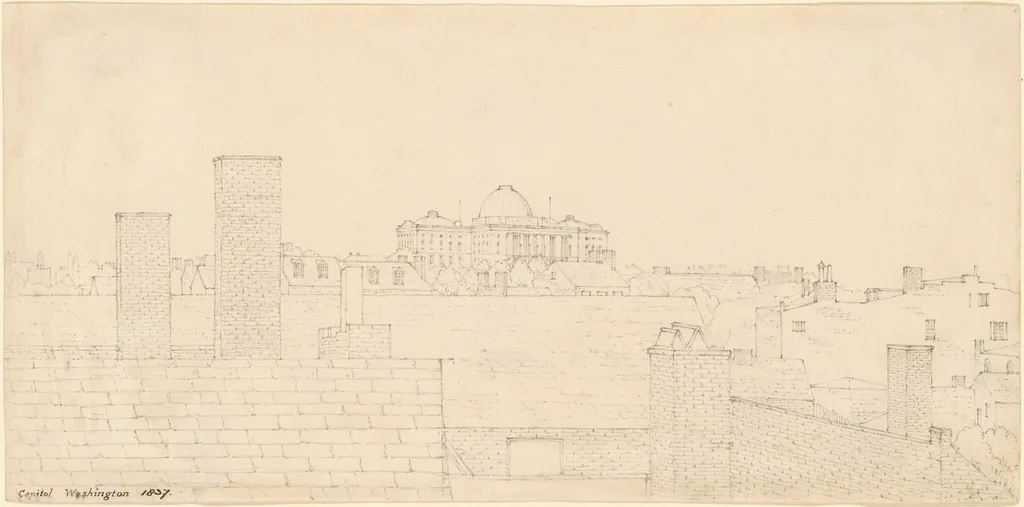
Capitol, Washington is a graphite drawing by the Romanticist artist George Strickland. It dates from 1837 and is held in the collection of the National Gallery of Art.
About this work
Overview
The emphasis on broad forms and muted shading conveys a sense of transient urban presence, as if the city were still emerging from its planning stages.
Created in 1837 by George Strickland, this graphite drawing captures a rudimentary view of Washington, D.C., with minimal detail and loose, rapid strokes. Executed on wove paper, the work lacks finish, suggesting it was made as a spontaneous observation rather than a formal composition. The emphasis on broad forms and muted shading conveys a sense of transient urban presence, as if the city were still emerging from its planning stages.
Subject & Meaning
The central structure, identifiable by its dome, likely represents the U.S. Capitol, then under construction. Surrounding buildings are rendered as generic blocks, their forms simplified to suggest density without specificity. The absence of clear landmarks or activity implies a focus on the city’s physical structure rather than its political or social life. The sketch evokes an impression of impermanence, as if the urban landscape were still taking shape.
Technique & Style
Strickland employed graphite with a restrained hand, using light hatching and minimal tonal variation to define mass and depth. Lines are sketchy and unrefined, avoiding fine detail in favor of overall composition. Shadows are suggested rather than modeled, and architectural elements are reduced to basic geometric shapes. The technique reflects a working method prioritizing rapid notation over finish, characteristic of observational studies from the period.
History & Provenance
The drawing dates from 1837, a time when Washington, D.C., was still developing as a federal capital. Strickland, a lesser-known artist of the era, produced this work during a period of active construction and civic expansion. Its survival suggests it may have been kept as a personal record rather than intended for public display. No documented exhibition or ownership history is widely recorded prior to its current acquisition.
Context
In the 1830s, Washington’s urban fabric was in flux, with many public buildings still incomplete. Artists often documented these sites as they evolved, capturing the tension between ambition and reality. Strickland’s drawing aligns with a broader trend of topographical sketches made by travelers and local observers, who recorded the city’s growth through informal, on-site studies rather than idealized renderings.
Legacy
Though not widely exhibited or reproduced, the drawing contributes to a quiet archive of early American urban documentation. Its unpolished quality offers insight into how contemporaries perceived the capital’s development—not as a finished monument, but as a work in progress. It stands as a modest but authentic record of a city finding its form, valued today for its historical candor rather than artistic ambition.
Artist & collection


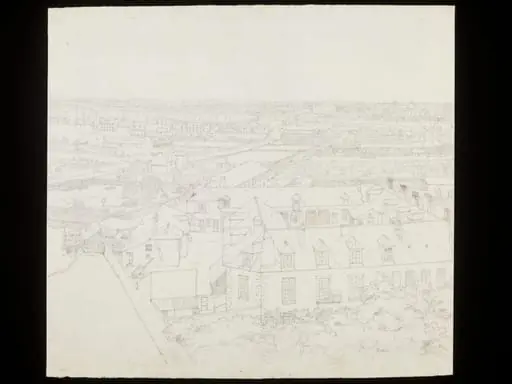 Preparatory study for a panorama of Paris from the Seine
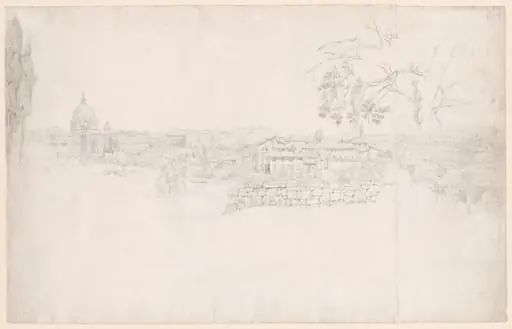 Fantasy Panorama of Rome from St. Peter's to the Castel San Angelo
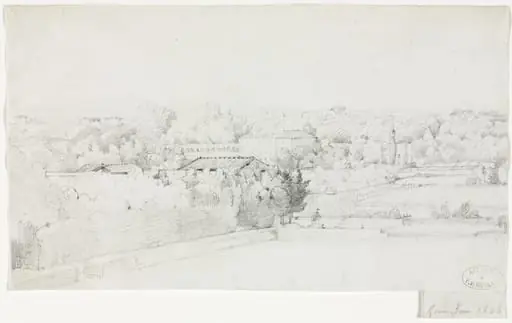 View of the Villa Borghese and its Orangerie from the Villa Medici
 Untitled
 Saint Servan
 Trial Sketch: Grand Rue, Dieppe
![Chatsworth [recto], by David Cox](https://artifactworldgallery.com/img/david-cox--chatsworth-recto--3f4d97adb21a8333-w320.webp) Chatsworth [recto]
Chatsworth [recto] Rue de la Sauvenière, Spa
 Temple
 Newburyport
 Three drawings of buildings on the Praya Grande, Macau
 The Capitoline Hill