Artwork
Nassau-Siegen, Johann VIII Graf von
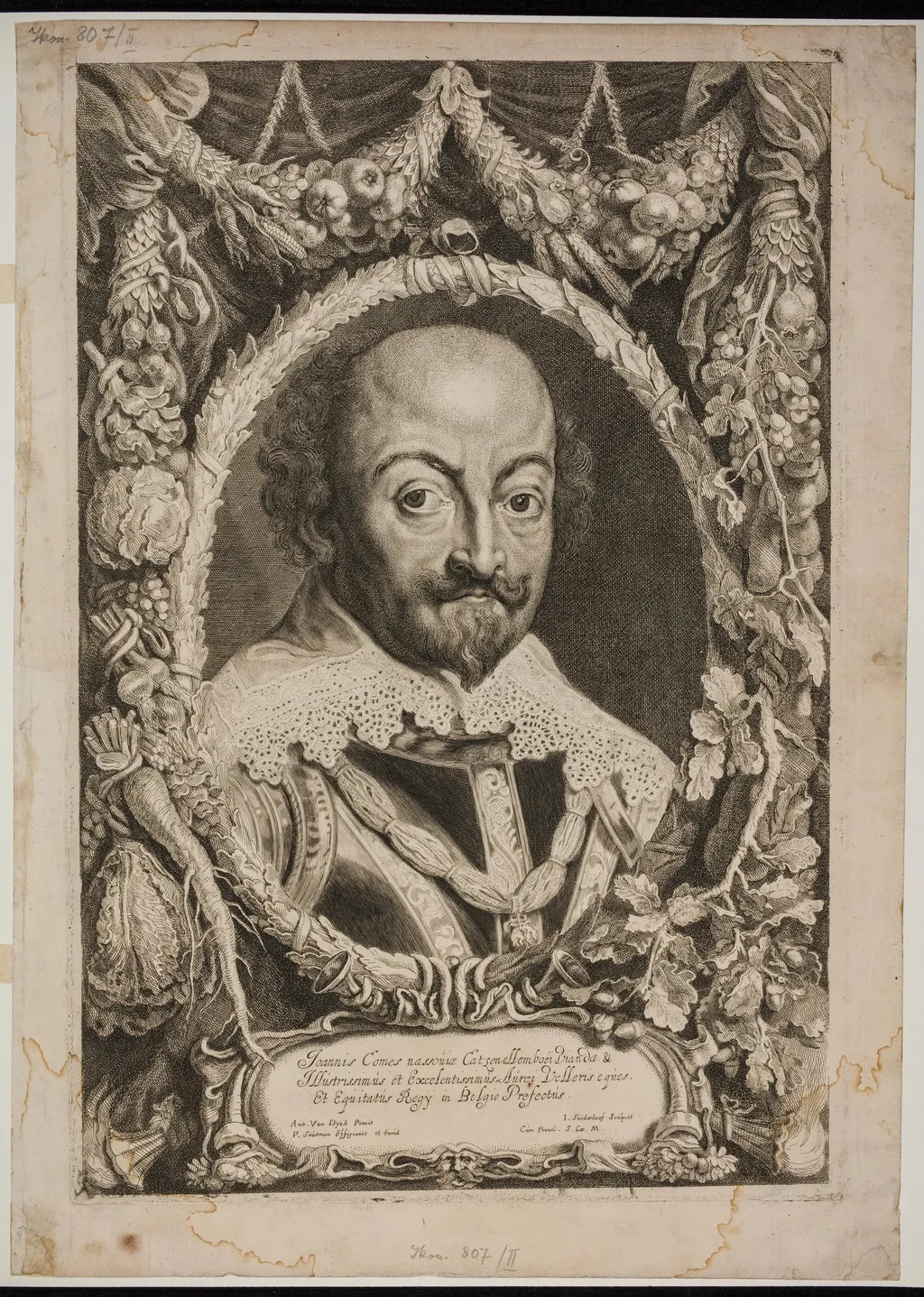
Nassau-Siegen, Johann VIII Graf von is a print by Jonas (1613-1686). Ryt. Suyderhoef. It dates from 1686 and is held in the collection of the Library of the Wroclaw University.
About this work
Overview
It was produced during a period when printed portraits served as tools of political and familial representation, circulating among elite networks across Europe.
This 1686 portrait print depicts Johann VIII, Count of Nassau-Siegen, created by Jonas Suyderhoef, a Dutch engraver known for his detailed line work. Rendered in monochrome, the image is a reproductive engraving intended for wide distribution. It was produced during a period when printed portraits served as tools of political and familial representation, circulating among elite networks across Europe.
Subject & Meaning
Johann VIII is portrayed with the regal bearing typical of noble portraiture: a full beard, ornate lace collar, and a dark, textured garment suggest status and dignity. The wreath of leaves and flowers encircling his head alludes to classical ideals of virtue and honor, common in post-Renaissance iconography. The inscription along the lower edge likely identifies him and possibly includes his titles, reinforcing his lineage and authority.
Technique & Style
Suyderhoef employed fine, controlled engraving lines to render texture—individual strands of hair, the sheen of lace, and the folds of fabric. Subtle gradations of tone, achieved through hatching and cross-hatching, create a soft chiaroscuro effect that models the face and draws focus to the count’s expression. The background remains unadorned, isolating the figure and enhancing the print’s formal clarity.
History & Provenance
The print was made in the late 17th century, likely for circulation among European aristocratic circles. It entered the collection of the Museum of Ethnography, an institution more commonly associated with cultural artifacts than noble portraiture, suggesting its acquisition may have been part of a broader ethnographic or historical documentation effort in the 19th or early 20th century.
Context
During the late 1600s, engraved portraits of nobility were widely produced as alternatives to painted likenesses, especially for those without access to court artists. These prints served both commemorative and propagandistic functions, reinforcing dynastic identity. Suyderhoef’s work reflects the Dutch engraving tradition, which emphasized precision and realism over theatricality.
Legacy
Though not widely known today, this print exemplifies the role of reproductive engraving in shaping public perception of European nobility. Its preservation in an ethnographic museum underscores how such images, once tools of status, later became historical documents. The work remains a quiet testament to the visual culture of early modern governance and lineage.
Artist & collection
Artist
Jonas (1613-1686). Ryt. Suyderhoef
This Dutch printmaker turned historical portraits into finely etched lines. Jonas Ryt. Suyderhoef made a portrait of Johann VIII Graf von Nassau-Siegen, a German count in armor and lace, pressed onto paper with sharp…