Artwork
First View of Zugro
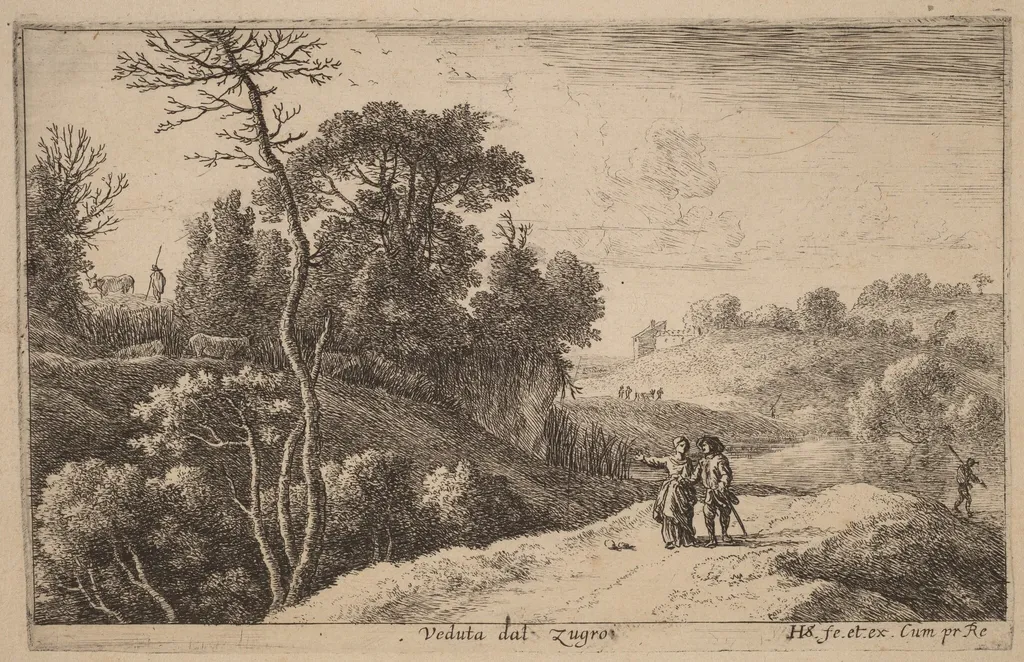
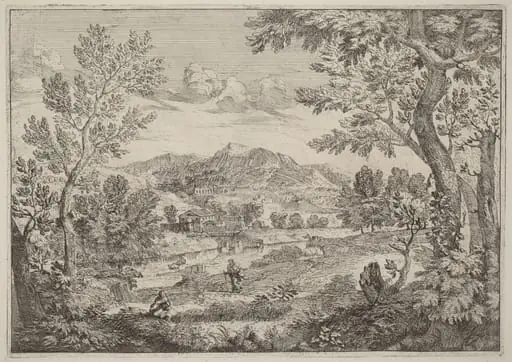
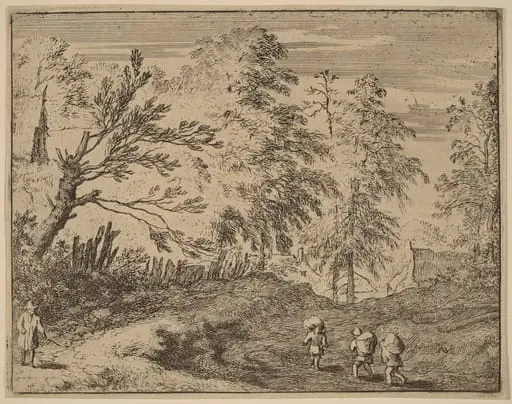
First View of Zugro is an ink print by the Baroque artist Herman van Swanevelt. It dates from 1628 and is held in the collection of the National Gallery of Art.
About this work
Overview
First View of Zugro is an etching executed in 1628 by the Dutch landscape artist Herman van Swanevelt. The work is a black‑and‑white print that captures a tranquil rural scene, presenting a narrow, winding path that cuts through a stand of trees and leads toward a distant hill where a shepherd watches over his flock.
Subject & Meaning
The composition depicts a quiet countryside vista rather than a narrative episode. A solitary shepherd tends sheep on a hill, while three figures—a pair of men and a woman—stand near the path’s edge, suggesting a moment of pause in everyday life. A modest house peeks through the foliage, reinforcing the sense of a lived, inhabited landscape.
Technique & Style
Van Swanevelt employed the fine, incised lines characteristic of early 17th‑century etching to render texture: the bark of trees, the folds of clothing, and the subtle gradations of ground are all suggested through delicate hatching. The print’s linear clarity and balanced perspective align it with the veduta tradition, emphasizing a measured, observational view of place.
Context
Created during the Dutch Golden Age, the work reflects the period’s growing interest in topographical accuracy and the natural world. While the title’s use of the Italian term veduta signals an influence from Italian landscape traditions, the subject matter remains rooted in the Dutch countryside, illustrating the cross‑cultural artistic exchanges of the era.
Own this work as a print
Artist & collection