Artwork
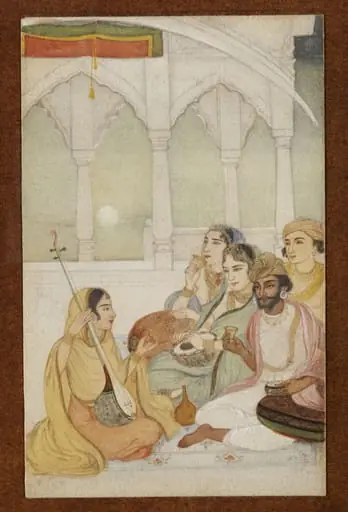
A Moonlight Music Party
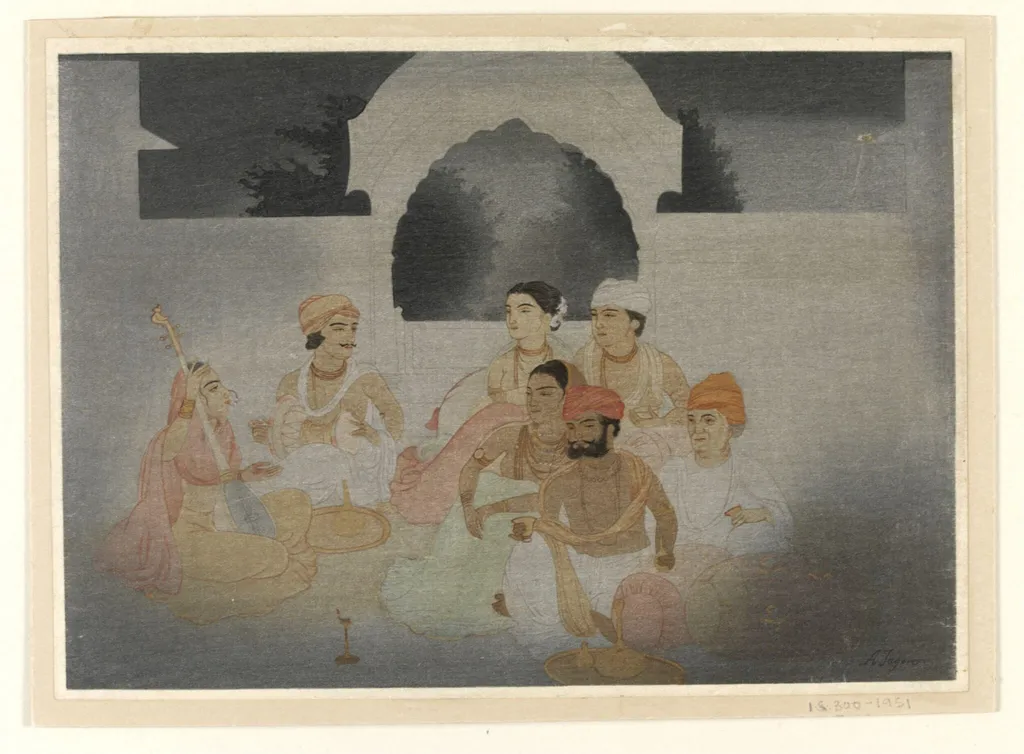
A Moonlight Music Party is a print by Abanindranath Tagore. It dates from 1900 and is held in the collection of the Victoria and Albert Museum.
About this work
Overview
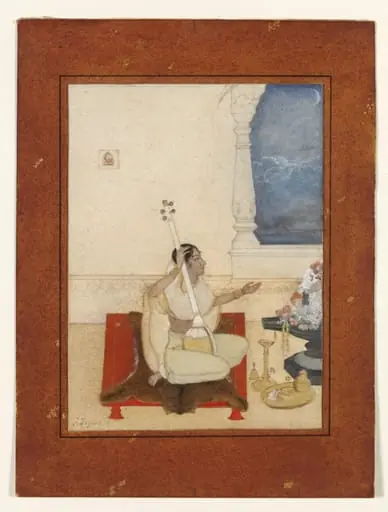
This print by Abanindranath Tagore depicts a nocturnal gathering where a woman plays the sitar, surrounded by attentive listeners.
This print by Abanindranath Tagore depicts a nocturnal gathering where a woman plays the sitar, surrounded by attentive listeners. Executed in a delicate, tonal style, it reflects the aesthetic ideals of the Bengal School, which sought to redefine Indian art through indigenous visual languages rather than Western academic norms. The quiet intimacy of the scene contrasts with the dominant colonial art pedagogy of the time.
Subject & Meaning
The scene portrays a private, contemplative moment of musical performance under moonlight, evoking spiritual and cultural continuity. The sitar player and her audience are rendered with stillness and grace, suggesting a connection to classical Indian traditions of raga and meditation. Tagore imbued such imagery with nationalist sentiment, positioning art as a vessel for cultural identity amid colonial disruption.
Technique & Style
Tagore employed soft washes and muted tones to create a hazy, atmospheric effect, drawing from Mughal and Rajput miniature painting traditions. Lines are subtle, forms are simplified, and light is suggested rather than modeled, avoiding Western chiaroscuro. The composition emphasizes flatness and rhythm, aligning with Indian aesthetic principles while adapting them to modern printmaking.
History & Provenance
Created during the height of the Bengal School’s influence (circa 1910–1920), this print emerged from Tagore’s efforts to establish an alternative to British-run art institutions. It was likely produced as a woodcut or lithograph for wider dissemination, reflecting the movement’s goal to make culturally rooted art accessible beyond elite circles. The work entered public collections as Indian nationalism grew.
Context
Tagore’s work arose in response to the colonial education system that privileged European techniques. By reviving pre-colonial Indian styles and themes, he positioned art as a form of resistance and renewal. This print reflects broader cultural revival efforts across literature, music, and craft, all aimed at reclaiming a distinct Indian identity during the early 20th-century independence movement.
Legacy
Tagore’s synthesis of traditional Indian aesthetics with modern sensibilities laid the foundation for later generations of Indian artists. His emphasis on indigenous sources influenced national art education and museum curation, helping to shift perceptions of what constituted ‘Indian art.’ This print remains a touchstone in discussions of cultural autonomy in colonial-era visual culture.
Artist & collection

Artist
Abanindranath Tagore was an Indian painter who was the principal artist and creator of the Indian Society of Oriental Art in 1907.