Artwork
Grapevine
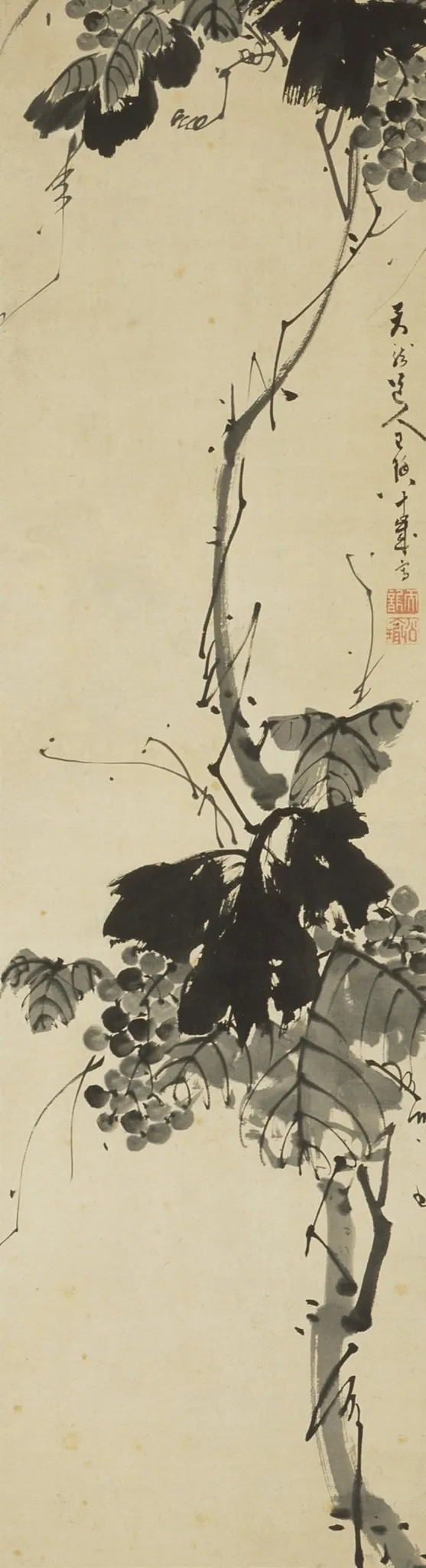
Grapevine is an unspecified painting by Tenryū Dōjin. It dates from 1802 and is held in the collection of the Los Angeles County Museum of Art.
About this work
Overview
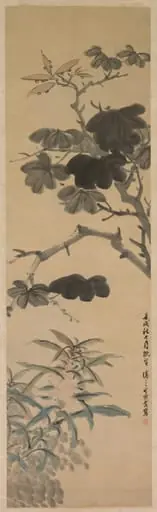
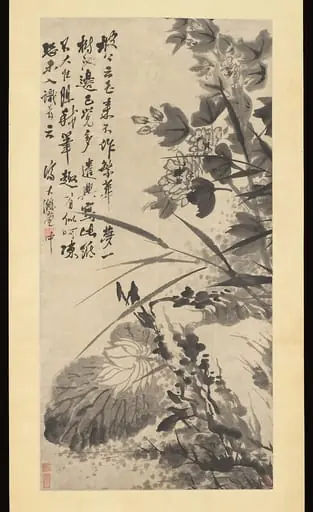
Grapevine, painted in 1802 by Tenryū Dōjin, is part of the collection at the Los Angeles County Museum of Art. The work presents a single vine that sweeps diagonally across the surface, its foliage and fruit rendered against a muted beige backdrop. The composition balances the organic vitality of the plant with a restrained, almost monochrome setting.
Subject & Meaning
The canvas focuses on a grapevine, displaying clusters of grapes at differing stages of maturation, from pale green to deep purple, alongside broad, serrated leaves. By emphasizing the vine’s growth and the fruit’s ripeness, the painting alludes to themes of abundance, seasonal change, and the passage of time inherent in agricultural cycles.
Technique & Style
Tenryū employs vigorous brushwork and pronounced dark shading to model the vine’s forms, creating a tactile sense of depth. The contrast between the rich, shadowed foliage and the light background reflects a chiaroscuro approach, while the varied brushstrokes give the grapes a textured, three‑dimensional appearance.
History & Provenance
Executed in the early nineteenth century, Grapevine entered the Los Angeles County Museum of Art’s holdings through acquisition in the late twentieth century. Its documented provenance traces back to Japanese collections before crossing to the United States, where it has been displayed as part of the museum’s Asian art exhibitions.
Context
The painting belongs to a period when Japanese artists were exploring Western-influenced chiaroscuro techniques, integrating them with traditional ink and brush methods. Tenryū’s work parallels contemporaneous experiments by other painters who sought to render volume and atmospheric depth through strong tonal contrasts, situating Grapevine within a broader cross‑cultural artistic dialogue.
Artist & collection