Artwork
Untitled
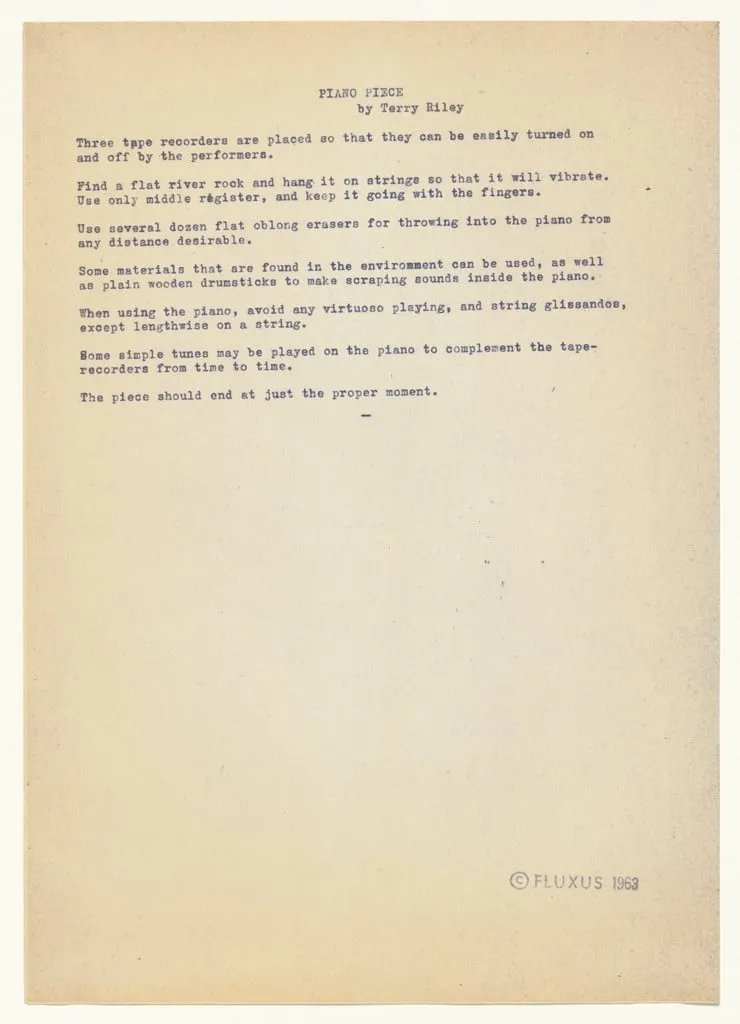
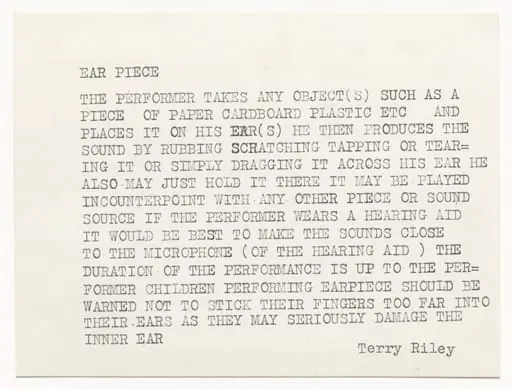
Untitled is a print by Terry Riley. It dates from 1963 and is held in the collection of the Museum of Modern Art.
About this work
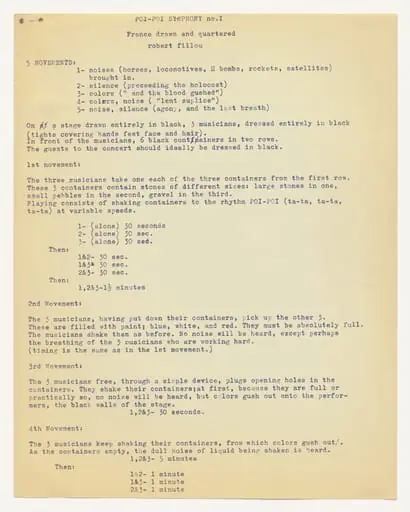
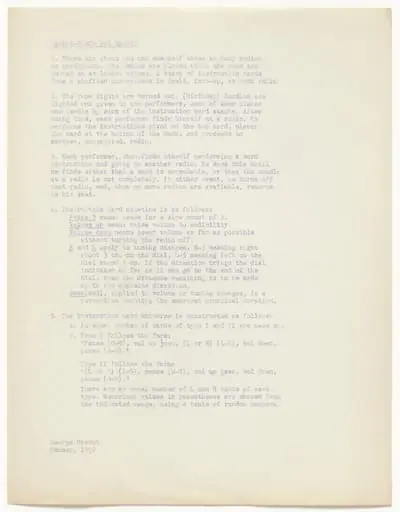
The text is simple, with short paragraphs listing odd tasks like hanging a river rock on strings and throwing erasers into a piano.
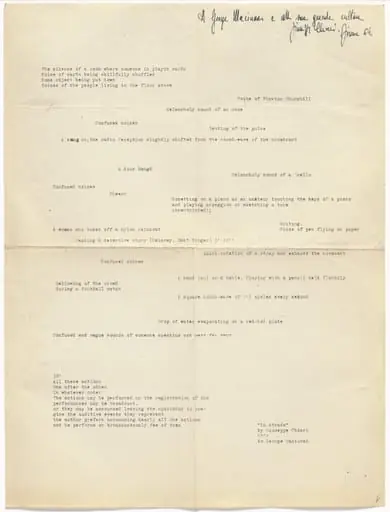
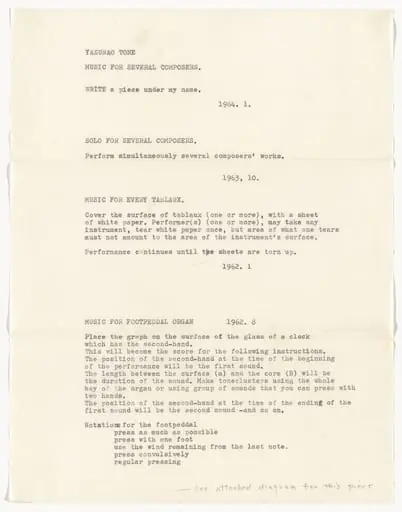
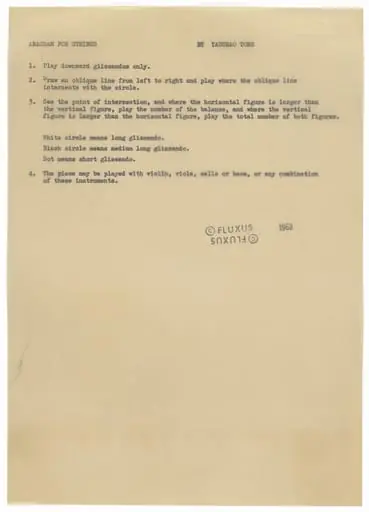
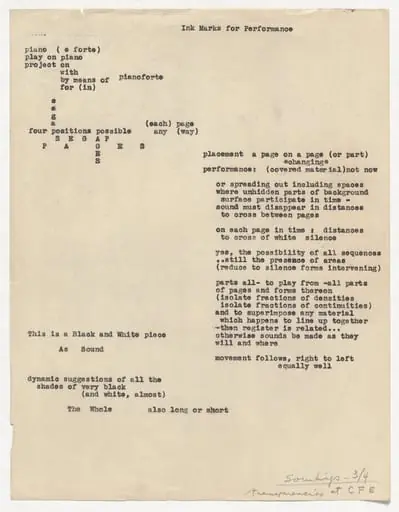
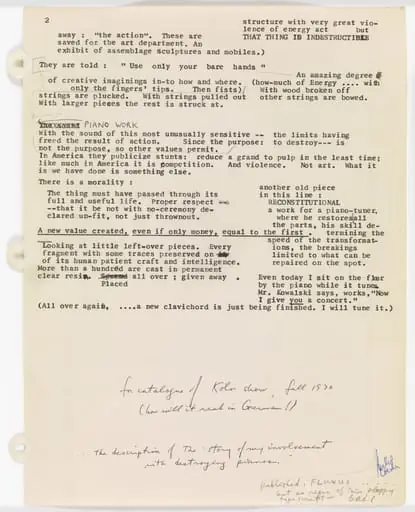
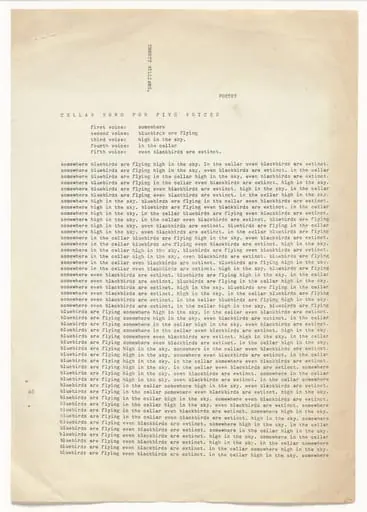
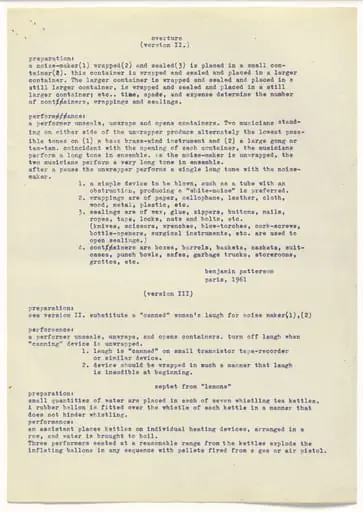
This is a typed sheet of instructions on a light tan background. The text is simple, with short paragraphs listing odd tasks like hanging a river rock on strings and throwing erasers into a piano. The words are clear but feel like directions for a strange performance. At the bottom right, there’s a small printed mark: “FLUXUS 1963.”
The instructions seem to describe a piece of music that isn’t played in the usual way—it’s more like an experiment. The artist, Terry Riley, was part of a group that pushed boundaries in how music could be made.
If this sounds interesting, look up Terry Riley.
Overview
Created around 1963, this mimeograph print by Terry Riley is a textual score rather than a traditional musical notation. It appears as a plain sheet on light tan paper, with typed instructions that outline unconventional actions. The work carries no musical notes or rhythms, instead proposing physical gestures as the basis for sonic experience. A small 'FLUXUS 1963' stamp in the lower right confirms its association with the experimental art collective.
Subject & Meaning
The piece presents a series of absurd, poetic directives—such as suspending a river rock by strings or hurling erasers into a piano—that reframe music as an event rooted in behavior rather than notation. These instructions invite participation and chance, challenging the notion of music as a fixed composition. The work resists performance norms, treating sound as an emergent result of arbitrary acts rather than deliberate technique.
Technique & Style
Executed in mimeograph, the print uses the medium’s characteristic grainy texture and slightly smudged typography to evoke the DIY ethos of underground art circles. The layout is utilitarian, with no decorative elements, reinforcing its function as a directive. The language is deliberately plain and procedural, contrasting with the surreal content, creating a tension between form and instruction.
History & Provenance
Produced in 1963, the work was distributed as part of the Fluxus movement’s ephemeral publications, which emphasized accessibility and anti-commercialism. It entered The Museum of Modern Art’s collection as an artifact of experimental practice, reflecting the institution’s growing interest in conceptual and performance-based works during the 1960s. Its survival as a physical object is unusual, given the movement’s preference for transient, reproducible formats.
Context
Riley was embedded in a network of artists and composers rejecting traditional structures in favor of indeterminacy and everyday materials. Fluxus, active across Europe and the U.S., treated art as an open-ended process. This piece aligns with contemporaneous works by George Brecht and Yoko Ono, which similarly used text to trigger actions rather than produce fixed outcomes, blurring boundaries between music, theater, and visual art.
Legacy
The print exemplifies how conceptual scores expanded the definition of music beyond sound production. It influenced later generations of performance artists and composers who prioritized process over product. While not widely performed as originally intended, its presence in museum collections affirms its role in redefining artistic authorship and the materiality of musical notation.
Artist & collection

Artist
Terrence Mitchell Riley is an American composer and performing musician best known as a pioneer of the minimalist school of composition.