Artwork
Untitled
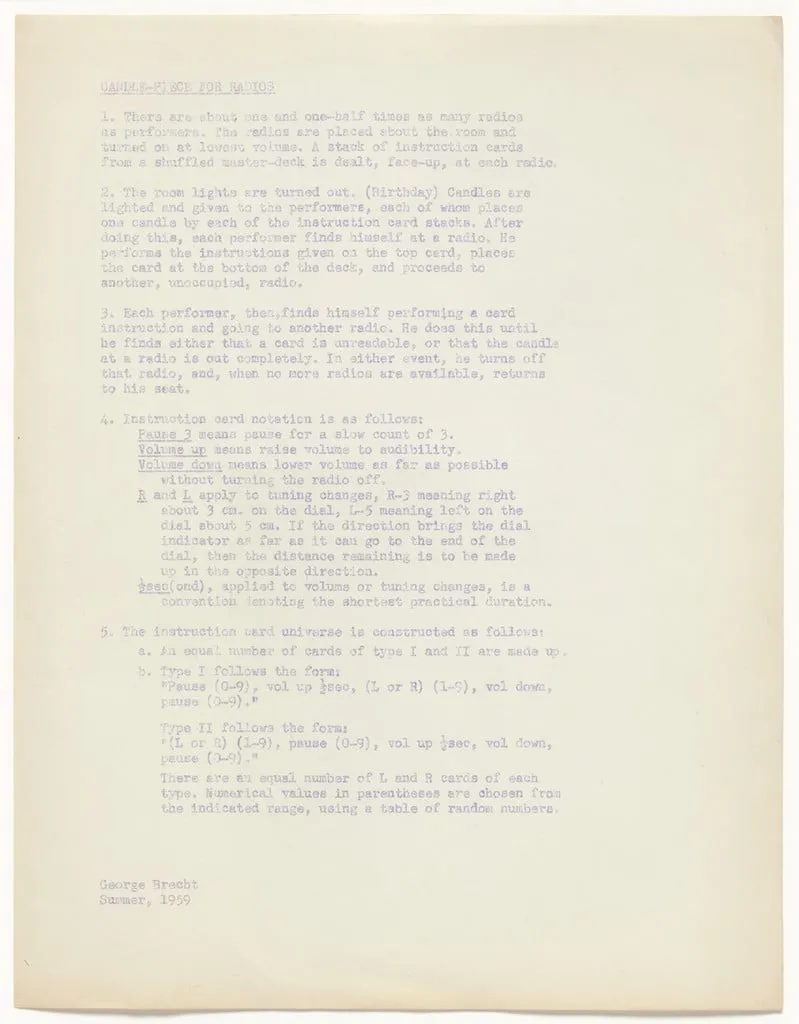
Untitled is a print by George Brecht. It dates from 1959 and is held in the collection of the Museum of Modern Art.
About this work
"* The instructions look like a game where performers follow random cards to adjust radio volumes and dials.
This image shows a typed page with black text on a light background. The words are arranged in numbered steps, describing how to use radios and candles in a performance. There’s a handwritten signature at the bottom: *"George Brecht, Summer 1959."*
The instructions look like a game where performers follow random cards to adjust radio volumes and dials. It’s more like a set of rules than a traditional artwork.
Look up George Brecht next to see how he turned everyday objects into art.
Overview
George Brecht produced this typed instruction piece in 1959, predating his formal association with Fluxus. It functions as a score rather than a conventional artwork, presenting a sequence of actions involving radios and candles. The format resembles a game or ritual, inviting performers to interpret its directives. Its material simplicity—black ink on paper—emphasizes the primacy of idea over object.
Subject & Meaning
The work’s subject is the act of participation itself. By outlining procedures for manipulating everyday objects—radios and candles—it shifts focus from visual aesthetics to lived experience. The randomness implied by the numbered steps challenges fixed interpretations, suggesting that meaning emerges through performance rather than static form. It redefines art as an event shaped by the audience’s engagement.
Technique & Style
Brecht employed typewritten text arranged in sequential steps, mimicking instructional manuals or game rules. The handwritten signature at the bottom personalizes the piece without altering its impersonal structure. The absence of images or decorative elements reinforces its conceptual nature. This method aligns with his broader practice of using mundane formats to subvert traditional artistic conventions.
History & Provenance
Created in summer 1959, this piece predates the official formation of Fluxus but anticipates its ethos. Brecht, then working as a chemist, was developing ideas that would later influence the movement’s emphasis on event-based art. The work circulated among artists in New York before being formally recognized within Fluxus circles, establishing its role as an early prototype of conceptual performance scores.
Context
Emerging in the late 1950s, this work responded to a growing interest in breaking down boundaries between art and life. Influenced by John Cage’s indeterminacy and the experimental spirit of postwar avant-garde circles, Brecht’s piece reflects a broader shift toward dematerialized art. It aligns with contemporaneous efforts to prioritize process, chance, and viewer involvement over traditional craftsmanship.
Legacy
This instruction-based format became a hallmark of conceptual and performance art in the 1960s and beyond. Brecht’s approach influenced artists who sought to decentralize authorship and elevate everyday actions as artistic material. Though modest in appearance, the work contributed to a lasting redefinition of what an artwork could be—no longer a fixed object, but a set of possibilities activated by others.
Artist & collection
Artist
George Brecht (August 27, 1926 – December 5, 2008), born George Ellis MacDiarmid, was an American conceptual artist and avant-garde composer, as well as a professional chemist who worked as a consultant for companies…