Artwork
Amsterdam, Ships at the IJ on Choppy Water
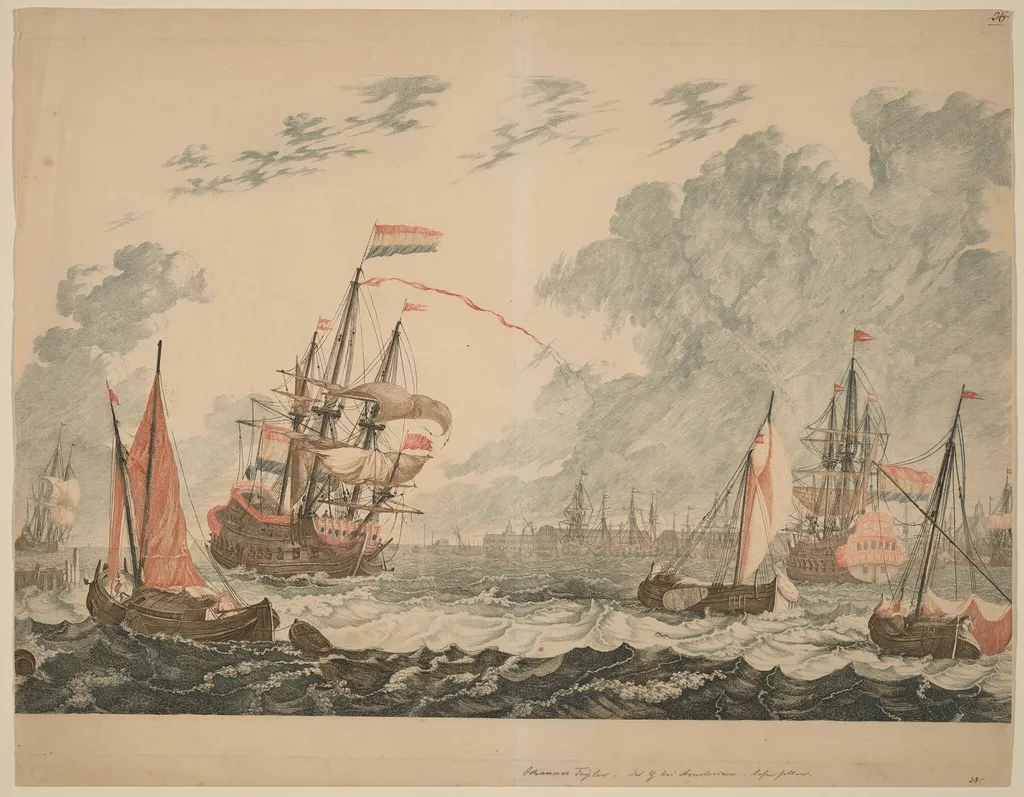
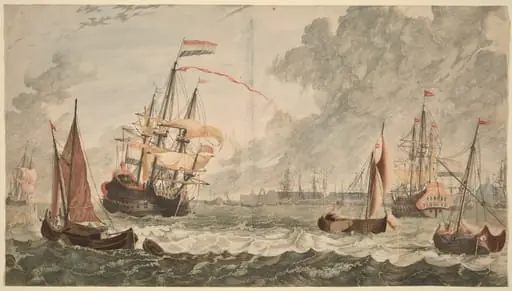
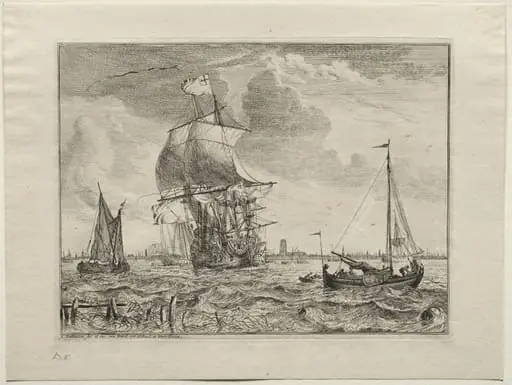
Amsterdam, Ships at the IJ on Choppy Water is an ink print by the Baroque artist Johann Teyler. It dates from 1691 and is held in the collection of the National Gallery of Art. This color etching, dated around 1691, depicts a dynamic harbor scene at Amsterdam’s IJ waterway.
About this work
Overview
This color etching, dated around 1691, depicts a dynamic harbor scene at Amsterdam’s IJ waterway. Johann Teyler captures the turbulence of choppy waters beneath towering merchant vessels, their sails taut against gusting winds. The composition contrasts the scale of seafaring ships with a solitary rowboat in the foreground, while a storm-laden sky looms over the city’s distant silhouette.
Subject & Meaning
The rowboat’s precarious position may symbolize vulnerability amid the grandeur of commercial shipping, reflecting broader themes of struggle and resilience.
The print portrays the IJ’s bustling maritime activity, a vital artery for trade and transport in 17th-century Amsterdam. The rough waters and billowing sails evoke the challenges of navigation, underscoring both human endeavor and nature’s unpredictability. The rowboat’s precarious position may symbolize vulnerability amid the grandeur of commercial shipping, reflecting broader themes of struggle and resilience.
Technique & Style
Teyler employs the etching process, incising lines into a metal plate to create intricate details of waves, rigging, and clouds. The print’s tonal variation is achieved through *à la poupée*, a method involving selective ink application to produce subtle gradations of color. This technique enhances the depiction of light playing across turbulent water, lending depth and texture to the scene.
History & Provenance
Produced near the end of the 17th century, the work belongs to a period when Amsterdam’s harbor was a hub of global commerce. Little is documented about its early ownership, though its survival suggests it circulated among collectors of maritime or topographical prints. The print’s precise dating remains approximate, typical for works from this era lacking explicit inscriptions.
Context
During the late 1600s, Amsterdam’s port was central to the Dutch Republic’s economic dominance. Prints like this served both documentary and aesthetic purposes, catering to audiences fascinated by seafaring life. The stormy setting may also reflect contemporary anxieties about maritime risks, as well as the Dutch mastery of naval technology and trade routes.
Legacy
Teyler’s etching exemplifies the period’s innovation in color printing, a technique still evolving in the 17th century. While less celebrated than paintings of the era, such works contributed to the visual record of Amsterdam’s urban and maritime identity. Today, it offers insight into the technical experimentation and thematic concerns of Dutch printmakers during the Golden Age.
Own this work as a print
Artist & collection