Artwork
Pissing Cow and Two Sheep
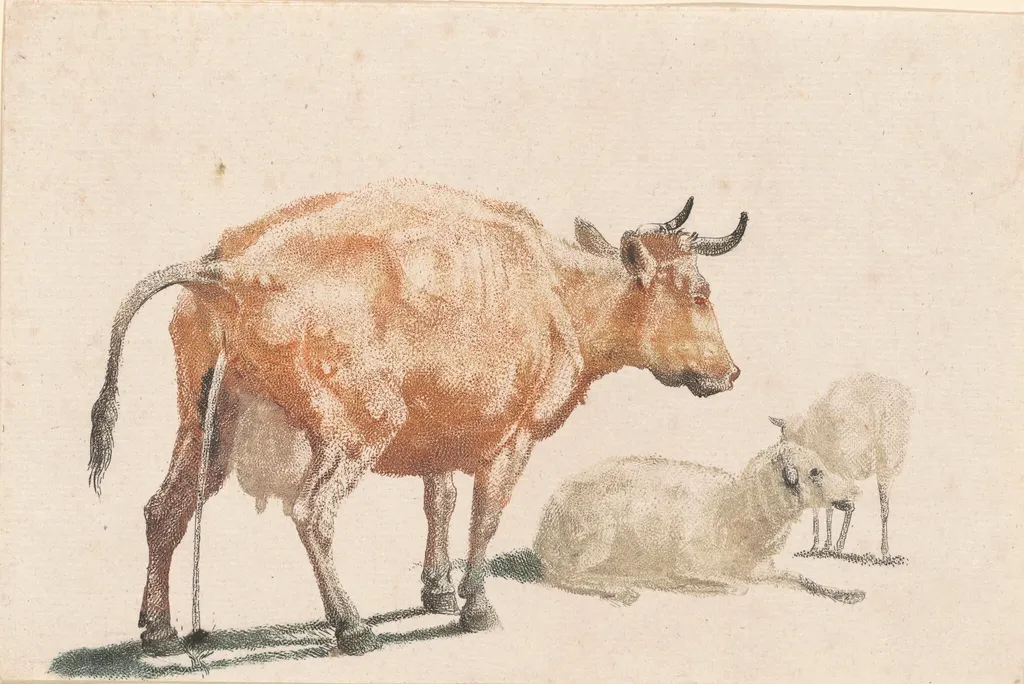
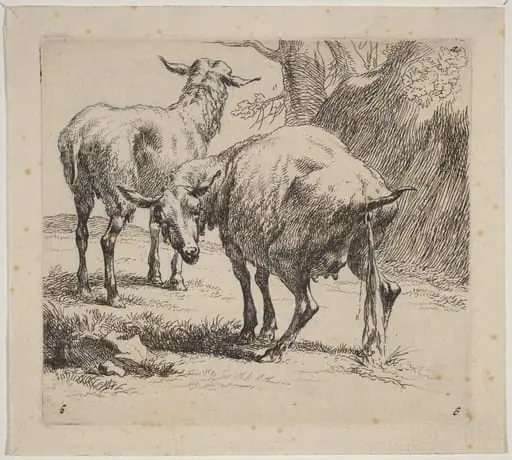
Pissing Cow and Two Sheep is an ink print by the Baroque artist Johann Teyler. It dates from 1691 and is held in the collection of the National Gallery of Art.
About this work
Overview
Created around 1691 by Johann Teyler, this color etching depicts a cow urinating near two sheep, rendered in ink applied by hand to the raised surfaces of the plate—a technique known as à la poupée. Rare in etching practice, this method produced subtle, localized coloration on laid paper. The composition is framed by a low fence and bare tree trunks, grounding the scene in a quiet, rural setting.
Subject & Meaning
The image presents an unidealized moment of animal behavior: a cow, its white coat stained with grass, releases urine while two sheep stand nearby, unaffected. The cow’s calm demeanor contrasts with the absurdity of the act, suggesting neither moral judgment nor pastoral idealism. The scene may reflect an observational interest in ordinary rural life, stripped of symbolism or narrative pretense.
Technique & Style
Teyler employed à la poupée, a labor-intensive method where ink was dabbed by hand onto the etched plate’s raised lines, allowing selective color application. This technique, uncommon in etching, produced soft, uneven washes of pigment—green on the cow’s hide, muted tones on the ground. The lines are delicate, with minimal shading, emphasizing form through contour rather than depth or volume.
History & Provenance
Few examples survive, and those held in institutions like the National Gallery of Art, Washington, are among the most accessible.
The print originates from Teyler’s small body of etchings, mostly produced in the late 17th century. Few examples survive, and those held in institutions like the National Gallery of Art, Washington, are among the most accessible. Its rarity stems from the technique’s complexity and the limited number of impressions likely pulled. No documented early ownership records exist beyond institutional holdings.
Context
In an era dominated by religious, mythological, or aristocratic subjects, Teyler’s focus on mundane animal behavior was unusual. Dutch and Flemish printmakers often depicted rural life, but rarely with such unembellished directness. His work aligns with a quiet tradition of observational art, valuing the unremarkable over the heroic, reflecting a broader interest in naturalism among certain Northern European artists.
Legacy
Teyler’s etching remains a curiosity in print history, noted for its technical rarity and subject matter. It has not influenced broader artistic movements but is studied for its unconventional use of color and its unflinching depiction of animal behavior. Today, it stands as a quiet testament to the artist’s willingness to find interest in the overlooked details of everyday rural existence.
Artist & collection