Artwork
The Leominster Chalice
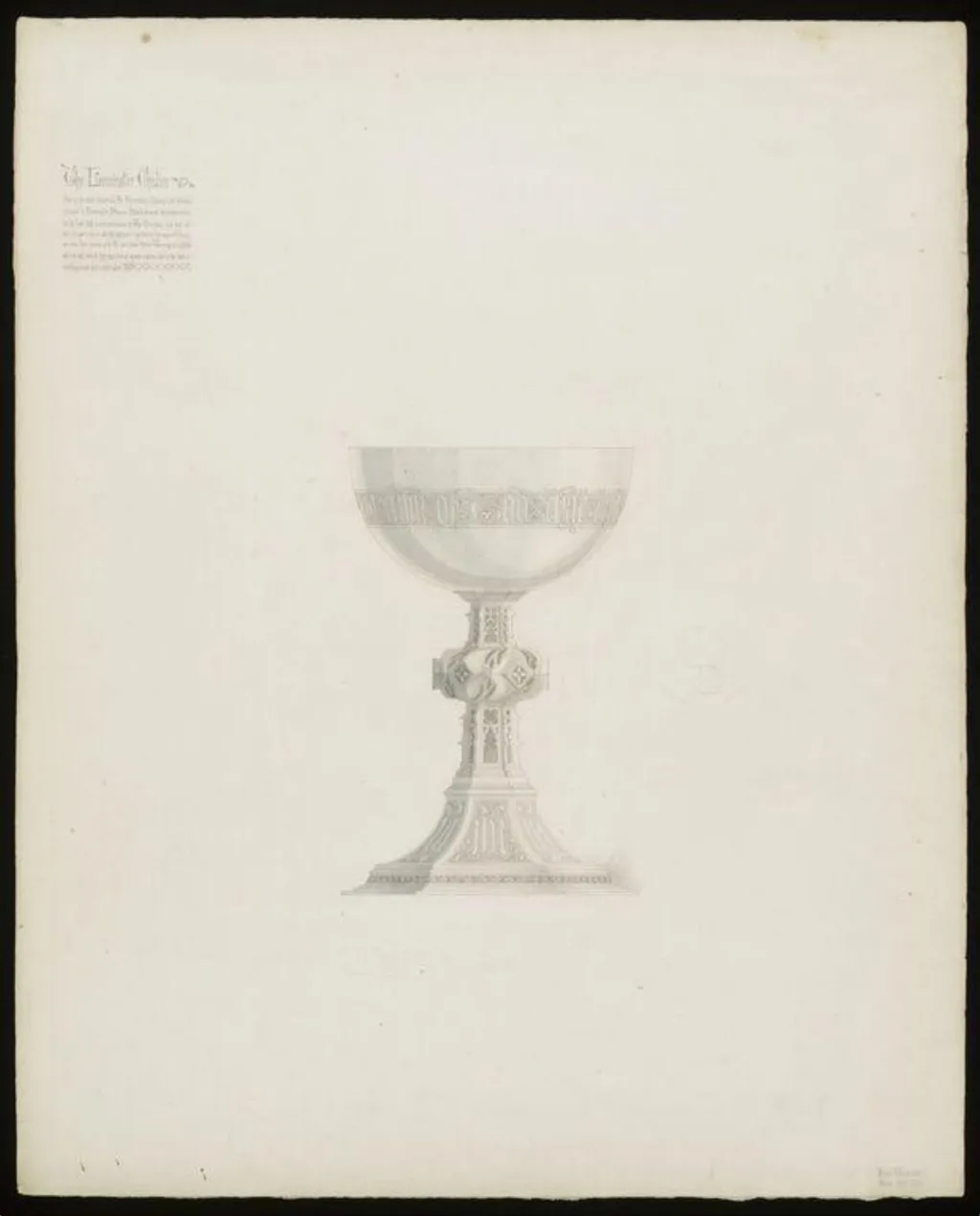
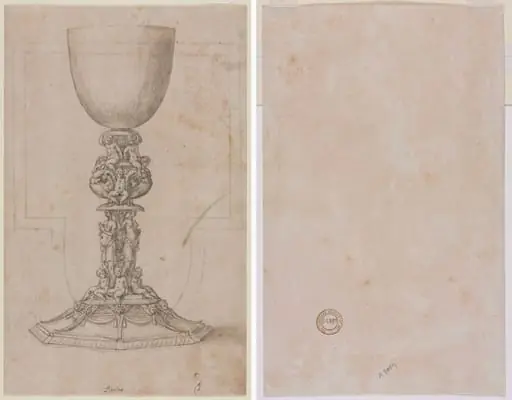
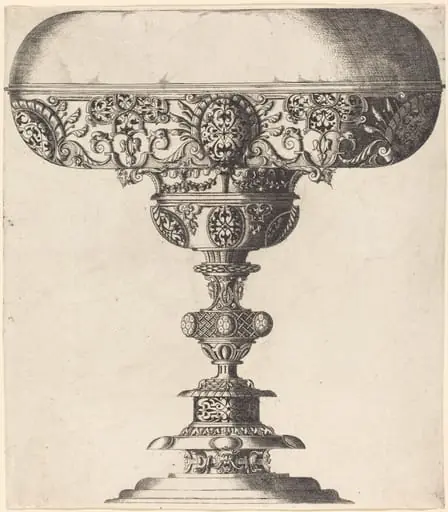
The Leominster Chalice is a drawing by Frank Theodore. It dates from 1911 and is held in the collection of the Victoria and Albert Museum.
About this work
Overview
The work belongs to a series of studies Theodore produced between 1909 and 1913, examining historic church silverware.
The Leominster Chalice is represented in a detailed pencil drawing by Frank Theodore, created during his apprenticeship with ecclesiastical metalworkers Barkentin and Krall. The work belongs to a series of studies Theodore produced between 1909 and 1913, examining historic church silverware. Though not a physical artifact itself, the drawing serves as a precise record of a liturgical object once held at St. James’ Church in Berwick St. James, now preserved in the British Museum.
Subject & Meaning
The chalice depicted is a liturgical vessel used in Christian Eucharistic rites, its form reflecting late medieval and Gothic Revival traditions. Its ornate stem and flared bowl, along with the encircling band at the rim, suggest a design influenced by 19th-century architects like Bodley and Burges, who sought to revive pre-Reformation craftsmanship. The drawing captures the object’s ceremonial gravity through meticulous attention to proportion and surface detail.
Technique & Style
Theodore rendered the chalice in light gray tones using fine cross-hatching and stippling, techniques common in metalwork documentation. The absence of color and the monochromatic palette emphasize form and texture over decoration, aligning with the functional purpose of the drawing as an archival record. The precision of line and shading reveals his training in metal casting and his ability to translate three-dimensional objects into two-dimensional plans.
History & Provenance
The original chalice was housed in St. James’ Church, Berwick St. James, Wiltshire, before being transferred to the British Museum. Theodore’s drawing, made during his formative years as a metalworker, was likely created for study or reference rather than public display. Its survival as part of his personal archive offers insight into the transmission of ecclesiastical design knowledge in early 20th-century Britain.
Context
Theodore’s work emerged during a period of renewed interest in medieval liturgical objects, spurred by the Gothic Revival and the Arts and Crafts movement. Architects like Bodley and Burges championed handcrafted church furnishings, prompting designers and draftsmen to document historic pieces. His drawings were part of a broader effort to preserve and reinterpret sacred metalwork for contemporary ecclesiastical use.
Legacy
Though Theodore did not achieve widespread fame, his drawings remain valuable as technical records of ecclesiastical silver. The Leominster Chalice study exemplifies the role of draftsmen in sustaining craft traditions during industrialization. Held in the British Museum’s collection, the drawing continues to inform scholarship on liturgical design and the training of early 20th-century metalworkers.
Artist & collection
Artist
Frank Theodore spent years hunched over library manuscripts and museum drawers, sketching medieval church silver until his hands cramped.

![Sheet of Studies [recto and verso], by John Flaxman](https://artifactworldgallery.com/img/john-flaxman--sheet-of-studies-recto-and-verso--af37285108779a00-w320.webp)