Artwork
Theatre. Gerasa -
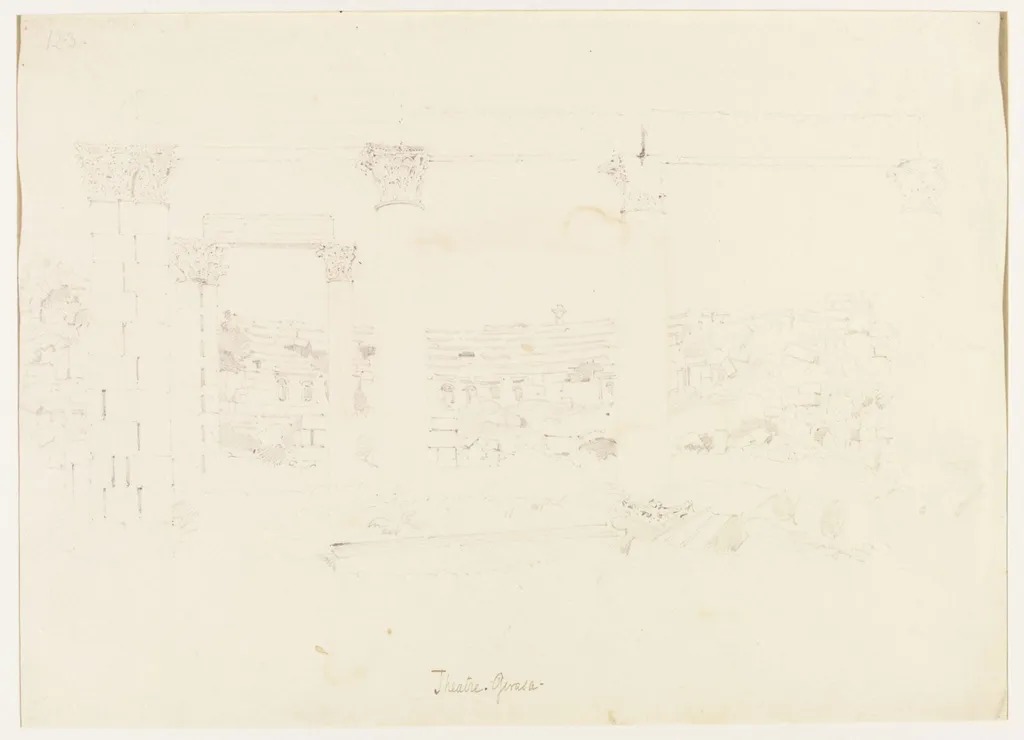
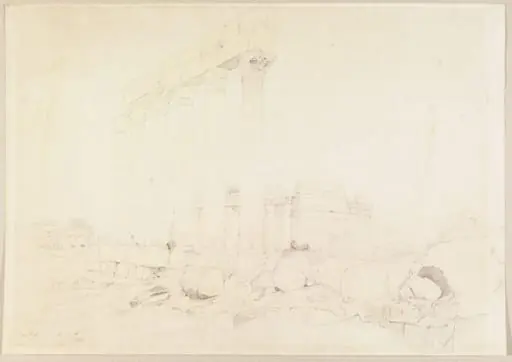
Theatre. Gerasa - is a drawing by the Romanticist artist William J. Tipping. It dates from 1842 and is held in the collection of the Victoria and Albert Museum. Created in 1842, *Theatre.
About this work
Overview
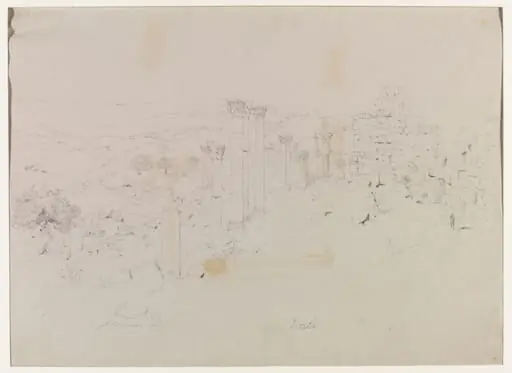
Created in 1842, *Theatre. Gerasa* is a pencil drawing by William J. Tipping, capturing the ruins of the ancient theater in Jerash. Long misattributed to William Turner, the work was reassociated with Tipping through archival records from the Searight collection. It belongs to a series of nine drawings (SD.1053–SD.1061) that surfaced at a Sotheby’s sale, documented by collector Rodney Searight.
Subject & Meaning
The focus on architectural fragments implies an interest in documenting ancient structures, not idealizing them.
The drawing depicts the remains of a Hellenistic-Roman theater in Jerash, then part of the Ottoman Empire. Its sparse, unpolished rendering suggests a field sketch made on-site, possibly during travel or study. The focus on architectural fragments implies an interest in documenting ancient structures, not idealizing them. The label ‘Gerasa’—the classical name for Jerash—anchors the image in historical geography.
Technique & Style
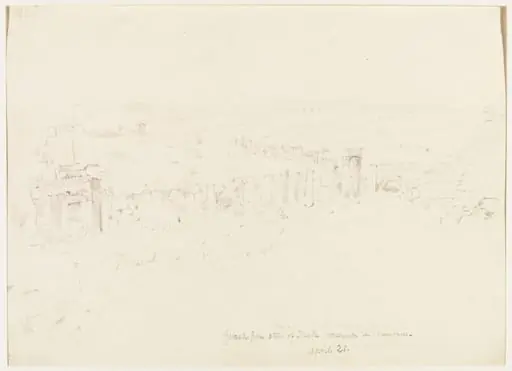
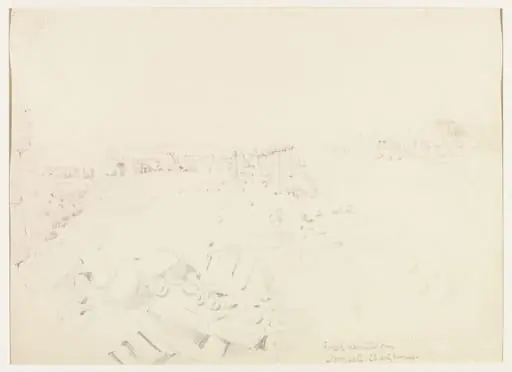
Executed in light, uneven pencil strokes, the drawing has the immediacy of a quick observational sketch. Lines are tentative, with some forms barely outlined and others reinforced with faint shading. There is no attempt at finish or detail; the work reads as a visual note, capturing spatial relationships rather than architectural precision. The looseness reflects a working method, not a lack of skill.
History & Provenance
The drawing was once incorrectly credited to William Turner, a diplomat and writer known for Middle Eastern travel. Research into the Searight Archive clarified Tipping’s authorship. It was part of a group of nine drawings sold by Sotheby’s, acquired by collector Rodney Searight, whose records helped reattribute the work. Its current location is not specified in available documentation.
Context
In the early 1840s, European travelers and antiquarians increasingly documented Near Eastern ruins as part of broader archaeological interest. Tipping’s sketch aligns with this trend, though it lacks the polish of published illustrations. Its informal quality suggests it was made for personal use or as preparatory material, not for public display or publication.
Legacy
The drawing contributes to a modest but valuable record of 19th-century engagement with Levantine antiquities. Its reattribution underscores the importance of archival research in correcting historical misidentifications. While not widely exhibited, it remains a quiet testament to the practice of on-site observation by lesser-known travelers of the period.
Artist & collection
Artist
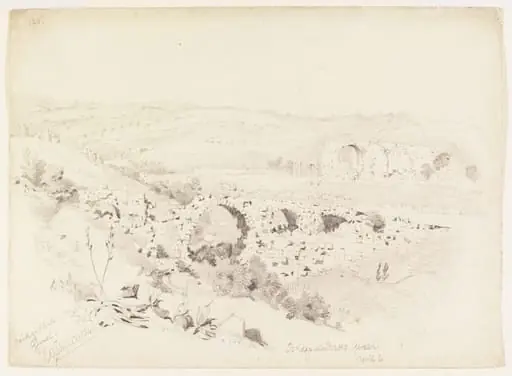
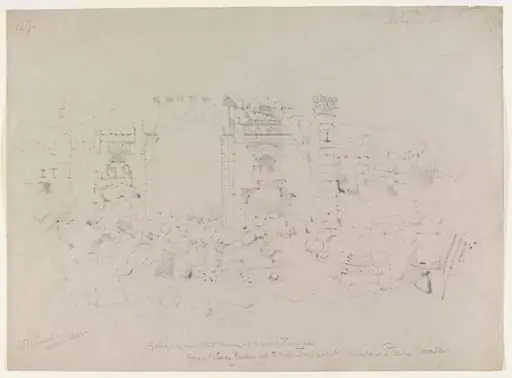
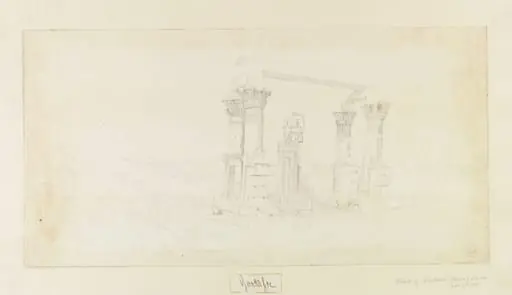
This British artist drew the ruins of an ancient Roman city in 1842. Look at the crumbling columns and stone arches in Grand Temple Gerasa, the tiered Theatre, and the small sketches of the Bridge & Bath. These exacting…

![Lower part of main [Street] Gerash - looking SW, by William J. Tipping](https://artifactworldgallery.com/img/william-j-tipping--lower-part-of-main-street-gerash-looking-sw--ff4c0c1a03806074-w320.webp)