Artwork
Baalbec
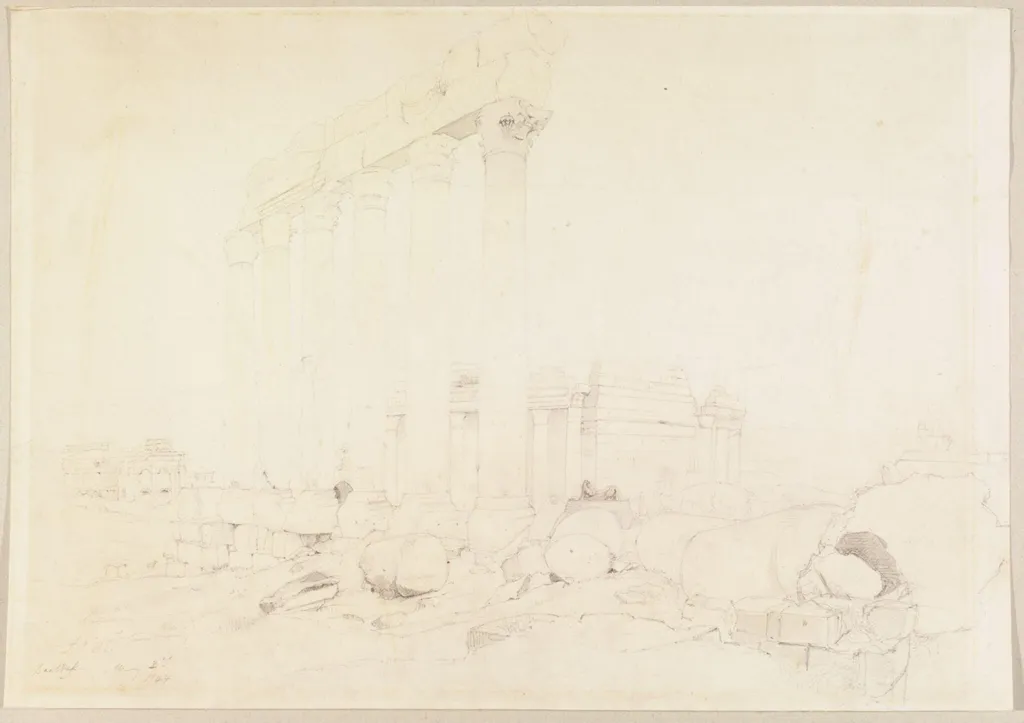
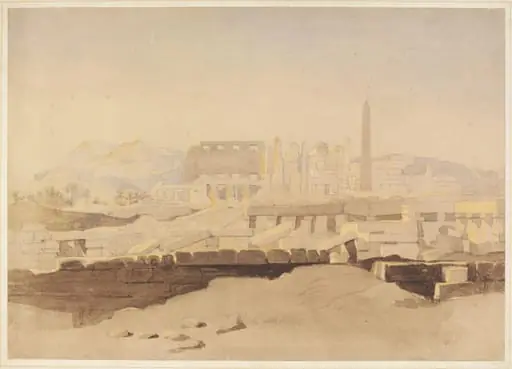
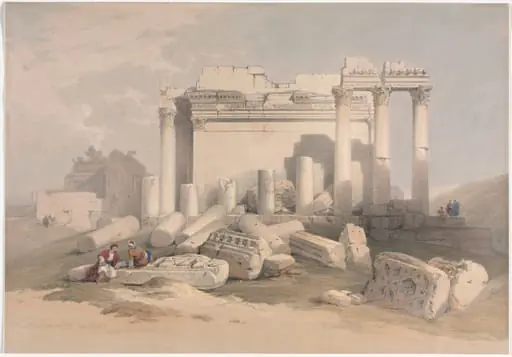
Baalbec is a watercolor work on paper by the Romanticist artist Godfrey Thomas Vigne. It dates from 1844 and is held in the collection of the Victoria and Albert Museum.
About this work
Overview
Its restrained palette and calm composition reflect a topographical interest common among 19th-century travelers and scholars documenting historical sites.
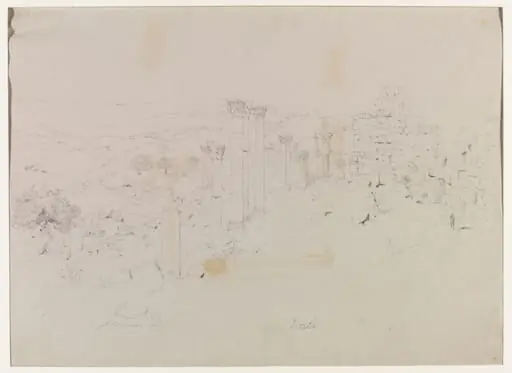
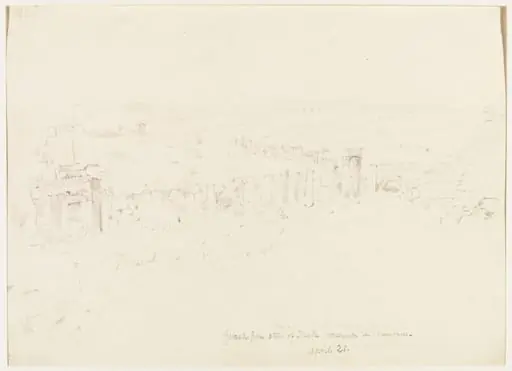
Created in 1844 by Godfrey Thomas Vigne, this watercolour captures the ruins of Baalbek in modern-day Lebanon. Executed in delicate washes of beige and gray, the work presents a quiet, atmospheric view of ancient stone structures under a soft, hazy sky. Its restrained palette and calm composition reflect a topographical interest common among 19th-century travelers and scholars documenting historical sites.
Subject & Meaning
The scene focuses on the monumental remains of the Roman temple complex at Baalbek, with towering columns and fragmented arches arranged to suggest both grandeur and decay. Vigne’s composition emphasizes scale and silence, inviting contemplation of time’s erosion rather than celebrating past power. The absence of human figures reinforces a sense of abandonment and enduring stillness.
Technique & Style
Vigne employed transparent watercolour washes to build subtle tonal gradations, avoiding bold outlines in favor of atmospheric blending. The light, muted palette and soft edges convey a sense of distance and weathered age. This approach aligns with topographical drawing traditions, where accuracy and mood were balanced to document architecture while evoking its emotional resonance.
History & Provenance
The watercolour was once part of the Royal Geographical Society’s collection, likely acquired during Vigne’s travels in the Middle East. It was later sold at Christie’s in January 1974, marking its transition from institutional archive to private ownership. Its journey reflects broader 19th-century patterns of collecting and dispersing visual records of antiquities.
Context
Vigne’s work emerged during a period of heightened European interest in Near Eastern antiquities, fueled by archaeological exploration and imperial expansion. While Romanticism influenced the emotional tone of such depictions, this piece prioritizes observation over drama, aligning more closely with scholarly documentation than artistic idealization.
Legacy
Though not widely exhibited today, the watercolour remains a record of Baalbek’s condition in the mid-19th century, offering insight into how Western observers interpreted ancient ruins before modern conservation efforts. Its quiet precision contributes to a lesser-known but significant body of travel-based topographical art from the period.
Artist & collection


![Lower part of main [Street] Gerash - looking SW, by William J. Tipping](https://artifactworldgallery.com/img/william-j-tipping--lower-part-of-main-street-gerash-looking-sw--ff4c0c1a03806074-w320.webp)