Artwork
'La Belle Vierge'
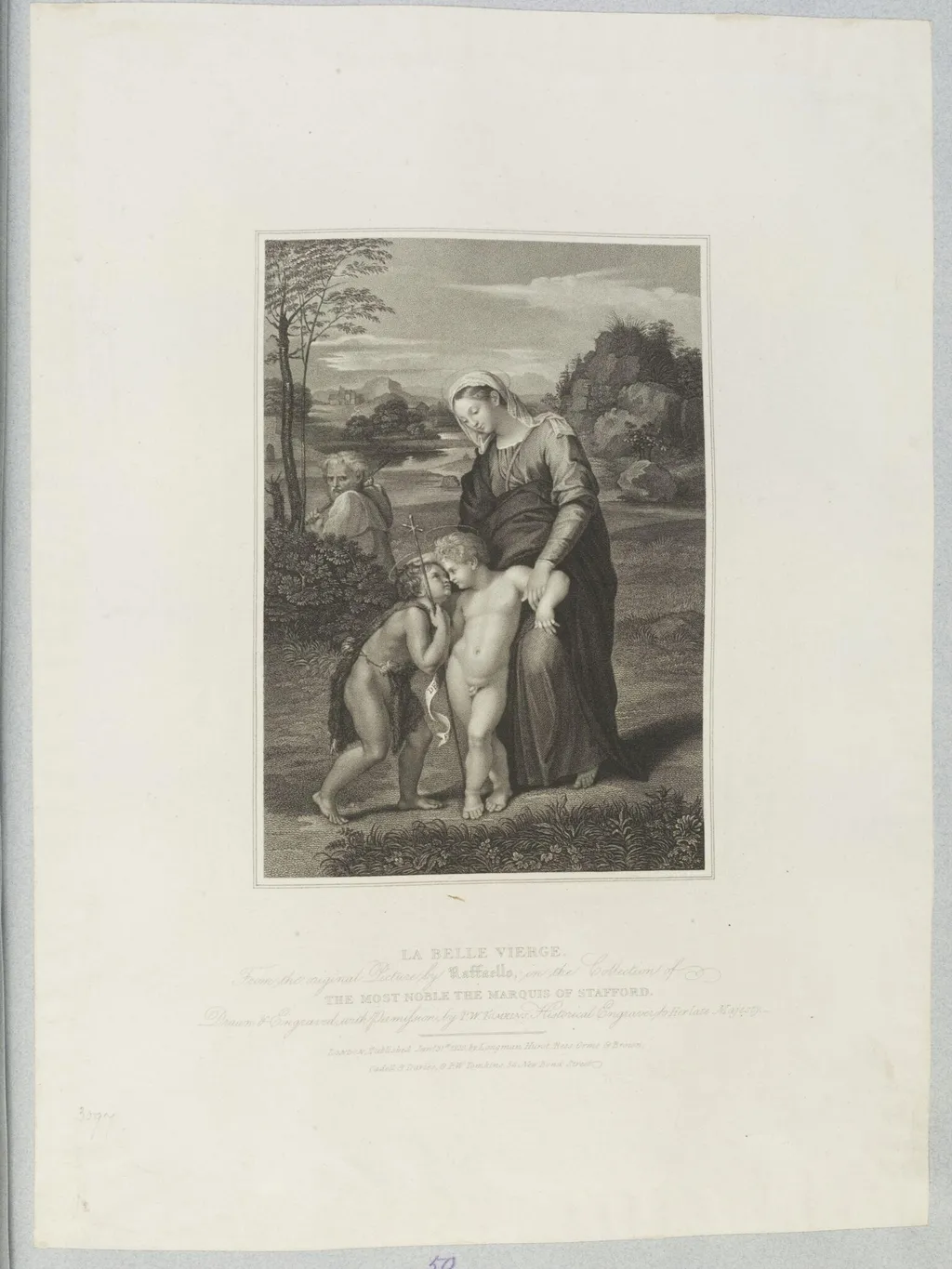
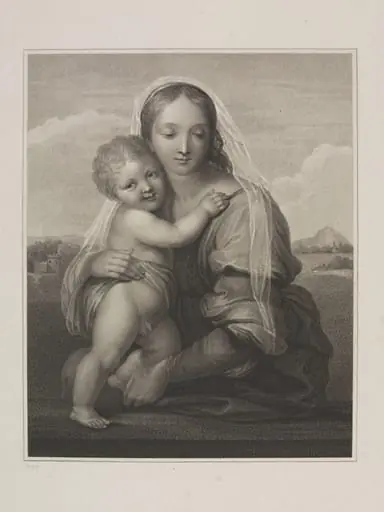
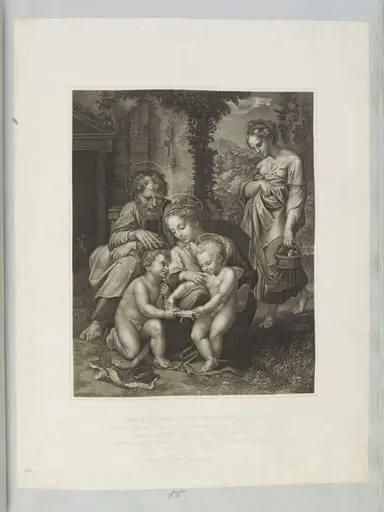
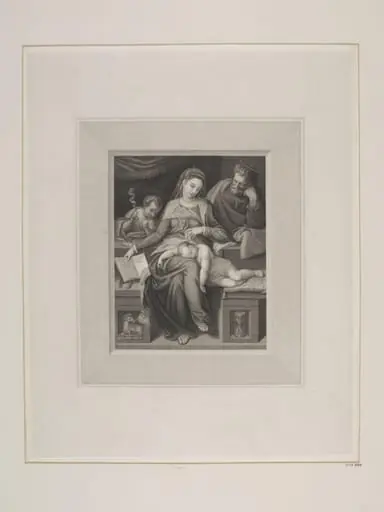
'La Belle Vierge' is a print by Peltro William Tomkins. It is held in the collection of the Victoria and Albert Museum.
About this work
Overview
The work captures a tender domestic scene rendered in fine linear detail, characteristic of 19th-century reproductive engraving practices.
La Belle Vierge is an 1850 engraving by Peltro William Tomkins, made as a reproductive print after a composition originally by Raphael. Executed on paper, it was produced as a proof state with open lettering, indicating an early impression before final text was added. The work captures a tender domestic scene rendered in fine linear detail, characteristic of 19th-century reproductive engraving practices.
Subject & Meaning
The image depicts a woman seated with a young child in her arms, while another child, bare except for a leafy wreath, stands beside her. Though titled La Belle Vierge—suggesting the Virgin Mary—the figures lack overt religious symbols. The composition evokes quiet intimacy rather than doctrinal narrative, reflecting a 19th-century preference for emotionally resonant, secularized interpretations of classical religious subjects.
Technique & Style
Tomkins employed fine-line engraving to render soft transitions of light and shadow across the figures’ skin and drapery. The subtle chiaroscuro enhances volume without harsh contrast, creating a gentle, luminous effect. Background elements—trees, a river, and a distant structure—are rendered with minimal detail, drawing focus to the central group and reinforcing the scene’s calm, contemplative mood.
History & Provenance
The engraving stems from Raphael’s early 16th-century painting, likely the Madonna of the Goldfinch or a similar work. Tomkins, a British engraver known for reproducing Old Master compositions, produced this version in 1850 for the British print market. The proof state with open letters suggests it was circulated among collectors or used for approval before final publication.
Context
In mid-19th-century Britain, reproductive engravings of Renaissance art were widely distributed to educate the middle class and elevate domestic taste. Tomkins’s work reflects this trend, translating high art into accessible formats. The choice of a maternal theme aligns with Victorian ideals of piety and familial virtue, even as the original religious context was softened for broader appeal.
Legacy
La Belle Vierge stands as an example of how Renaissance imagery was reinterpreted through 19th-century print culture. While not original, it preserved Raphael’s composition for audiences unfamiliar with the source painting. Its quiet aesthetic influenced later reproductive prints, contributing to the enduring visual presence of classical subjects in domestic interiors across Europe and America.
Artist & collection