Artwork
Holy Family and St. John
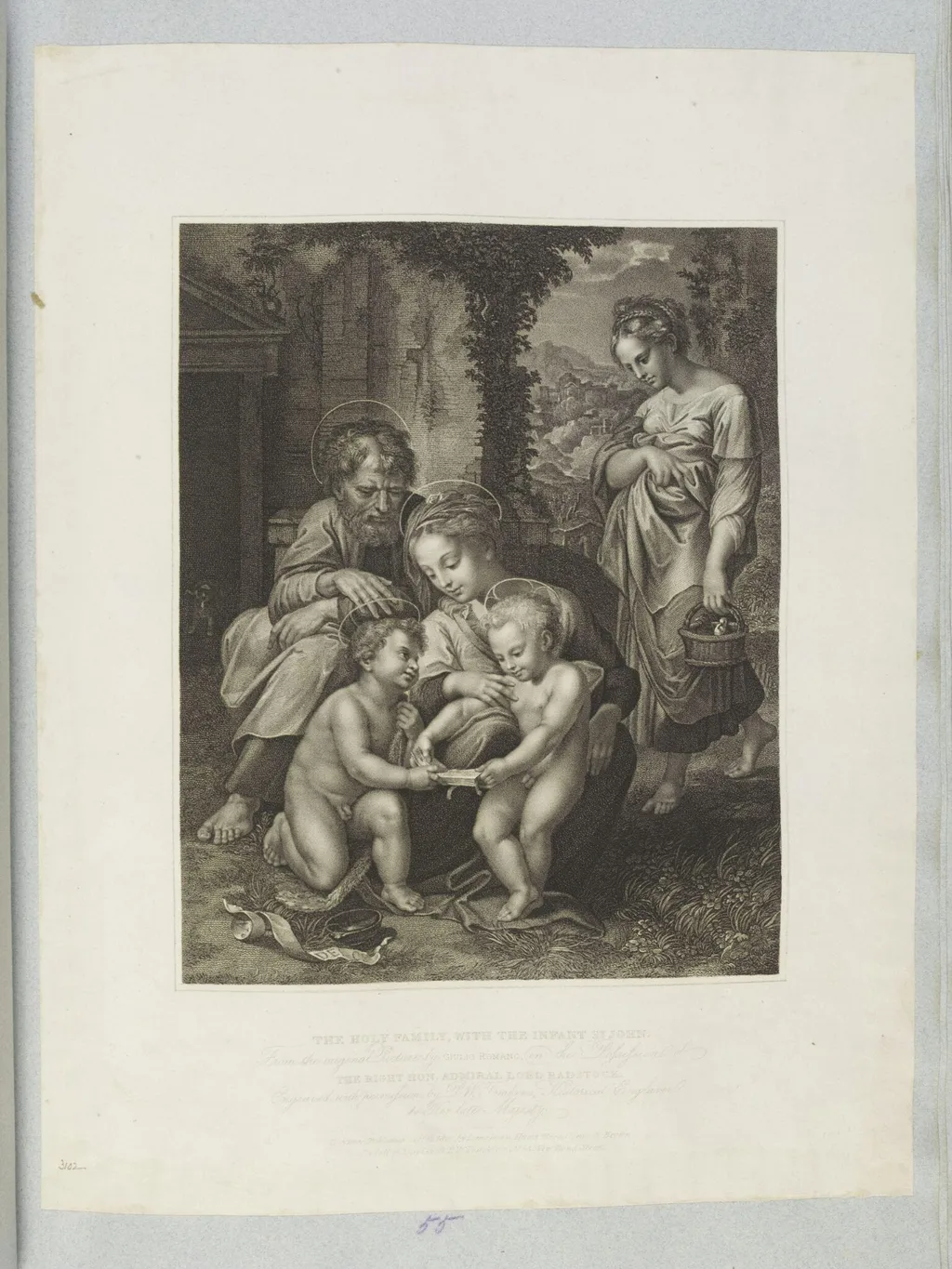
Holy Family and St. John is a print by Peltro William Tomkins. It is held in the collection of the Victoria and Albert Museum.
About this work
Overview
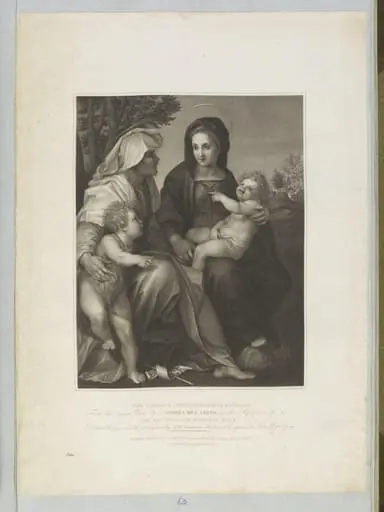
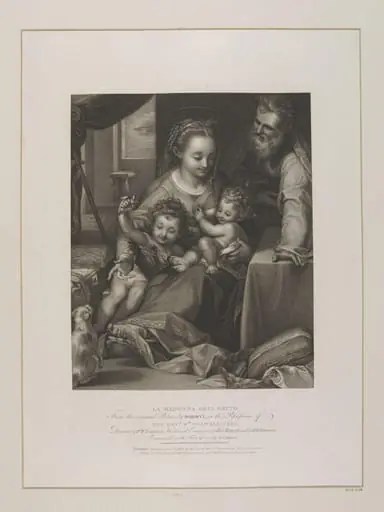
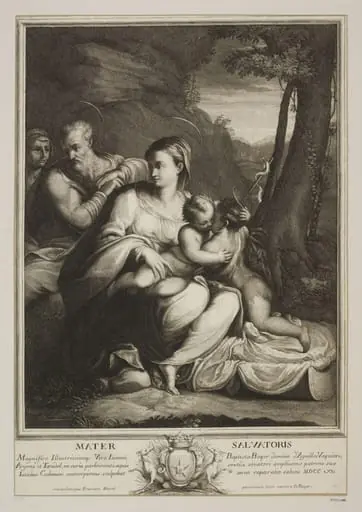
This 1850 print on paper, produced by Peltro William Tomkins, reproduces a composition originally conceived by Giulio Romano. It depicts a domestic interior scene with five figures, rendered in monochrome with pronounced contrasts of light and shadow. The work is a reproductive engraving, intended to disseminate a celebrated earlier design to a broader audience through the medium of print.
Subject & Meaning
Joseph kneels in reverence beside the children, while Mary stands nearby holding fruit, symbolizing abundance and earthly care.
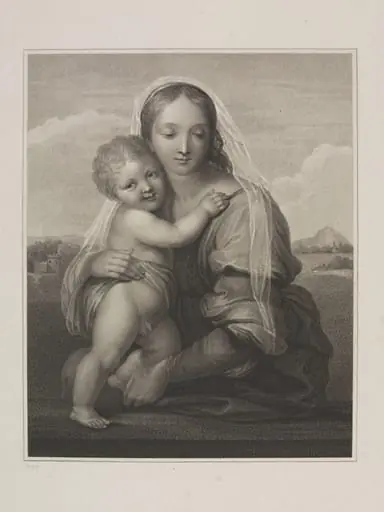
The scene portrays the Holy Family—Mary, Joseph, and the infant Jesus—alongside the young Saint John the Baptist. Joseph kneels in reverence beside the children, while Mary stands nearby holding fruit, symbolizing abundance and earthly care. The halos identify the sacred figures, and the presence of John, often associated with Christ’s future ministry, suggests a quiet foreshadowing of divine purpose.
Technique & Style
Tomkins employed engraving to translate Romano’s composition into a graphic format, emphasizing chiaroscuro through precise line work and tonal gradation. The strong interplay of light and dark defines the figures’ forms and creates depth within the confined interior space. The background, with its window and distant landscape, is rendered with delicate, receding lines that enhance spatial illusion without distracting from the central group.
History & Provenance
The print was made in 1850 by Peltro William Tomkins, a British engraver known for reproducing Old Master compositions. It derives from a drawing or painting by Giulio Romano, a Renaissance artist and pupil of Raphael, whose works were widely studied and replicated in the 18th and 19th centuries. This print likely served educational or devotional purposes in middle-class British households.
Context
In mid-19th century Britain, reproductive prints were common tools for art education and religious reflection. Romano’s Mannerist style, with its emotional intensity and sculptural figures, remained influential despite the rise of Neoclassicism. Tomkins’s engraving reflects a continued interest in Renaissance religious imagery, adapted for domestic consumption through accessible, affordable media.
Legacy
As a reproductive engraving, this work contributed to the circulation of Romano’s compositional ideas beyond original paintings and drawings. While not an original creation, it preserved and transmitted a significant Renaissance subject to audiences unfamiliar with the source material. Such prints formed part of the visual culture that sustained religious and artistic literacy in the 19th century.
Artist & collection