Artwork
Avem un guvern militar
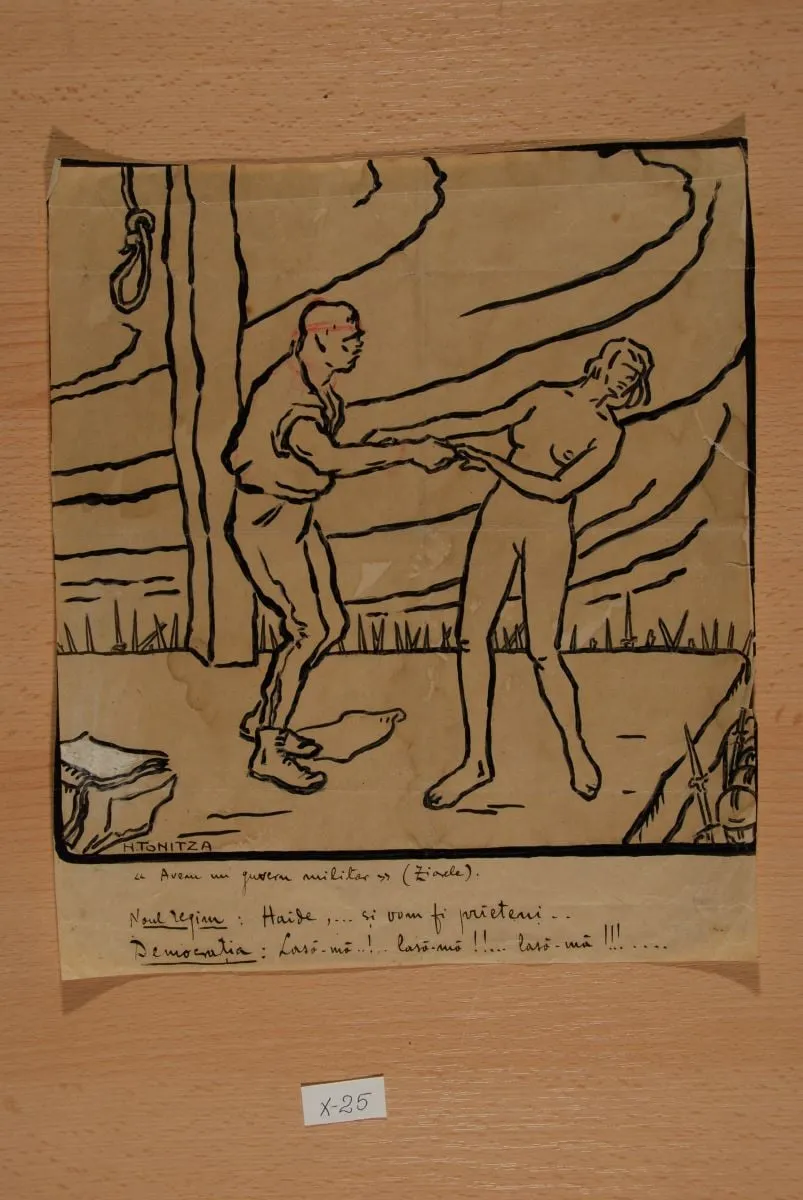
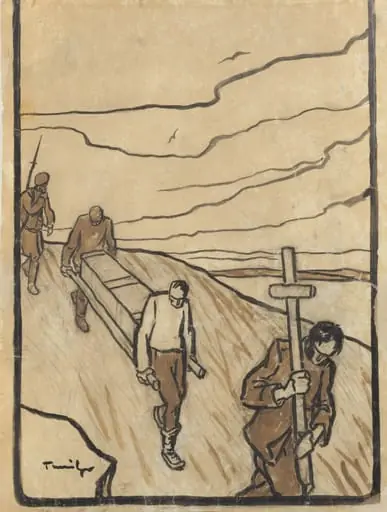
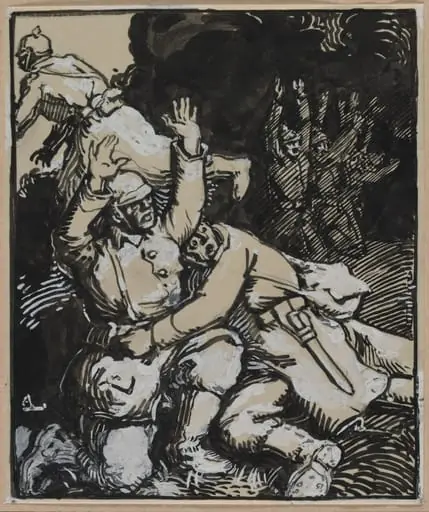
Avem un guvern militar is a drawing by Nicolae Tonitza. It dates from 1923 and is held in the collection of the Brukenthal National Museum.
About this work
Overview
Created around 1923 by Romanian artist Nicolae Tonitza, this ink sketch confronts political violence through minimal yet charged imagery.
Created around 1923 by Romanian artist Nicolae Tonitza, this ink sketch confronts political violence through minimal yet charged imagery. Executed with rapid, expressive lines, it captures a moment of coercion in an ambiguous outdoor space. The work’s urgency is amplified by its unfinished appearance, suggesting immediacy rather than polished composition. It functions as both a visual record and a silent indictment.
Subject & Meaning
The scene depicts one figure restrained by another, his bare torso and raised arms suggesting vulnerability and resistance. Above them, a noose hangs from a tree branch, while scattered rocks imply a site of execution or abandonment. Below, fragmented Romanian phrases blend military command with a cry for democratic order, creating a dissonance between authority and plea. The image evokes repression without depicting overt brutality.
Technique & Style
Tonitza employs loose, angular strokes and dense cross-hatching to convey tension and texture. The rough ground and jagged foliage are rendered with minimal detail, emphasizing emotional weight over realism. The ink’s uneven application and visible corrections reinforce a sense of haste, as if the artist responded to events in real time. The absence of color heightens the sketch’s stark, documentary quality.
History & Provenance
Produced during a period of political instability in Romania, the sketch reflects Tonitza’s engagement with contemporary social unrest. It was likely made in response to the military’s increasing influence in governance after World War I. The work remained in private hands for decades before entering public collections, where its political resonance has been reevaluated in light of 20th-century authoritarianism.
Context
In early 1920s Romania, civilian institutions were weakening under military pressure. Tonitza, known for his humanist perspective, used art to critique power structures. This sketch aligns with broader European modernist trends that favored expressive line over idealized form, but its specificity to Romanian politics distinguishes it as a localized act of dissent during a fragile democratic transition.
Legacy
The sketch endures as a quiet testament to artistic resistance in times of repression. Though not widely exhibited during Tonitza’s lifetime, it has since become a reference point in Romanian art history for its unflinching portrayal of state coercion. Its raw aesthetic continues to inform discussions on the role of drawing as political testimony in modern Eastern European art.
Artist & collection

Artist
Nicolae Tonitza was a Romanian painter, engraver, lithographer, journalist and art critic. Drawing inspiration from Post-Impressionism and Expressionism, he had a major role in introducing modernist guidelines to local art.