Artwork
Yvette Guilbert
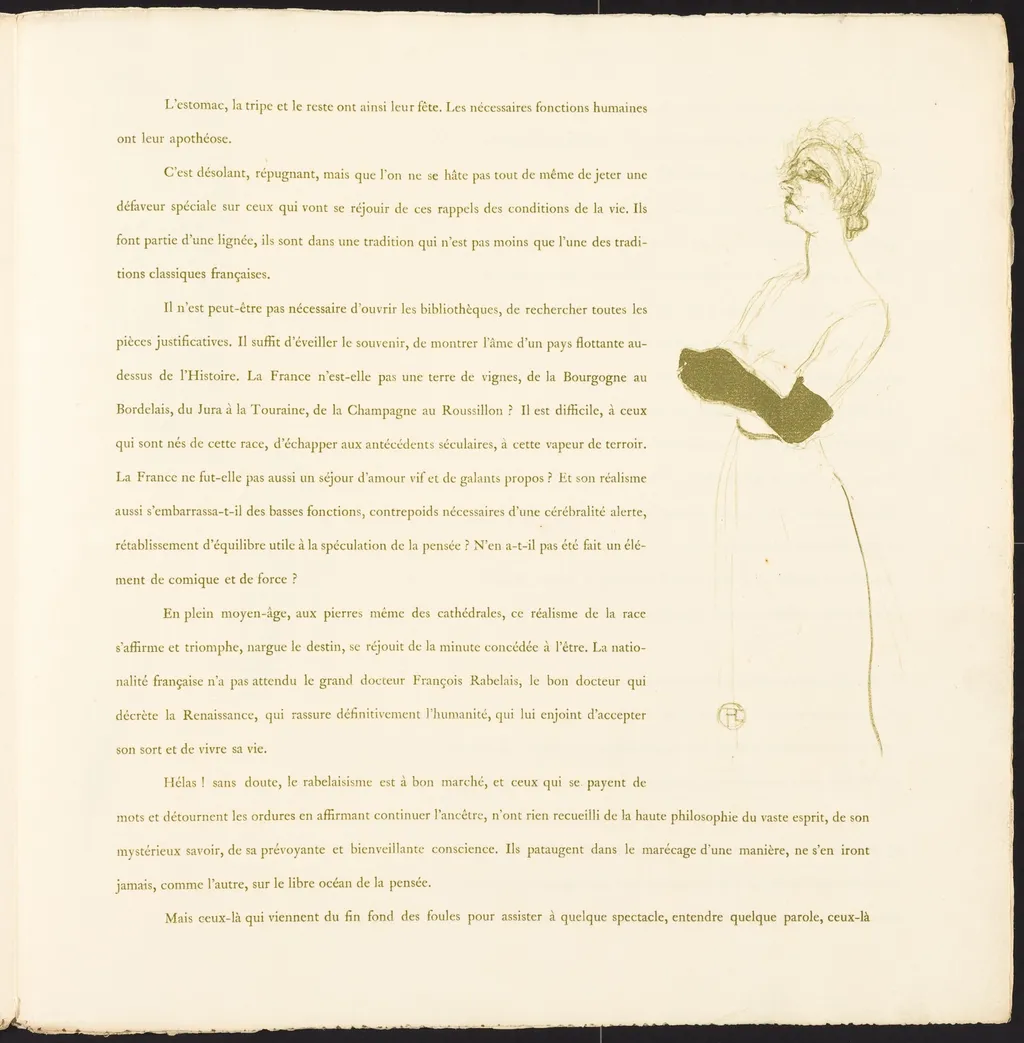
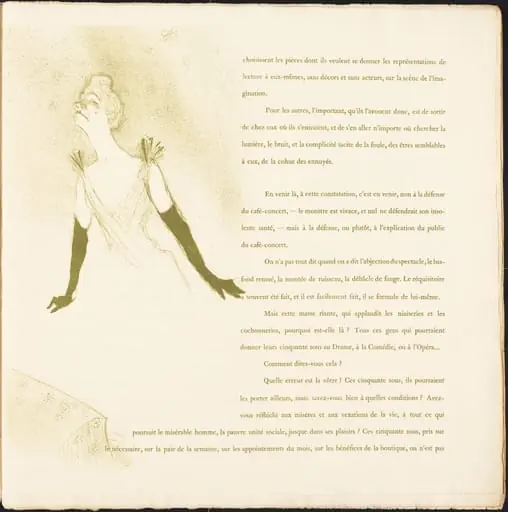
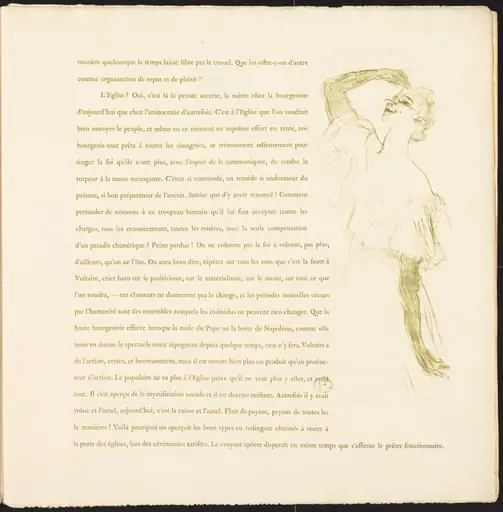
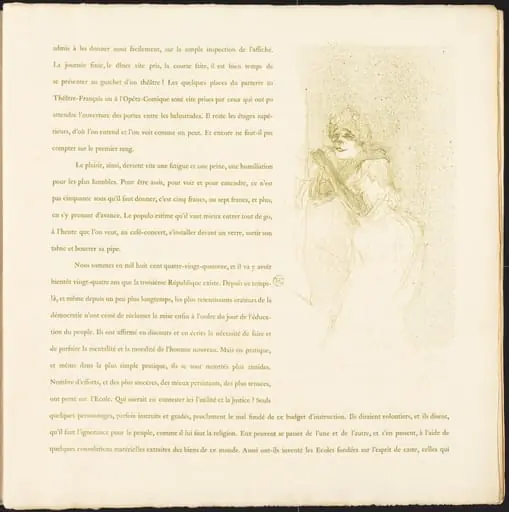
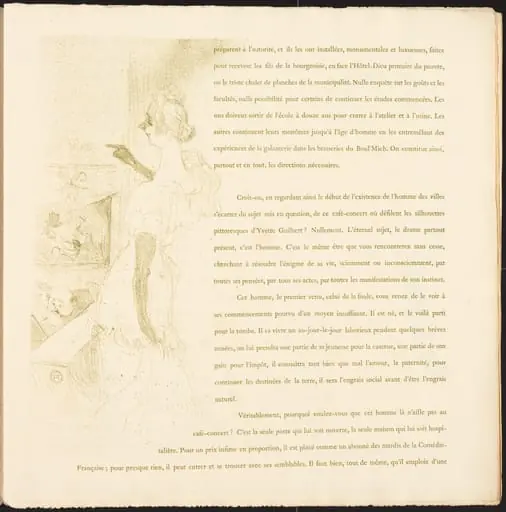
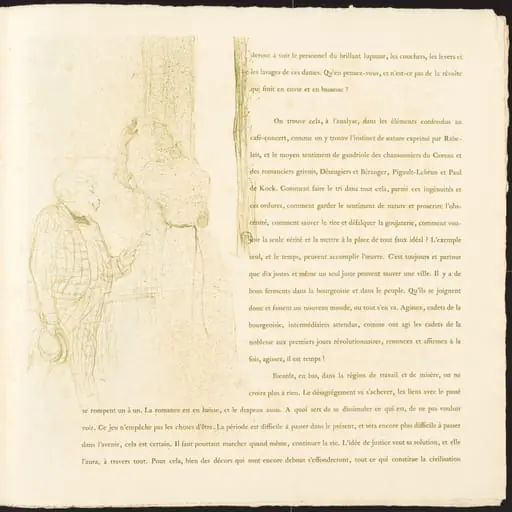
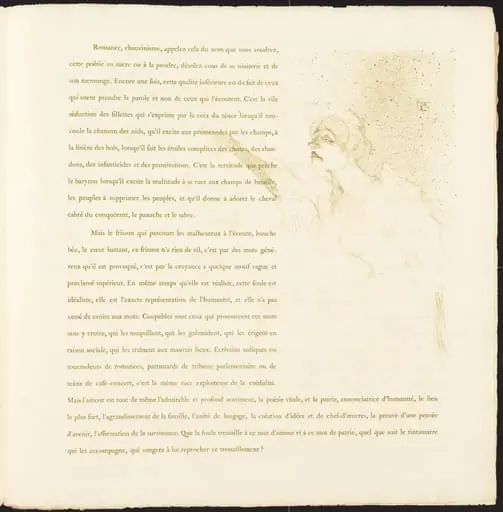
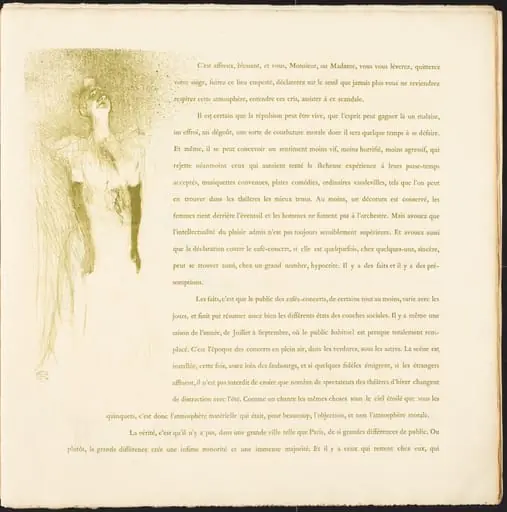
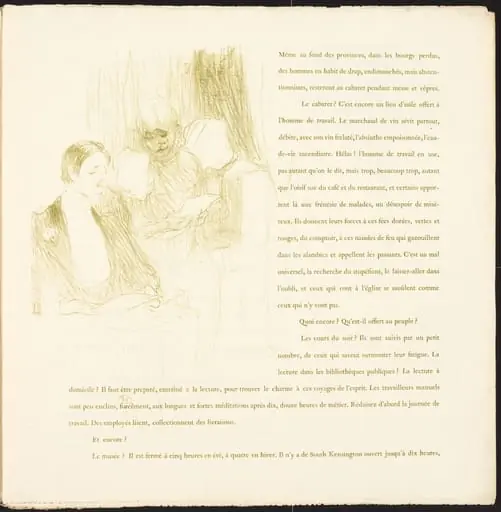
Yvette Guilbert is an ink print by the Impressionist artist Henri de Toulouse-Lautrec. It dates from 1894 and is held in the collection of the National Gallery of Art.
About this work
Overview
The absence of background or decorative elements directs attention entirely to the subject’s presence, emphasizing economy of form and expressive line.
Created in 1894, this lithograph by Henri de Toulouse-Lautrec depicts the French cabaret performer Yvette Guilbert in olive-green ink on paper. Executed in a reductive, linear manner, the print exemplifies Lautrec’s mastery of graphic media to capture fleeting moments of urban life. The absence of background or decorative elements directs attention entirely to the subject’s presence, emphasizing economy of form and expressive line.
Subject & Meaning
Yvette Guilbert, a celebrated singer known for her distinctive voice and theatrical persona, is portrayed mid-performance, caught in a moment of quiet alertness. Her turned body and angled head suggest both intimacy and distance—she is present yet removed, as if suspended between stage and spectator. The image conveys the psychological tension of public performance, revealing the artist’s interest in the inner life of entertainers beyond their public personas.
Technique & Style
Lautrec employed lithography to achieve sharp, gestural lines with minimal tonal variation, using only olive-green ink to define form. The sketch-like quality arises from uneven, deliberate strokes that avoid refinement, lending the image a sense of immediacy. The lack of shading or detail in the background isolates the figure, reinforcing the artist’s focus on contour and posture as carriers of emotional weight.
History & Provenance
This print was produced during Lautrec’s most active period in Parisian printmaking, when he regularly collaborated with publishers to distribute images of performers from Montmartre’s music halls. Though the exact initial distribution is undocumented, the work entered public collections in the early 20th century, reflecting growing recognition of lithography as a legitimate artistic medium beyond commercial reproduction.
Context
In the 1890s, Parisian cabarets like the Moulin Rouge became cultural hubs where artists, writers, and performers intersected. Lautrec, drawn to marginalized figures in these spaces, used lithography to document their lives with psychological depth. His depictions of singers like Guilbert challenged traditional portraiture by prioritizing authenticity over idealization, aligning with broader modernist shifts in visual culture.
Legacy
Lautrec’s approach to lithography influenced later generations of graphic artists by demonstrating how limited palettes and stripped-down compositions could convey psychological complexity. His portraits of performers helped elevate printmaking to the status of fine art, paving the way for 20th-century artists who embraced the medium for its directness and capacity for emotional resonance.
Artist & collection
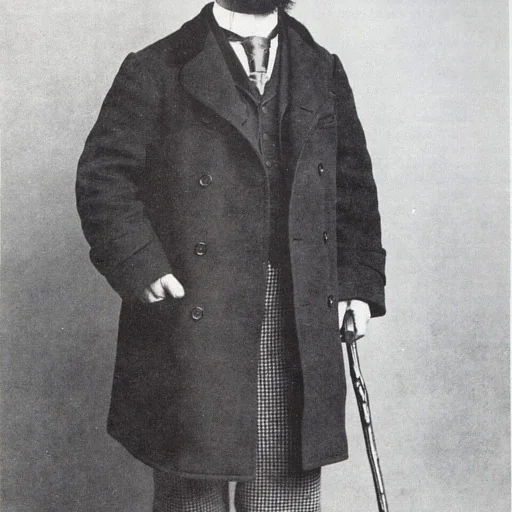
Artist
Comte Henri Marie Raymond de Toulouse-Lautrec-Montfa (24 November 1864 – 9 September 1901), known as Toulouse-Lautrec (French: ), was a French painter, printmaker, draughtsman, caricaturist, and illustrator.