Artwork
Bagpipe Players
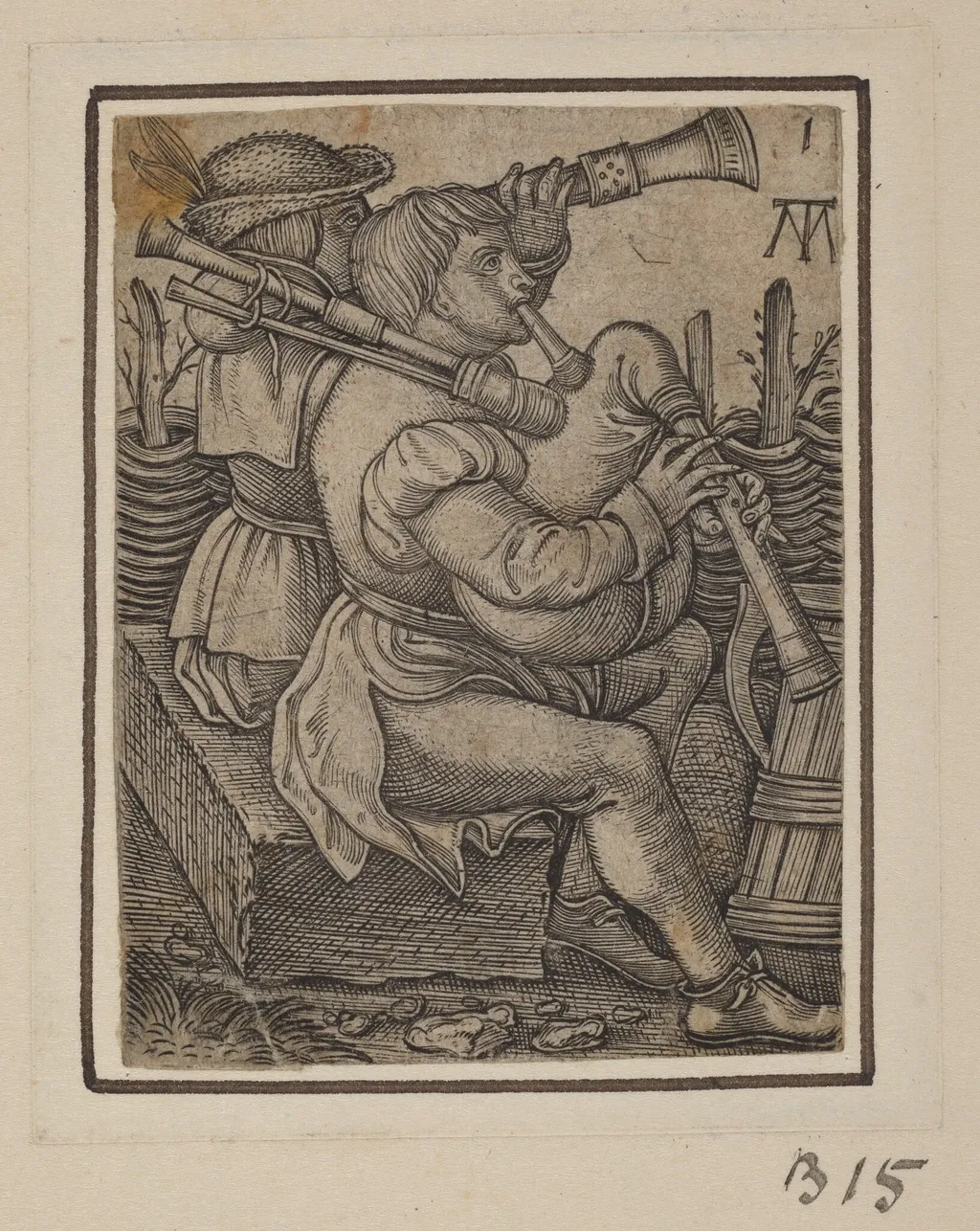
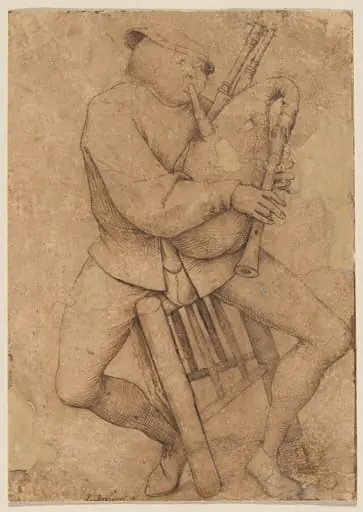
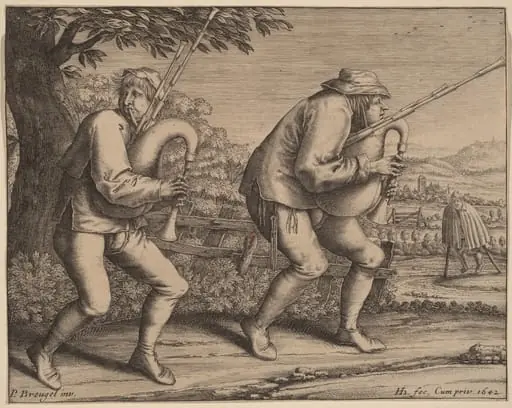
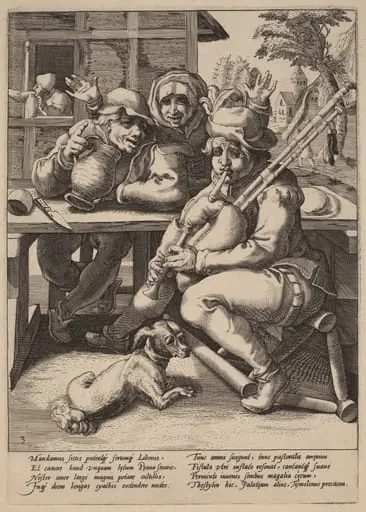
Bagpipe Players is an ink print by the Renaissance artist Martin Treu. It dates from 1540 and is held in the collection of the National Gallery of Art.
About this work
Overview
Rendered on laid paper, the work belongs to the tradition of Renaissance printmaking, where detailed line work replaced color to convey form and movement.
Created around 1540, this engraving by Martin Treu depicts two figures engaged in musical performance. Rendered on laid paper, the work belongs to the tradition of Renaissance printmaking, where detailed line work replaced color to convey form and movement. The composition centers on the figures’ energetic posture, with minimal background elements directing attention to their physicality and activity.
Subject & Meaning
The two figures, depicted with rounded, robust forms and bare feet, appear immersed in lively music-making. One plays a bagpipe while the other prepares to strike a drum, their expressions and gestures suggesting unrestrained joy. Their exaggerated physiques and disheveled clothing hint at folk or lower-class associations, common in period depictions of rural entertainers, possibly reflecting contemporary interest in everyday life beyond aristocratic subjects.
Technique & Style
Treu employed fine, intersecting lines—cross-hatching—to model volume and texture without pigment. The dense, irregular strokes define fabric folds, skin contours, and the roughness of the ground, creating a tactile, energetic surface. This method, typical of Northern Renaissance engraving, prioritized linear precision over atmospheric perspective, emphasizing the figures’ physical presence through rhythmic mark-making.
History & Provenance
The print’s early 16th-century origin places it within a flourishing market for reproductive and genre prints in Central Europe. While no specific early ownership records are documented, similar works by Treu circulated among collectors and artisans, serving both decorative and instructional purposes. Its survival suggests it was valued for its lively subject and technical skill, though it remains less studied than major Renaissance masters.
Context
During the 1540s, German and Netherlandish printmakers increasingly turned to scenes of peasant life, influenced by humanist interest in observation and vernacular culture. Treu’s work aligns with this trend, echoing artists like Bruegel in capturing unidealized figures in motion. The absence of religious or mythological themes signals a shift toward secular, observational art, supported by advances in print technology and urban demand for accessible imagery.
Legacy
Though not widely reproduced in later centuries, the engraving exemplifies the technical capabilities of Renaissance line engraving and the period’s fascination with bodily expression in mundane settings. Its raw, unpolished aesthetic contrasts with idealized classical forms, offering insight into how ordinary life was visually encoded in early modern Europe. It remains a modest but instructive example of genre printmaking’s evolving role.
Artist & collection