Artwork
Platforma industrială Tulcea
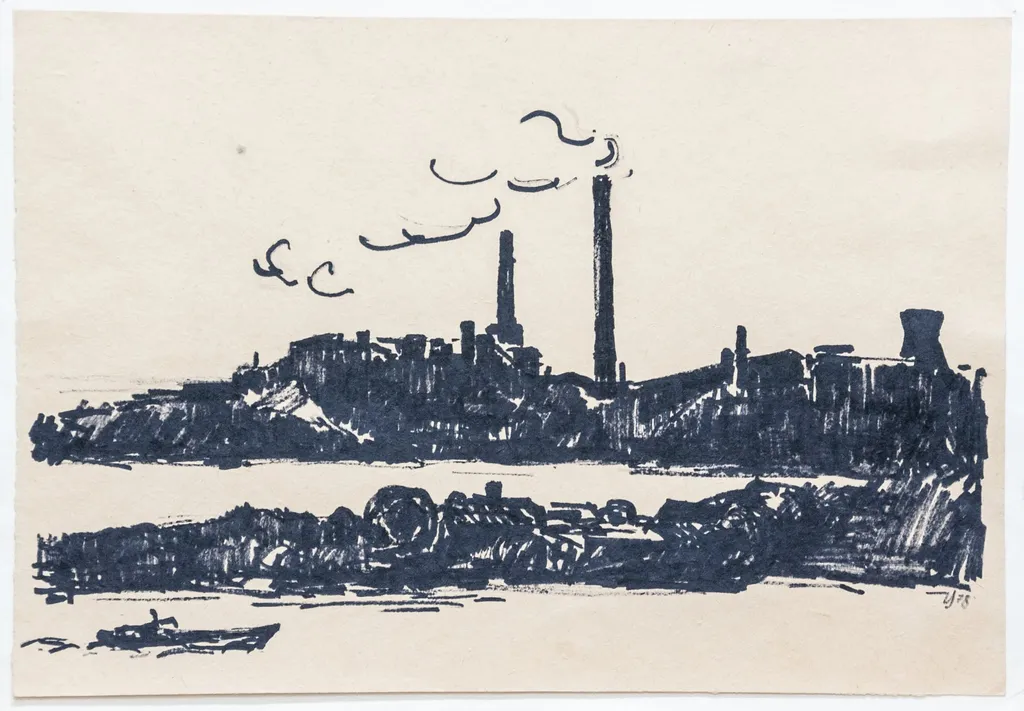
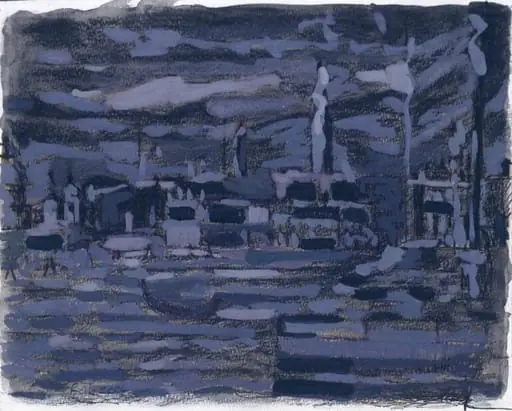
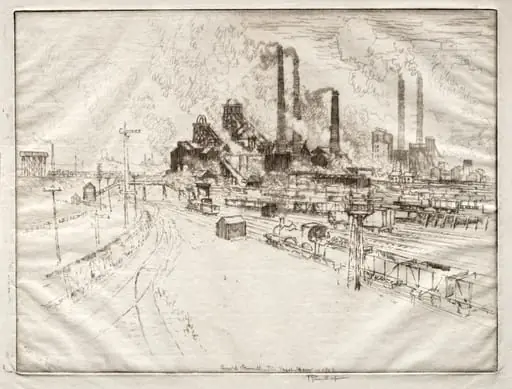
Platforma industrială Tulcea is a drawing by Vladimir Șulschi. It dates from 1950 and is held in the collection of the Gavrila Simion Eco-Museum Research Institute Tulcea.
About this work
Overview
The composition emphasizes vertical forms—smokestacks and buildings—over human presence, conveying a sense of mechanical dominance over the landscape.
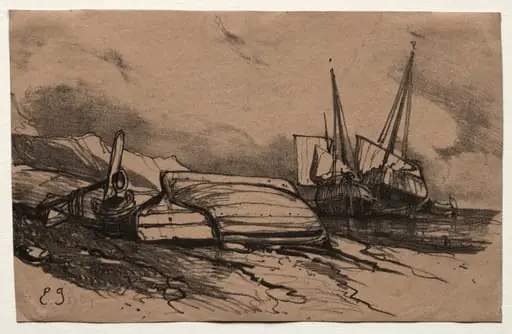
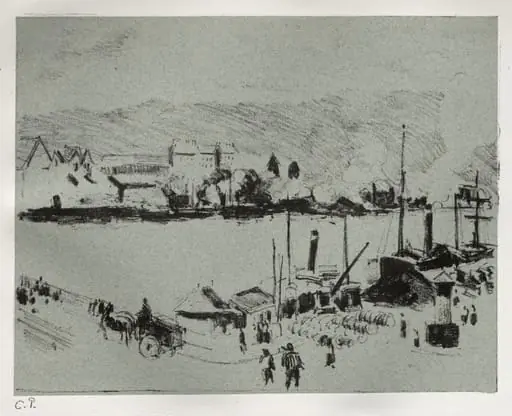
Created around 1950 by Vladimir Șulschi, this ink sketch depicts an industrial site in Tulcea. Rendered in monochrome with rapid, uneven lines, the work captures the dense, chaotic architecture of a factory complex. The composition emphasizes vertical forms—smokestacks and buildings—over human presence, conveying a sense of mechanical dominance over the landscape. A faint boat in the lower corner suggests proximity to water, grounding the scene in its riverine context.
Subject & Meaning
The drawing portrays a working industrial zone, likely tied to Romania’s postwar economic priorities. The overwhelming scale of smokestacks and structures implies the centrality of heavy industry during this period. The minimal detail given to the boat and absence of figures underscore a focus on infrastructure rather than labor or life. The hazy, smoky atmosphere may reflect both physical conditions and the era’s ideological emphasis on industrial progress.
Technique & Style
Șulschi employed dense, gestural ink strokes to construct form and shadow, using heavy cross-hatching to deepen areas of contrast. The sketch’s loose, almost hurried lines suggest immediacy, as if drawn on-site. Shadows are built through layered marks rather than smooth gradients, creating a textured, tactile surface. The lack of fine detail and the dominance of dark tones reinforce the somber, oppressive mood of the industrial environment.
History & Provenance
The work is held in the collection of the Museum of Ethnography, indicating its value as a document of social and economic conditions rather than purely aesthetic expression. Its survival suggests it was preserved as part of a broader effort to record Romania’s industrial transformation in the early decades of the communist period. No earlier provenance is documented, but its style aligns with mid-century documentary sketching practices.
Context
In the early 1950s, Romania underwent rapid industrialization under state planning, with cities like Tulcea becoming hubs for transport and manufacturing along the Danube. This sketch reflects the visual reality of that transformation—factories rising amid older, smaller settlements. The artist’s focus on structure over people mirrors official narratives that prioritized output and modernization over individual experience.
Legacy
As a modest, unpolished sketch, the work resists grand artistic claims but offers a direct visual record of a pivotal era. It contributes to understanding how artists engaged with state-driven industrialization—not as celebrants, but as observers of its physical and emotional weight. Its preservation in an ethnographic museum affirms its role as cultural testimony rather than fine art.
Artist & collection
Artist
Vladimir Șulschi kept his sketchbook in his back pocket like a Swiss Army knife—always ready to jot down something seen from a moving train or a factory fence.
Museum
Gavrila Simion Eco-Museum Research Institute Tulcea
Continue through works from the same source collection.