Artwork
Henry de Lorraine, Third Duc de Guise
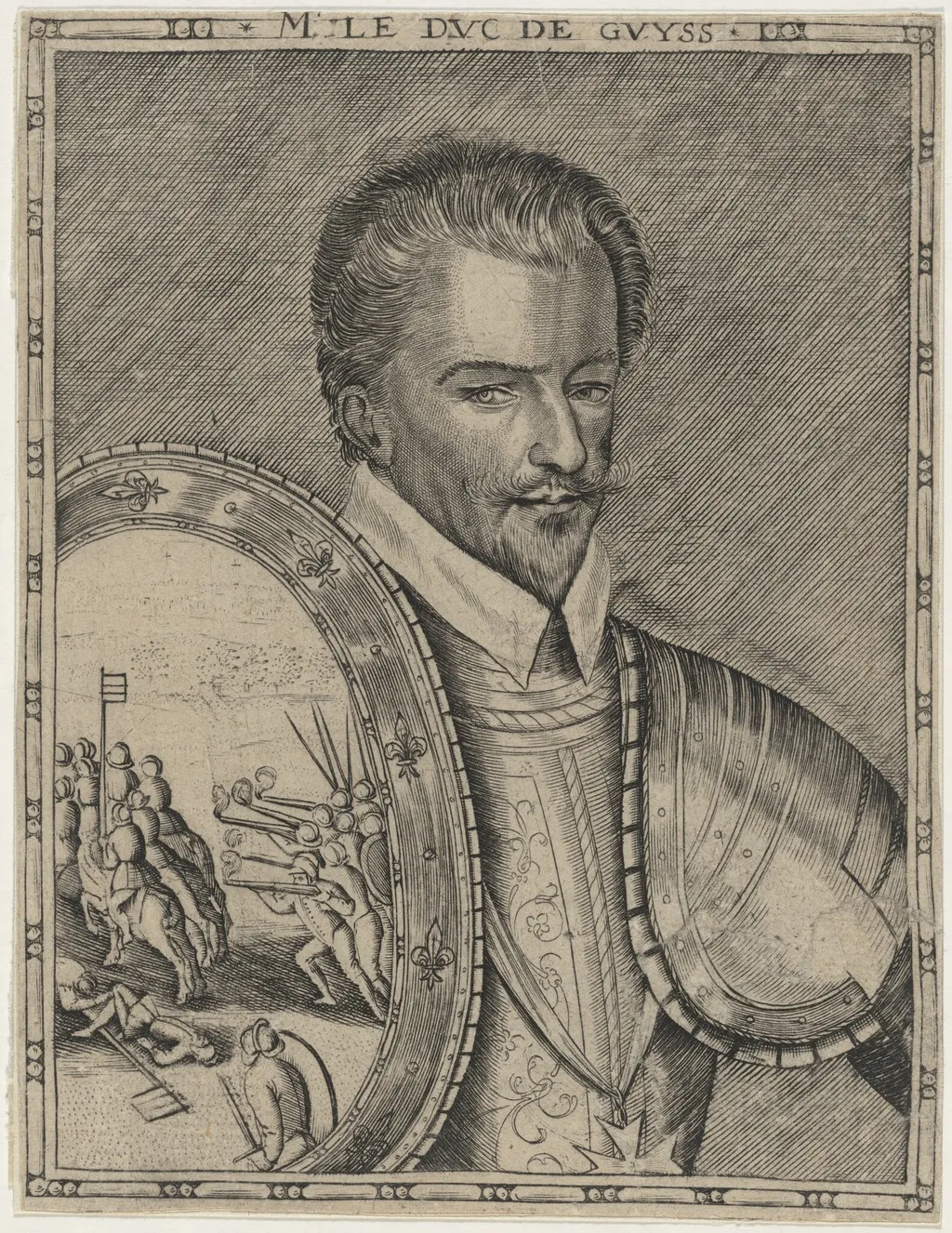
Henry de Lorraine, Third Duc de Guise is an ink print by the Romanticist artist Unknown 19th Century. It dates from 1850 and is held in the collection of the National Gallery of Art. The print depicts Henry de Lorraine, the third Duke of Guise, rendered in a monochrome engraving.
About this work
Overview
The print depicts Henry de Lorraine, the third Duke of Guise, rendered in a monochrome engraving. He is shown in elaborate armor with a ruffled collar, his expression solemn, his hair dark and his beard trimmed short. Behind him rests a shield bearing a family crest and a key-shaped emblem, positioned on a ledge.
Technique & Style
The image is created through fine cross‑hatching, a method of layering closely spaced parallel lines to suggest tonal variation and three‑dimensional form. This approach gives the portrait a crisp, detailed texture, especially evident in the rendering of metal, fabric folds, and the decorative elements of the shield.
Subject & Meaning
The portrait presents the duke as a martial figure, emphasizing his noble status through the ornate armor and heraldic symbols. The inclusion of the shield and key motif underscores his lineage and authority, while the serious facial expression conveys a sense of duty and gravitas associated with his rank.
History & Provenance
The engraving bears the inscription “M. le Duc de Guyss,” identifying its subject and confirming its French origin. As a printed work, it would have been reproduced for circulation among the aristocracy and collectors, serving both as a visual record of the duke’s appearance and as a symbol of his prestige.
Artist & collection

Artist