Artwork
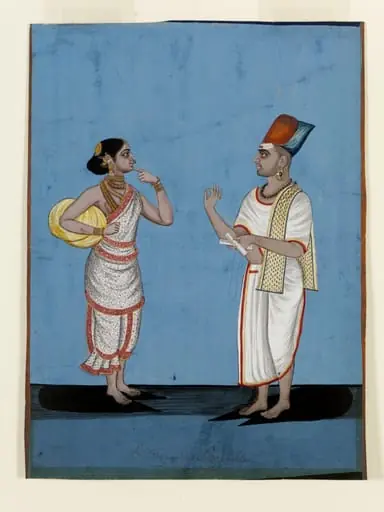
A beggar and his wife
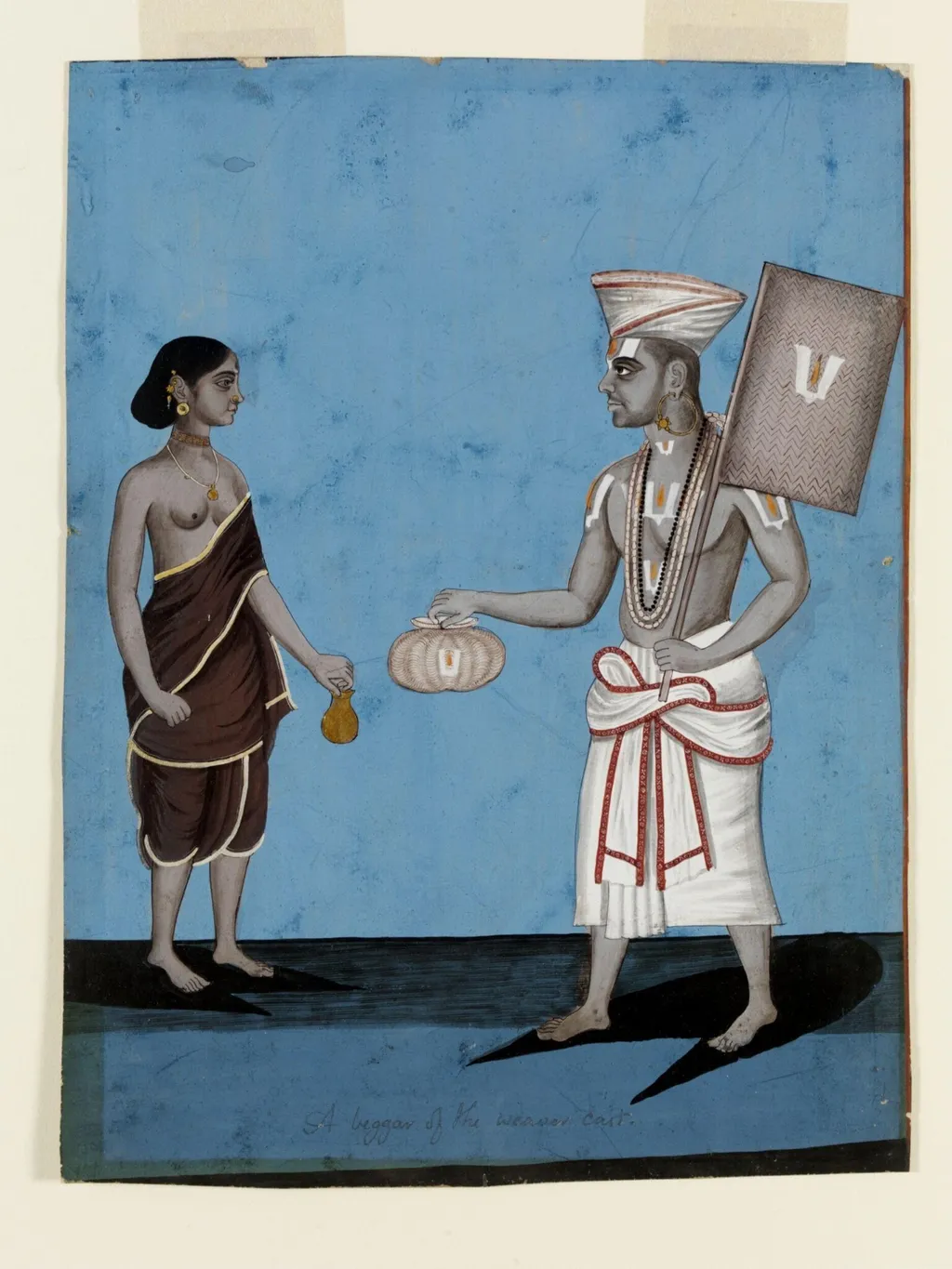
A beggar and his wife is a paint painting by the Romanticist artist Unknown. It dates from 1790 and is held in the collection of the Victoria and Albert Museum. This painting is one of sixteen works depicting Indian castes and professions, part of a series created to document social roles.
About this work
Overview
This painting is one of sixteen works depicting Indian castes and professions, part of a series created to document social roles.
This painting is one of sixteen works depicting Indian castes and professions, part of a series created to document social roles. The composition presents two figures—a man and a woman—posed against a uniform blue backdrop. Their attire and attributes suggest a life of itinerant poverty, aligning with the work’s title. The series includes contributions from two artists, identifiable by variations in background color.
Subject & Meaning
The figures represent a beggar and his spouse, rendered with minimal narrative context. The man’s white garment, Vaishnava markings, and basket imply religious mendicancy, while the woman’s dark wrap and vessel hint at domestic labor. Their bare feet and modest possessions underscore economic hardship. The inclusion of a shield with a faint mark may reference a specific community or symbolic protection, though its exact significance remains ambiguous.
Technique & Style
Executed in a flat, linear style, the painting emphasizes clarity over realism. The figures are outlined with precision, their forms simplified against an unmodulated background. Color is applied in broad, even strokes, with limited shading to suggest volume. The restrained palette—white, brown, and blue—reflects the series’ documentary intent, prioritizing legibility of costume and occupation over atmospheric effects.
History & Provenance
The work entered the collection in 1879, transferred from the India Museum. It was part of a set of four framed paintings donated by P. F. Campbell-Johnston. The series’ dual authorship is inferred from variations in background hues, though individual attributions remain uncertain. Its acquisition reflects 19th-century European interest in ethnographic representations of Indian society.
Context
Produced during a period of colonial administration, such paintings served as visual records of Indian social hierarchies. They were often commissioned or collected by British officials, merchants, or scholars seeking to catalog cultural practices. The plain backgrounds and standardized poses align with classificatory traditions, distancing the subjects from individual identity while emphasizing their role as typological specimens.
Legacy
The painting contributes to broader understandings of 19th-century ethnographic art, illustrating how colonial perspectives shaped visual documentation. Its inclusion in museum collections highlights the tension between observation and interpretation in representations of marginalized communities. The series remains a reference point for studies of caste, occupation, and colonial visual culture in South Asia.
Artist & collection

 Domestic Scene
 Giacomo and Cardinal Marco, investing Andrea, Abbot of San Zeno, with his Benefice
 The Nymph of Fontainebleau
 Portrait of a Woman
 Madonna and Child with Saints in the Enclosed Garden
 Venus and Minerva
 Family Group of Four on Sofa
 Wall painting from Room H of the Villa of P. Fannius Synistor at Boscoreale
 A carpenter and his wife
 Bangle-seller and his wife
 A locksmith and his wife
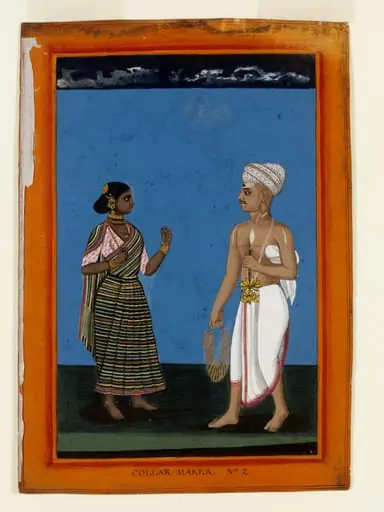 A necklace-seller and his wife
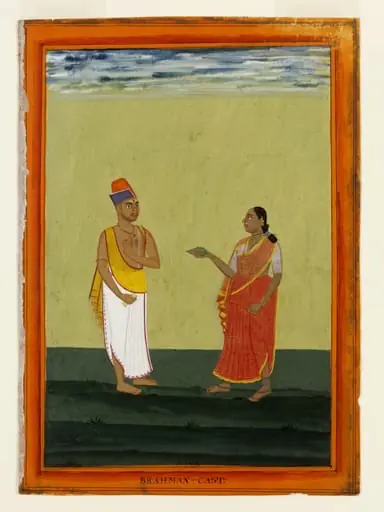 A Brahmin fortune-teller and his wife
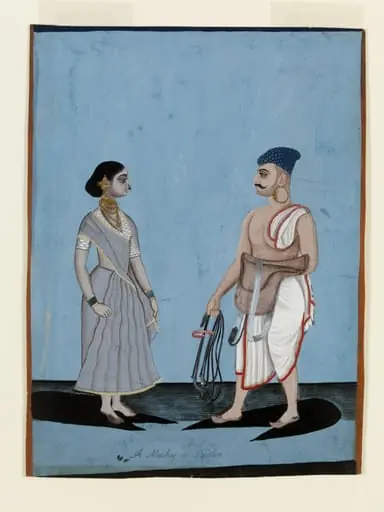 A saddler and his wife
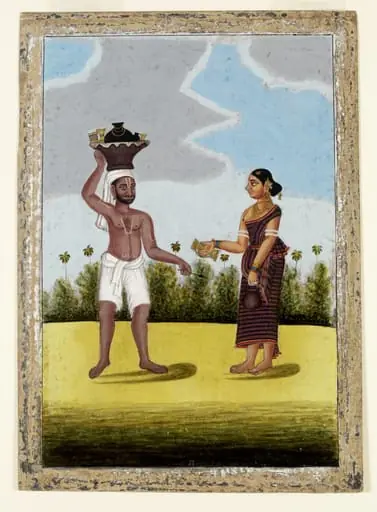 An oil-seller and his wife
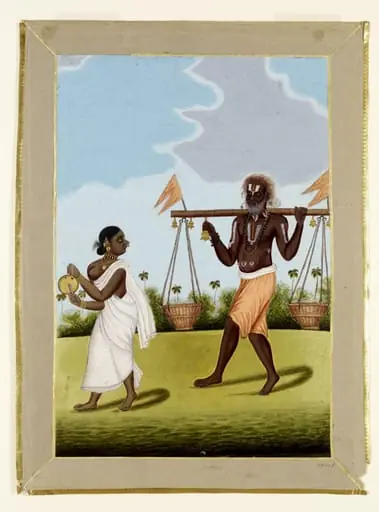 A holy-water-carrier and his wife
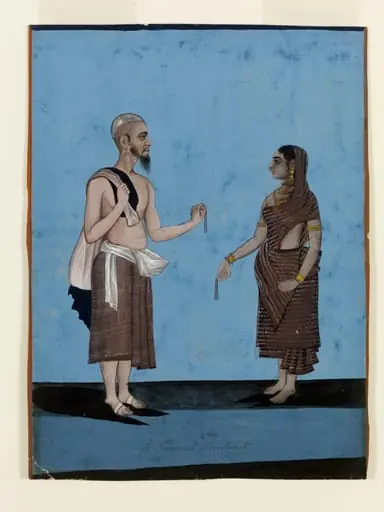 Lubbee pedlars
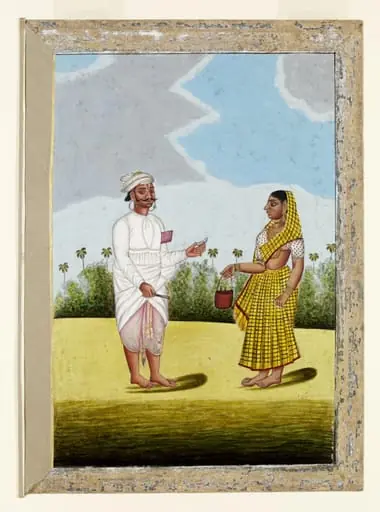 A barber and his wife
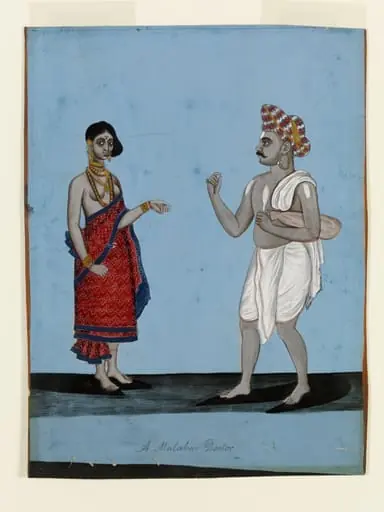 A Malabar doctor and his wife
 A Brahmin story-teller and his wife