Artwork
A nautch
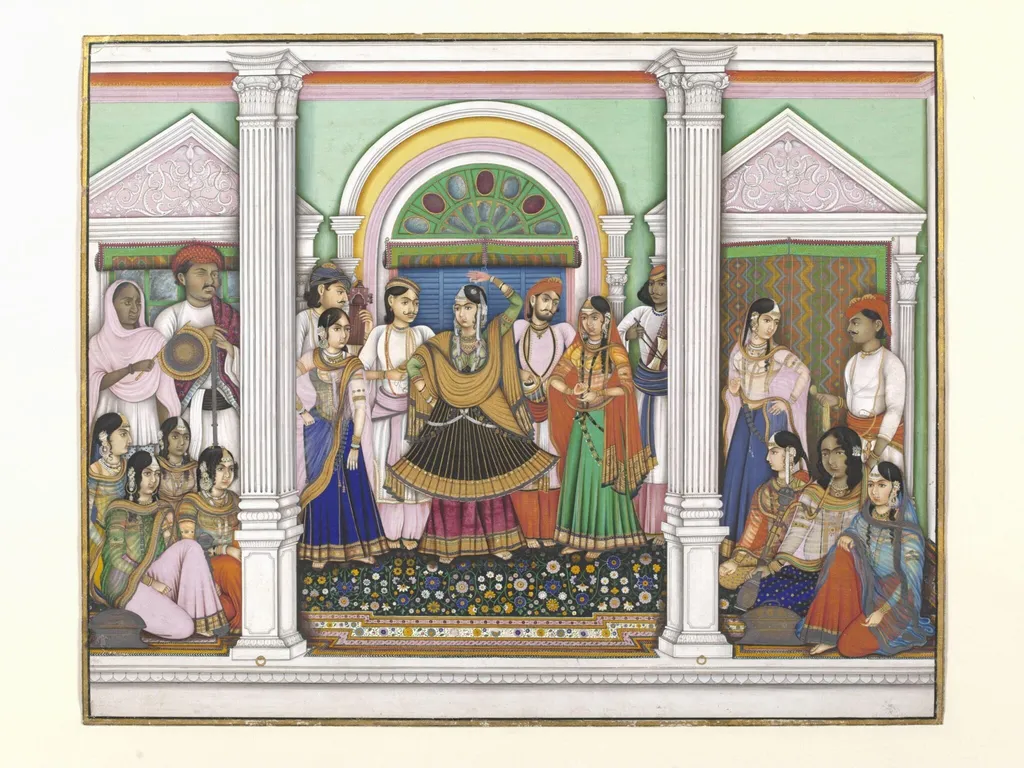
A nautch is a paint painting by the Patna School of Painting artist Unknown. It dates from 1820 and is held in the collection of the Victoria and Albert Museum.
About this work
These works mixed Indian subjects with European styles—like the mansion’s stained-glass fanlight above the door.
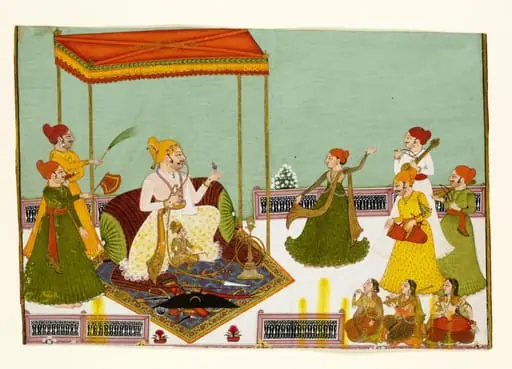
This painting shows a nautch girl dancing on a veranda. Six musicians sit behind her playing drums and flutes. Two women watch from the sides while others wait in the background.
It’s a “Company painting” made for British officials in Delhi around 1820. These works mixed Indian subjects with European styles—like the mansion’s stained-glass fanlight above the door.
Check out more Company paintings at the Victoria and Albert Museum.
Overview
Created in Delhi circa 1820, this work belongs to the genre known as Company painting, a hybrid style produced by Indian artists for European patrons, particularly officials of the British East India Company. The composition centers on a nautch dancer performing on the veranda of a residence that incorporates European architectural elements such as a stained‑glass fanlight.
Subject & Meaning
The central figure is a professional dancing girl, or nautch performer, a term derived from the Hindi and Marathi word for dance. She is accompanied by a small ensemble of musicians—four men and two women—who provide rhythmic and melodic support, while additional dancers and attendants occupy the periphery, suggesting a staged entertainment for an audience of colonial residents.
Technique & Style
The painting merges traditional Indian decorative motifs with Western conventions of perspective and shading. The use of linear perspective to render the veranda and the detailed rendering of the stained‑glass fanlight reflect European influence, while the vivid coloration and ornamental patterns remain rooted in Indian artistic practice.
History & Provenance
Commissioned for British officials stationed in Delhi, the work exemplifies the commercial production of such images, which were often sold in local bazaars as well as ordered directly. It reflects the cultural exchange and visual documentation of colonial life during the early nineteenth century.
Context
Company paintings served as visual records of Indian customs for European audiences, translating native performances like the nautch into a format familiar to Western eyes. The inclusion of a European‑style mansion underscores the blending of domestic spaces and cultural practices under colonial rule.
Artist & collection

 Domestic Scene
 Giacomo and Cardinal Marco, investing Andrea, Abbot of San Zeno, with his Benefice
 The Nymph of Fontainebleau
 Portrait of a Woman
 Madonna and Child with Saints in the Enclosed Garden
 Venus and Minerva
 Family Group of Four on Sofa
 Wall painting from Room H of the Villa of P. Fannius Synistor at Boscoreale