Artwork
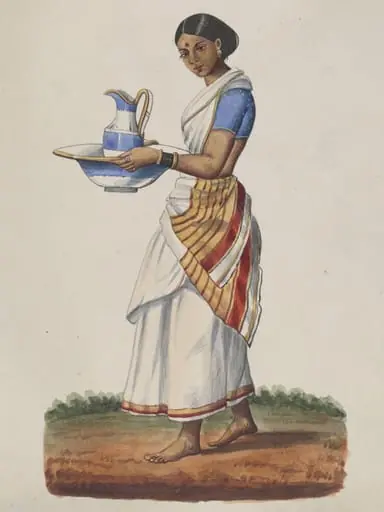
A South-Indian Woman
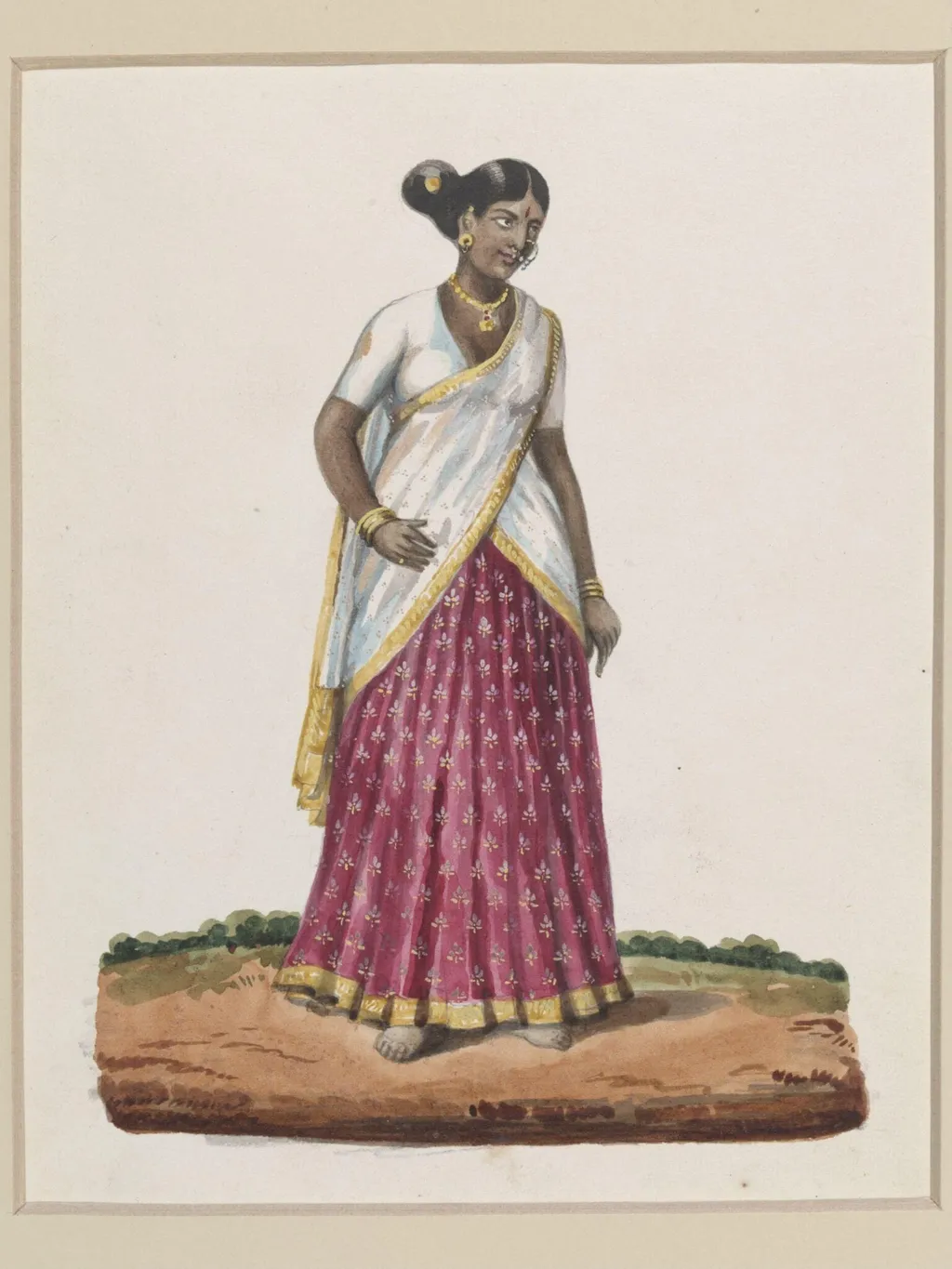
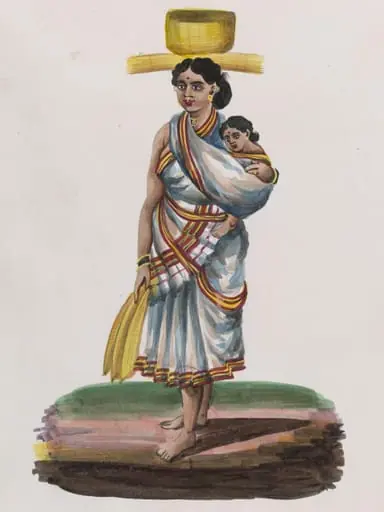
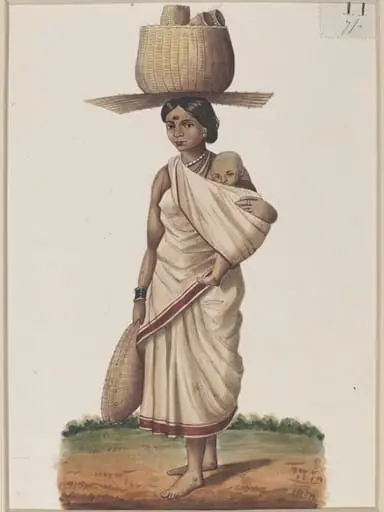
A South-Indian Woman is a paint painting by the Patna School of Painting artist Unknown. It dates from 1860 and is held in the collection of the Victoria and Albert Museum.
About this work
Overview
The work portrays a South‑Indian woman standing on a modest patch of earth, dressed in a white sari edged with gold and a red skirt patterned with gold and white floral motifs. Her dark hair is gathered in a bun, and she wears gold earrings, a necklace, and bracelets. The figure’s gaze is lowered, her right hand rests on her hip while the left hangs at her side, against a plain beige backdrop.
Subject & Meaning
The sitter is likely an ayah, a domestic caregiver common in colonial households, representing the everyday labor force of the period. By focusing on a single individual rather than an idealized portrait, the image records the attire, posture, and social role of women employed in service, offering insight into gendered work and cultural dress in mid‑nineteenth‑century South India.
Technique & Style
Executed in watercolor on paper, the piece employs the precise line work and muted palette characteristic of Company painting, a genre that merged Indian artistic traditions with European realism. The rendering emphasizes accurate anatomical proportions and detailed costume ornamentation, while the flat background and restrained shading reflect the influence of British patronage on local artists seeking to document colonial life.
History & Provenance
Created around 1860 in Trichinopoly (present‑day Tiruchirappalli), the painting belongs to a series of fifteen images each depicting a different occupation. The series was produced under the auspices of British officials who commissioned Indian artists to illustrate the social landscape of their territories, a practice that facilitated the exchange of visual conventions between the two cultures.
Context
During the mid‑nineteenth century, Indian artists working for the East India Company adopted European techniques to satisfy colonial demand for documentary images. This shift toward realism marked a departure from earlier, more stylized courtly art, aligning the works with the broader trend of visual ethnography that sought to catalog the diverse peoples and professions of the British Empire.
Artist & collection

 Domestic Scene
 Giacomo and Cardinal Marco, investing Andrea, Abbot of San Zeno, with his Benefice
 The Nymph of Fontainebleau
 Portrait of a Woman
 Madonna and Child with Saints in the Enclosed Garden
 Venus and Minerva
 Family Group of Four on Sofa
 Wall painting from Room H of the Villa of P. Fannius Synistor at Boscoreale