Artwork
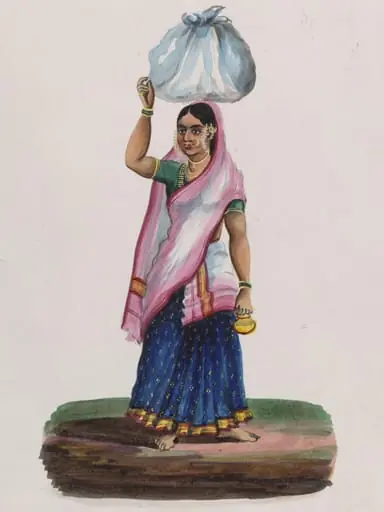
An ayah in a blue choli carrying a china ewer and basin
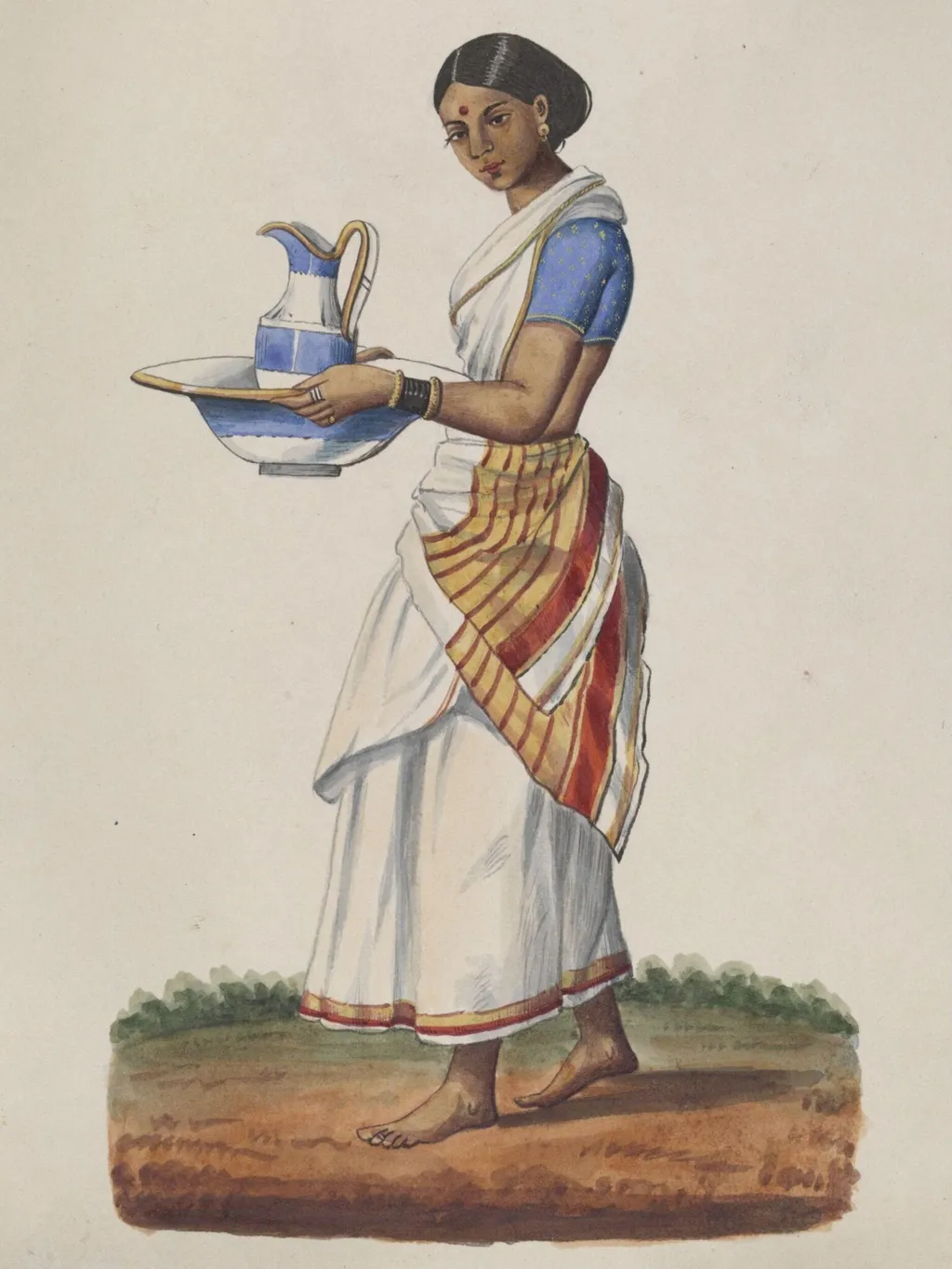
An ayah in a blue choli carrying a china ewer and basin is a watercolor work on paper by the Patna School of Painting artist Unknown. It dates from 1860 and is held in the collection of the Victoria and Albert Museum.
About this work
Overview
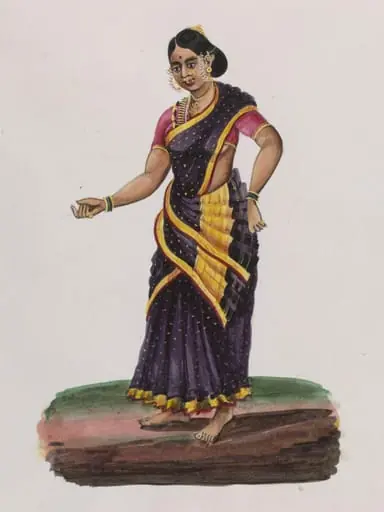
This watercolour depicts an ayah, or nursemaid, standing barefoot on a patch of grass, holding a silver tray with a blue-and-white porcelain pitcher and basin.
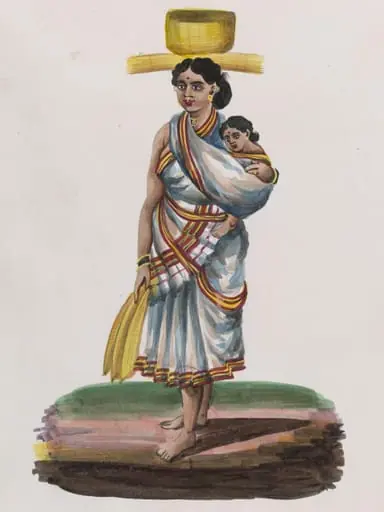
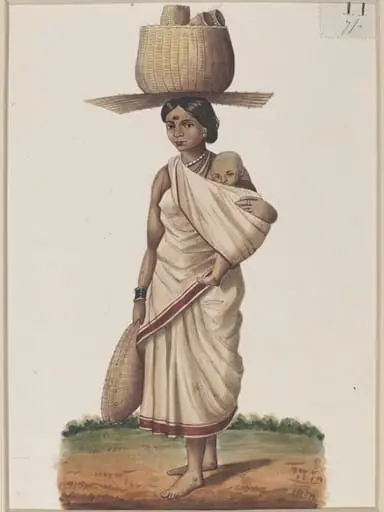
This watercolour depicts an ayah, or nursemaid, standing barefoot on a patch of grass, holding a silver tray with a blue-and-white porcelain pitcher and basin. Rendered in delicate brushwork, the figure is set against a minimalist background defined by a single horizon line. The work belongs to a series of fifteen illustrations documenting daily occupations in Trichinopoly, South India, produced during the early 19th century under British colonial influence.
Subject & Meaning
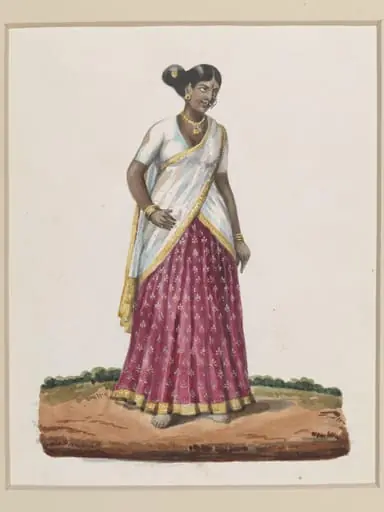
The ayah is portrayed not as an idealized figure but as a working woman in practical attire: a blue choli with gold detailing, a white skirt, and a striped shoulder cloth. Her calm expression and steady hands suggest dignity in labor. The presence of the china ewer and basin—likely used for washing children—hints at her role in domestic care. The image avoids romanticism, focusing instead on the quiet routine of service in a colonial household.
Technique & Style
The artist uses transparent watercolour with precise, linear detail, reflecting European academic training adapted to Indian subjects. The flat, unadorned background isolates the figure, emphasizing form and texture. Colors are bright but restrained, with the blue of the choli and porcelain contrasting against the white ground. Brushwork is controlled, capturing fabric folds and ceramic glaze without embellishment, aligning with the observational goals of Company painting.
History & Provenance
Created in Trichinopoly around the 1820s, this piece is one of fifteen in a series commissioned by British residents to document local professions. Such works were often compiled into albums for European collectors, serving as ethnographic records. The artist, likely trained in a local atelier familiar with both Mughal miniaturist traditions and Western perspective, produced these images for a colonial market seeking authentic depictions of Indian life.
Context
Company painting emerged as a hybrid style under British patronage, blending Indian techniques with European realism. While traditional Indian art often featured elaborate settings and symbolism, these works prioritized clarity and detail for foreign viewers. The ayah’s plain clothing and unadorned environment reflect a shift toward documenting everyday roles rather than courtly or religious themes, aligning with colonial interests in categorizing social functions.
Legacy
This watercolour contributes to a broader archive of colonial-era visual documentation, offering insight into the lives of service workers often excluded from official histories. Its preservation in institutions like the Victoria and Albert Museum underscores its value as a record of cross-cultural artistic exchange. Though produced for a colonial audience, the image retains the quiet humanity of its subject, resisting caricature through its restrained realism.
Artist & collection

 Domestic Scene
 Giacomo and Cardinal Marco, investing Andrea, Abbot of San Zeno, with his Benefice
 The Nymph of Fontainebleau
 Portrait of a Woman
 Madonna and Child with Saints in the Enclosed Garden
 Venus and Minerva
 Family Group of Four on Sofa
 Wall painting from Room H of the Villa of P. Fannius Synistor at Boscoreale