Artwork
Abdul Qadir Gilani
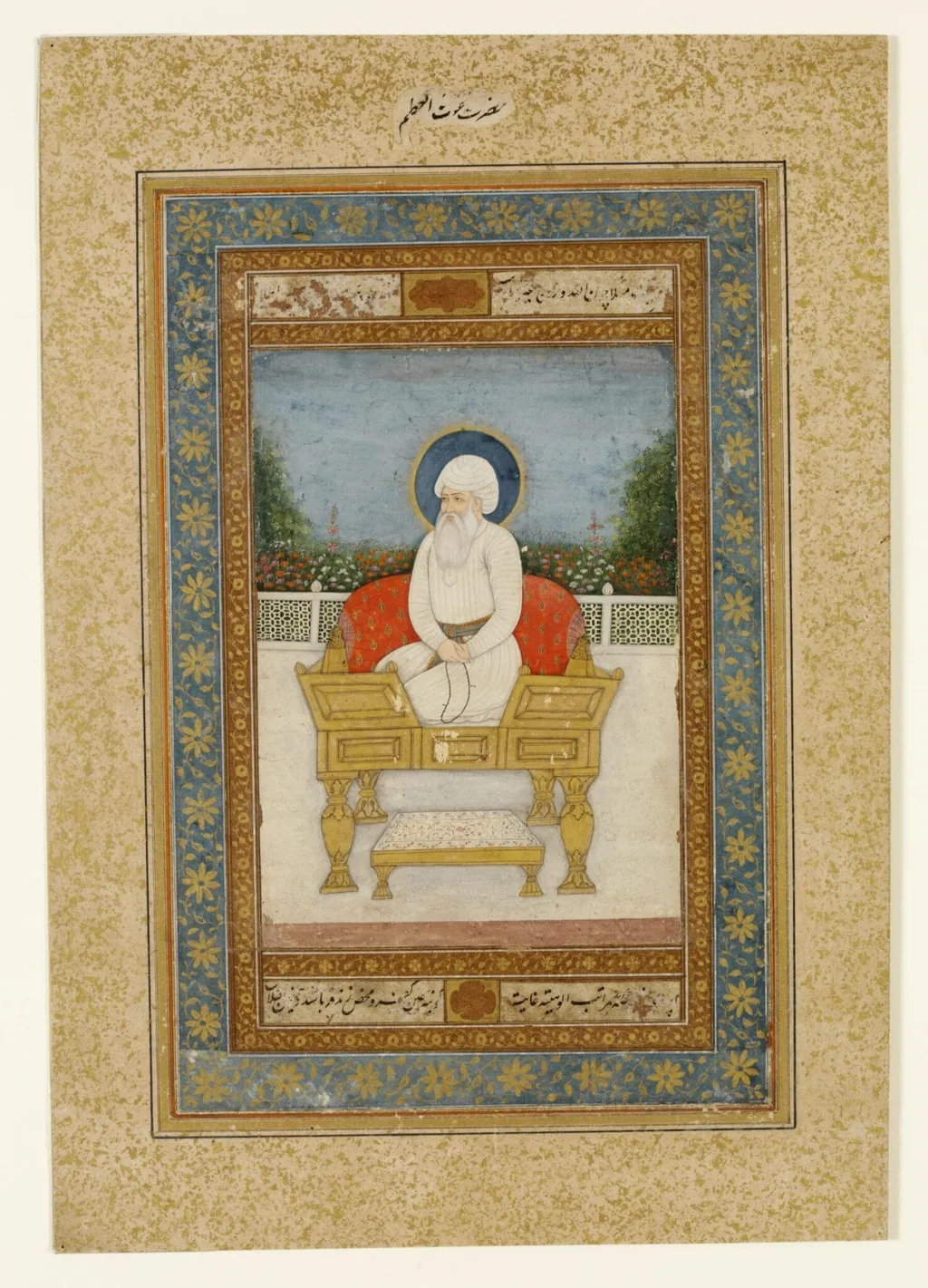
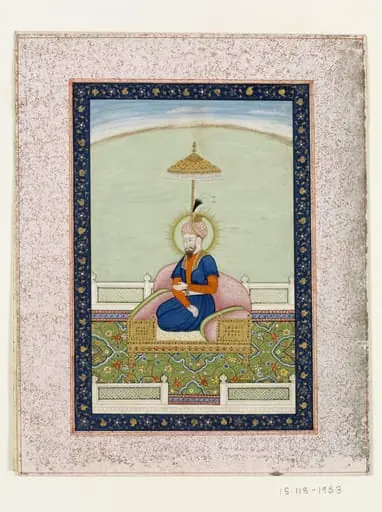
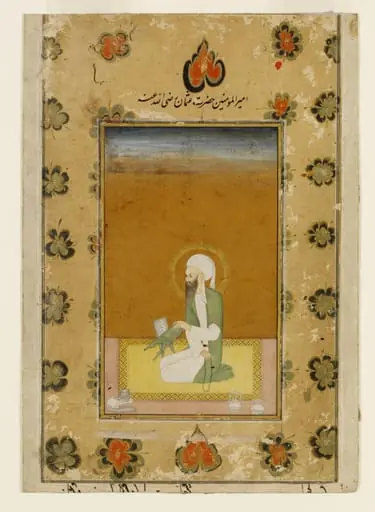
Abdul Qadir Gilani is a paint painting by Unknown. It dates from 1750 and is held in the collection of the Victoria and Albert Museum. The work is a mid‑18th‑century portrait executed in opaque watercolor and gold on paper.
About this work
Overview
The work is a mid‑18th‑century portrait executed in opaque watercolor and gold on paper. It presents the revered figure Abdul Qadir Gilani, an Iranian Sufi saint who lived between 1078 and 1166, seated upon an elaborately gilded throne. The composition is framed by decorative borders in blue, gold and red, and includes a modest inscription along the edges.
Subject & Meaning
Abdul Qadir Gilani is depicted as an elderly man with a white beard and turban, clothed in white robes. He holds a rosary in his folded hands, a traditional symbol of piety, while a blue halo encircles his head, indicating sanctity. A small stepping stool rests on the floor, suggesting accessibility to the holy figure.
Technique & Style
The artist employed opaque watercolor combined with gold leaf to achieve a luminous surface. The figure’s features are rendered with delicate brushwork, while the throne’s carved golden legs and red cushions are highlighted through fine detailing. The background garden, rendered in soft washes, provides a tranquil contrast to the richly ornamented foreground.
History & Provenance
Created around 1750, the painting reflects the Persian artistic tradition of venerating saints through portraiture. Its provenance traces back to private collections before entering a public institution, where it now resides as part of a broader assemblage of Islamic devotional art.
Context
During the 18th century, depictions of Sufi saints served both devotional and didactic purposes, reinforcing the spiritual lineage of the Qadiriyya order founded by Gilani. The inclusion of a garden setting aligns with Persian iconography that associates paradise and divine favor with holy figures.
Artist & collection

 Domestic Scene
 Giacomo and Cardinal Marco, investing Andrea, Abbot of San Zeno, with his Benefice
 The Nymph of Fontainebleau
 Portrait of a Woman
 Madonna and Child with Saints in the Enclosed Garden
 Venus and Minerva
 Family Group of Four on Sofa
 Wall painting from Room H of the Villa of P. Fannius Synistor at Boscoreale