Artwork
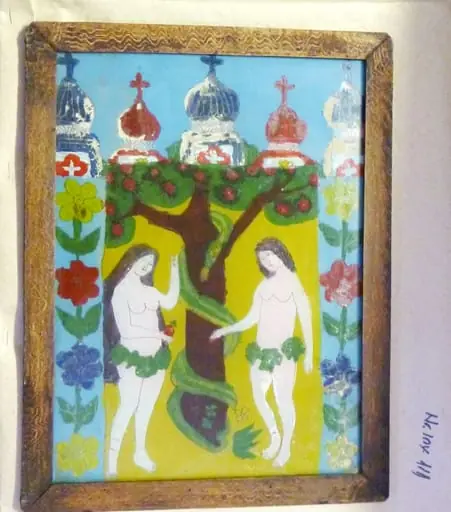
Adam si Eva
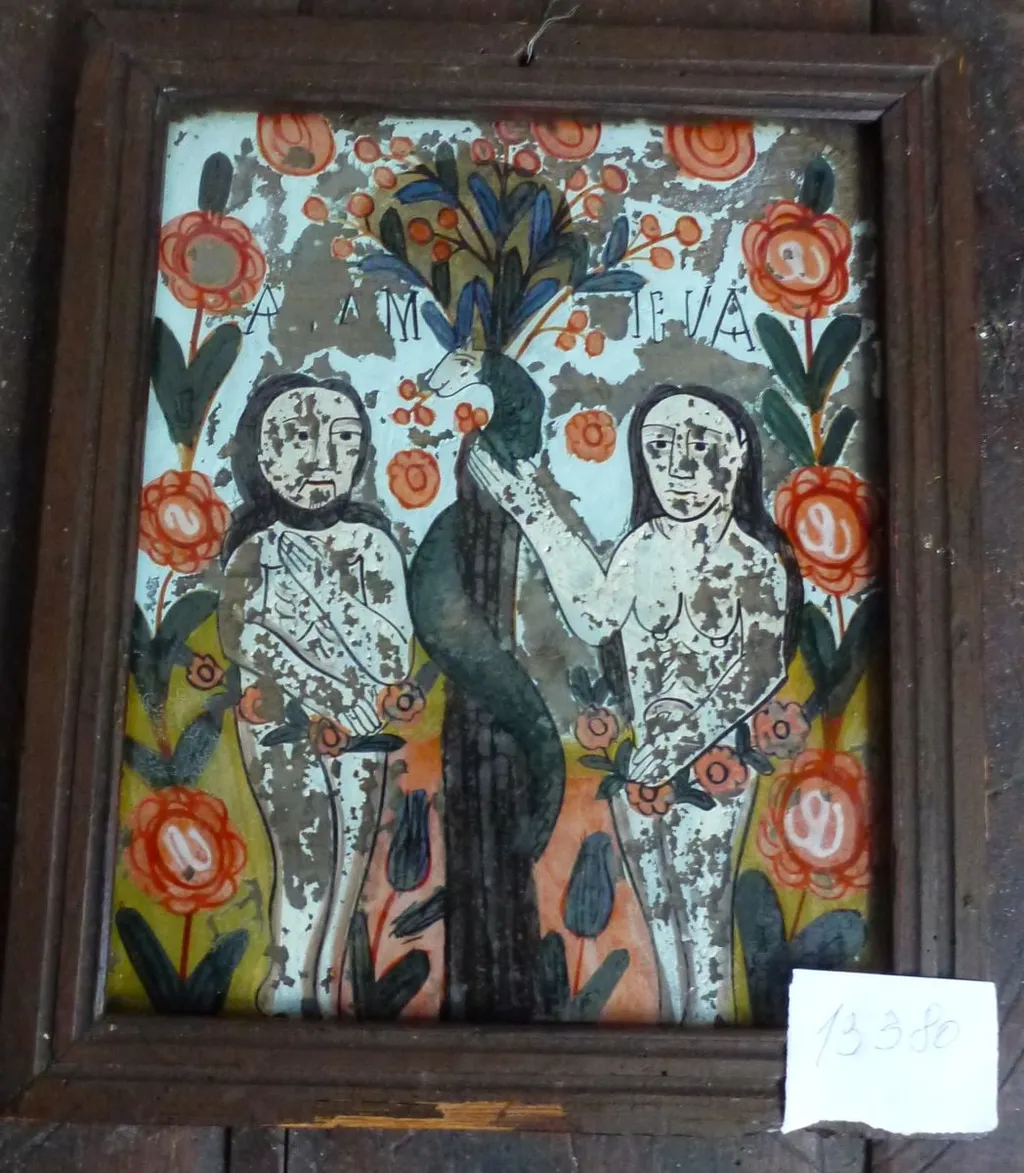
Adam si Eva is a drawing by Unknown. It dates from 1850 and is held in the collection of the Bistrita-Năsăud Museum Complex. This drawing depicts Adam and Eve in a garden setting, rendered in a straightforward folk-art manner.
About this work
Overview
This drawing depicts Adam and Eve in a garden setting, rendered in a straightforward folk-art manner. The figures are shown nude, positioned side by side amid stylized flora. Bold outlines and unmodulated colors define their forms, while a dark wooden frame encloses the composition, grounding the scene with a tactile warmth. The absence of intricate detail emphasizes a sense of primal simplicity.
Subject & Meaning
The image illustrates the biblical narrative of humanity’s origin, presenting Adam and Eve before the Fall. Their nudity and tranquil posture suggest innocence rather than shame, aligning with early moments in the Genesis account. The surrounding vegetation implies a harmonious natural world, reinforcing the theme of unspoiled creation without overt moral judgment.
Technique & Style
Executed with unrefined precision, the drawing uses flat areas of bright pigment and thick, confident lines typical of vernacular traditions. There is no attempt at perspective or anatomical realism; instead, form is reduced to essential shapes. The style reflects regional or amateur artistic practices, prioritizing symbolic clarity over technical sophistication.
History & Provenance
The artist remains unidentified, and no documented origin or date is known. The work likely emerged from a local or domestic context, possibly created as a devotional object or decorative piece. Its preservation within a wooden frame suggests it was valued as a household item, though its specific creation circumstances are lost to record.
Context
This piece belongs to a broader tradition of folk depictions of religious themes, common in rural or non-urban communities where formal art training was inaccessible. Such images often served to convey sacred stories through accessible visual language, blending biblical narratives with local aesthetic sensibilities and materials.
Legacy
As an anonymous work, it contributes to the collective memory of how biblical stories were interpreted outside institutional art circles. Its endurance in private collections or regional archives highlights the persistence of vernacular religious expression, offering insight into how ordinary people engaged with sacred imagery.
Artist & collection

 Domestic Scene
 Giacomo and Cardinal Marco, investing Andrea, Abbot of San Zeno, with his Benefice
 The Nymph of Fontainebleau
 Portrait of a Woman
 Madonna and Child with Saints in the Enclosed Garden
 Venus and Minerva
 Family Group of Four on Sofa
 Wall painting from Room H of the Villa of P. Fannius Synistor at Boscoreale
 Maica Indurerata
 Ioan și Iisus copii
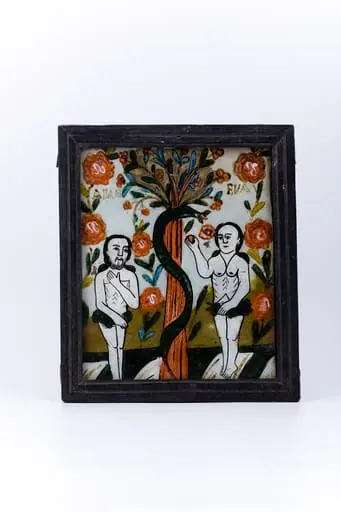 Icoana este o reprezentare narativă, scena centrală arătând căderea în păcat a lui Adam și a Evei și izgonirea lor din Rai. În centrul Grădinii Raiului este pomul cunoașterii, pe care se încolăcește viclenia și minciuna șarpelui gri-antracit, cu nervuri negre. În jurul pomului cunoașterii sunt Adam primind fructul păcatului din mâna Evei. Sunt dezbrăcați, acoperiți fiind doar de țesăturile fitomorfe, din vegetație verde-forest, din jurul mijlocului și a coapselor. Șarpele este încolăcit viclenește pe trunchiul pomului roșu vermillon-orange, zărindu-i-se geu capul printre fructele din coroană - mere sau smochine. Frunzele din pom sunt albastre regal-strălucitoare. Fondul icoanei este format din trei straturi concentrice: în interior este un câmp galben ocru-muștar de lumină - reprezentând frumusețea Grădinii Raiului, central este cerul albastru-alburiu, iar spre exterior este un chenar difuz de alb. În registrul inferior, este o alternanță oblică de verde de China, alb și bej-corai. Cromatica este armonioasă: albastru bleu-ciel-alburiu și regal, roșu vermillon-cărămiziu, ocru-muștar, galben-solar, verde kaki-forest, brun, gri, negru, alb. Inscripția din româno-chirilică se traduce Adam Eva. Icoana este din Nordul Transilvaniei, Nicula.
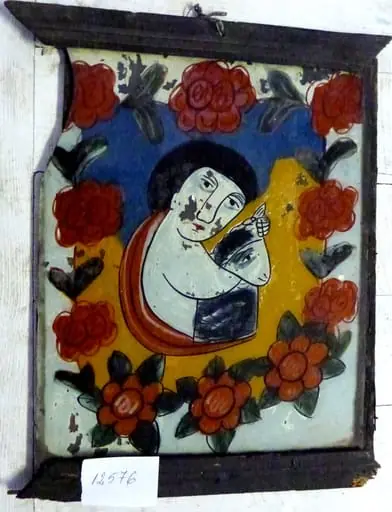 Ioan copil cu mielul
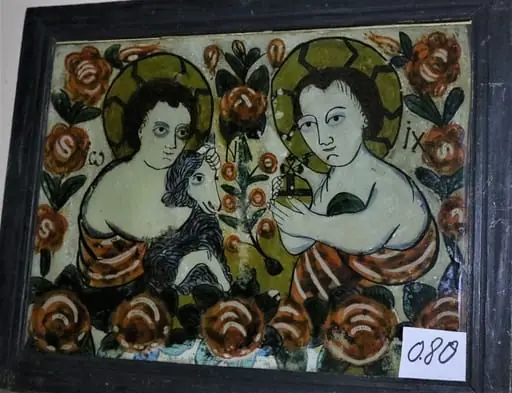 Iisus și Ioan copii
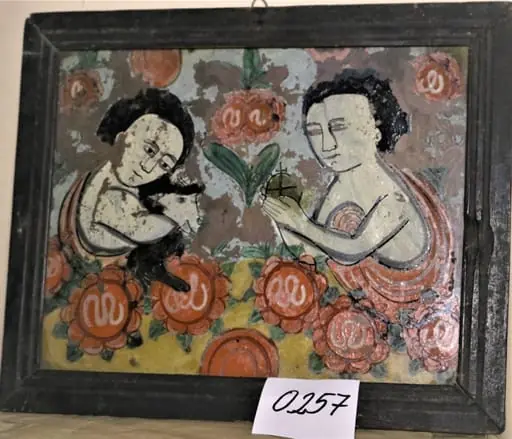
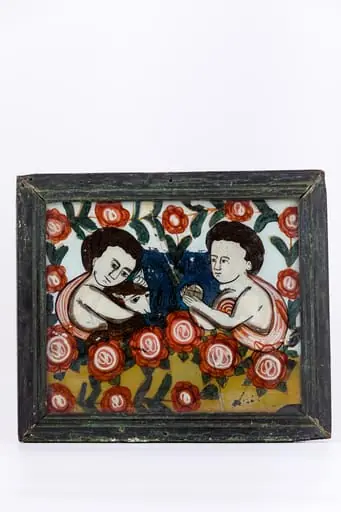 Icoana îi reprezintă dimpreună pe Mântuitorul Iisus Hristos și Sfântul Ioan Botezătorul, copii fiind, verișori, redați semi-profil, înfășurați cu câte o mantie roșie vermillon, dar cu umerii goi de copilași. Copilul Iisus ține în mâini, globul pământesc cu crucea deasupra, asemnea unui chivot de biserică, iar copilul Ioan ține un mieluț. Mieluțul este Însuși Mântuitorul Iisus Hristos, care Se va Jertfi pentru toată lumea, reprezentată de chivotul bisericii pe globul pământesc. Iată Mielul! - sunt cuvintele Sfântului Mare Prooroc Ioan Botezătorul și Înaintemergătorul Domnului nostru Iisus Hristos. Fondul icoanei este albastru bleumarin adânc și profund, în centrul icoanei, și bleu-ciel senin, pe margini, în registrul inferior este un câmp luminos de galben-ocru. În marginile icoanei, fondul este alb-albastru bleu-ciel foarte deschis și senin, înconjurat de elemente decorative fitomorfe - 16 trandafiri și bujori, ruje, roșii, cu frunze verzi. Cromatica este armonioasă și senină: roșu vermillon, albastru bleumarin, albastru bleu-ciel, galben-ocru; alb, negru. Icoana este de Gherla.
 icoană pe sticlă