Artwork
An African Lyre Player (recto)
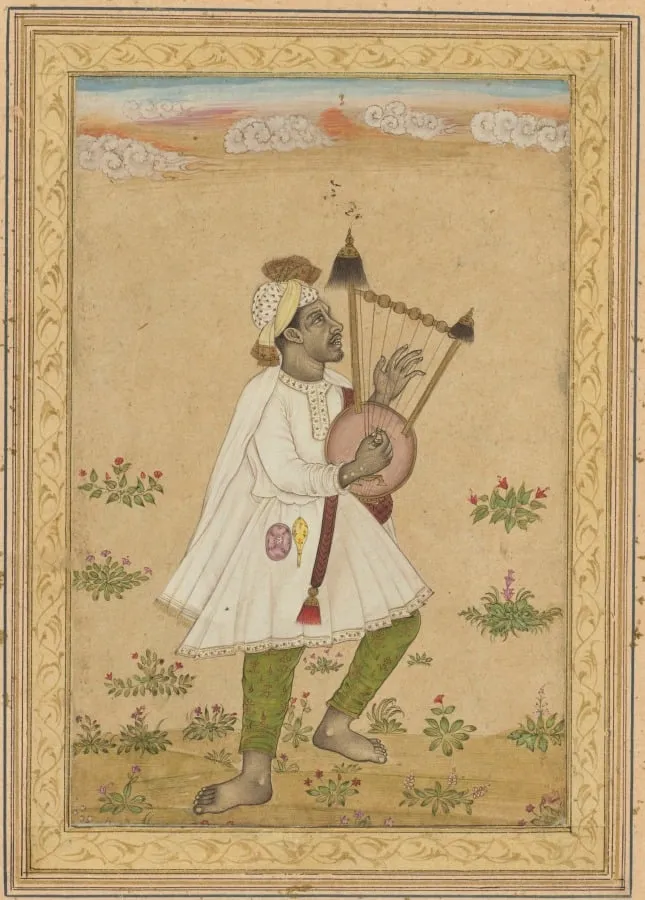
An African Lyre Player (recto) is an unspecified painting by the Baroque artist Unknown. It dates from 1650 and is held in the collection of the Cleveland Museum of Art. This 17th-century Deccan painting depicts a seated, dark-skinned man playing a small, wooden bowl lyre (nanga) against a plain background.
About this work
This painting comes from the Deccan region of India in the 1600s, where African musicians often worked in royal courts.
A man sits cross-legged, plucking a small wooden lyre with both hands. His dark skin and loose turban stand out against a plain background.
This painting comes from the Deccan region of India in the 1600s, where African musicians often worked in royal courts. The lyre he plays is called a *nanga*—a type common in Nubia, not India. It’s unclear if he’s a real person or a general idea of a musician.
To see more art from this time and place, look up india, deccan, 17th century.
Overview
This 17th-century Deccan painting depicts a seated, dark-skinned man playing a small, wooden bowl lyre (nanga) against a plain background. His identity remains unknown, leaving ambiguity whether the work is a portrait or a generic representation of a musician.
Subject & Meaning
The subject, likely an African musician in Indian royal service, holds a nanga, a lyre type originating from northeastern Africa's Nubia, contrasting with the Indian setting. The figure's dignified attire and realistic portrayal distinguish it from earlier, more caricatured depictions of Africans in Indian art.
Technique & Style
The painting's style is characteristic of 17th-century Deccan art, with a focus on the subject against a minimalist backdrop, emphasizing the musician and his instrument. The use of a plain background highlights the figure's attire and the nanga lyre.
History & Provenance
Originating from the Deccan region in western India during the 1600s, this work reflects the cultural exchange and employment of Africans in Indian royal courts as musicians, among other roles. The artist and specific court of origin are not documented.
Context
This piece is part of a broader phenomenon of African presence in 17th-century India, particularly in the Deccan, where Africans were integrated into various aspects of courtly life. The nanga lyre's Nubian origins underscore the transcontinental connections depicted.
Legacy
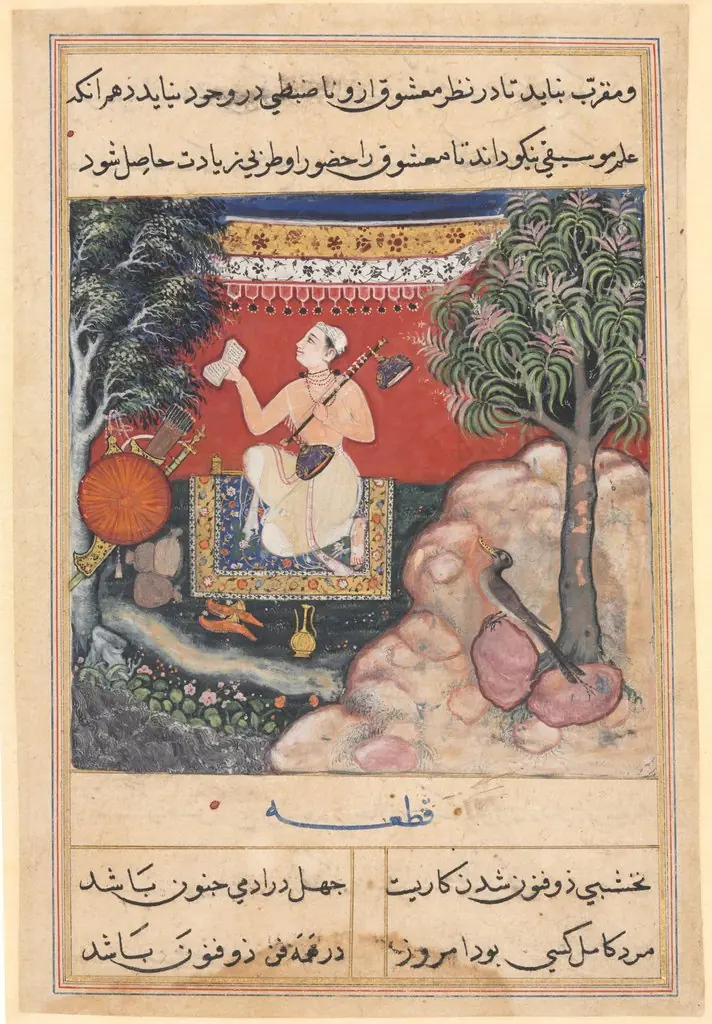
While not individually renowned, this painting contributes to the understanding of cultural diversity and artistic exchanges in early modern India. It contrasts with earlier works like the Tuti-nama's dancing Zangi, showing a shift towards more nuanced portrayals of African figures in Indian art.
Artist & collection

 Domestic Scene
 Giacomo and Cardinal Marco, investing Andrea, Abbot of San Zeno, with his Benefice
 The Nymph of Fontainebleau
 Portrait of a Woman
 Madonna and Child with Saints in the Enclosed Garden
 Venus and Minerva
 Family Group of Four on Sofa
 Wall painting from Room H of the Villa of P. Fannius Synistor at Boscoreale
 Untitled
 Aristu Jah
 A Mughal courtier
 Celebrations of Krishna's Birth, from a Bhagavata Purana
 The origin of music from a fabulous bird of India which had seven holes in its beak, from a Tuti-nama (Tales of a Parrot): Fourteenth Night
 Untitled
 Portrait of Maharaja Rai Singh of Bikaner (reigned 1574–1612)
 Mian Mukand Dev