Artwork
An Engine for raising Water from the Nile
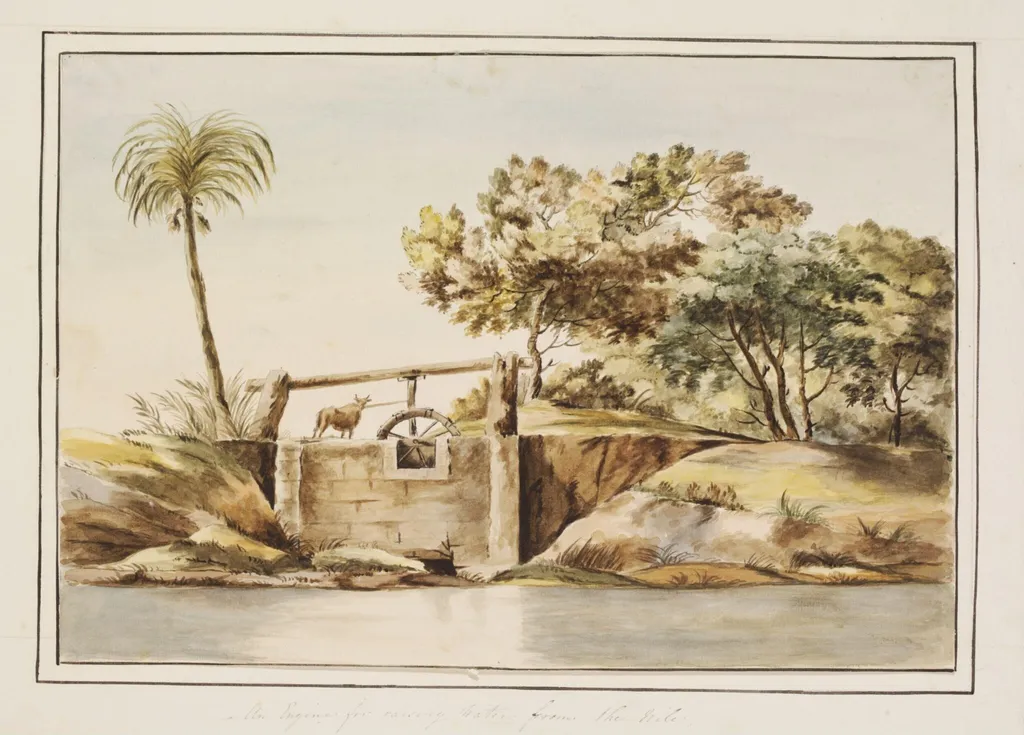
An Engine for raising Water from the Nile is a watercolor work on paper by the Romanticist artist Unknown. It dates from 1825 and is held in the collection of the Victoria and Albert Museum. This 1825 watercolour depicts a mechanical device designed to lift water from the Nile River.
About this work
Overview
Executed in delicate, translucent washes, the work captures a large water wheel positioned near the riverbank, with natural elements framing the structure.
This 1825 watercolour depicts a mechanical device designed to lift water from the Nile River. Executed in delicate, translucent washes, the work captures a large water wheel positioned near the riverbank, with natural elements framing the structure. Though once linked to civil engineer J. S. Perring, the style suggests a different hand, possibly a surveyor or amateur artist documenting local infrastructure. The piece reflects a practical interest in agricultural technology rather than artistic ambition.
Subject & Meaning
The scene centers on a water-lifting mechanism, likely a noria or similar device, used to irrigate farmland along the Nile. A small animal near the wheel and a leaning palm tree suggest a quiet, working landscape. The absence of human figures emphasizes the machine’s role as a silent agent of productivity. The composition conveys utility over spectacle, aligning with 19th-century documentation of Egyptian agrarian systems during periods of foreign technical interest.
Technique & Style
The artist employed light, fluid watercolour washes to render the water, foliage, and stone with a sense of atmospheric movement. Brushstrokes are loose and suggestive, avoiding sharp definition in favor of tonal gradations. The background trees and bushes are rendered in muted greens and browns, creating depth without detail. The water wheel, though mechanically rendered, is integrated into the landscape rather than isolated, indicating an observational rather than technical drafting approach.
History & Provenance
The drawing was likely made during a period of increased European interest in Egyptian engineering, possibly by a traveler or colonial official. Its attribution to J. S. Perring has been questioned due to stylistic inconsistencies with his known works. The piece entered institutional collections without clear documentation of its origin, suggesting it may have been acquired as a specimen of regional technology rather than as fine art.
Context
In the early 1820s, British and French engineers were surveying Egypt’s irrigation systems, often recording native machinery for potential adaptation. This watercolour aligns with a broader trend of documenting indigenous technology, not as exotic curiosity but as functional knowledge. The Nile’s seasonal flooding made water-lifting devices essential, and such drawings served practical or scientific purposes, often circulated among colonial administrators and agricultural societies.
Legacy
Though not widely exhibited or studied, the work contributes to a quiet archive of pre-industrial Egyptian engineering. It preserves a visual record of mechanical solutions adapted to local conditions, now largely obsolete. Its value lies not in artistic innovation but in its testimony to the intersection of environment, labor, and technology in 19th-century Egypt, offering insight into systems that sustained agriculture for centuries.
Artist & collection

 Domestic Scene
 Giacomo and Cardinal Marco, investing Andrea, Abbot of San Zeno, with his Benefice
 The Nymph of Fontainebleau
 Portrait of a Woman
 Madonna and Child with Saints in the Enclosed Garden
 Venus and Minerva
 Family Group of Four on Sofa
 Wall painting from Room H of the Villa of P. Fannius Synistor at Boscoreale
 The manner of treading out the Corn
 A Turkish Mosque on the Banks of the Nile
 View of the Sea Castle (Sidon)
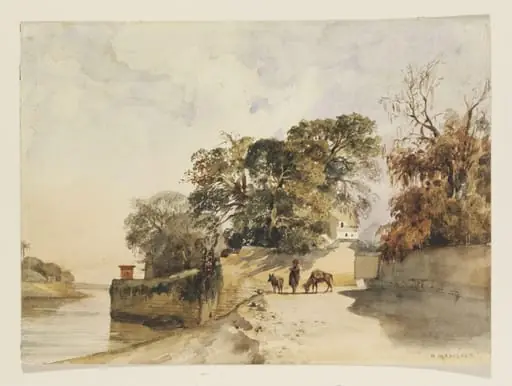 Qasr al-Ayni, Cairo
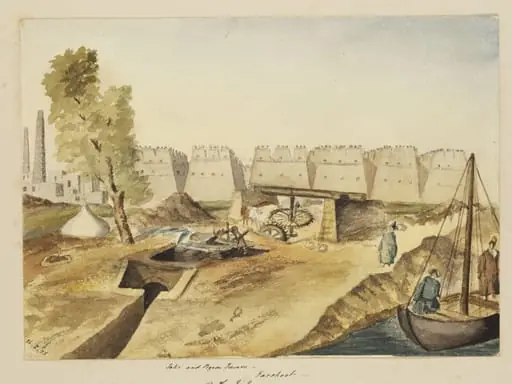 `Saki and Pigeon Towers - Farshoot - On the Nile'
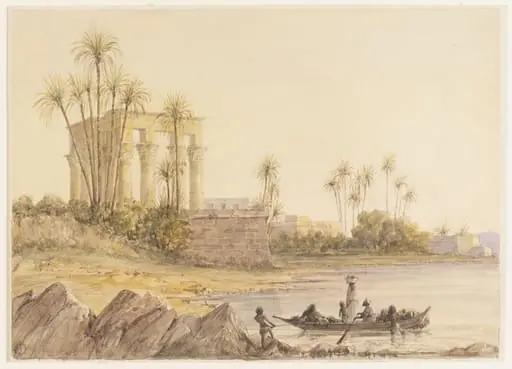 Landing Place. Philoe
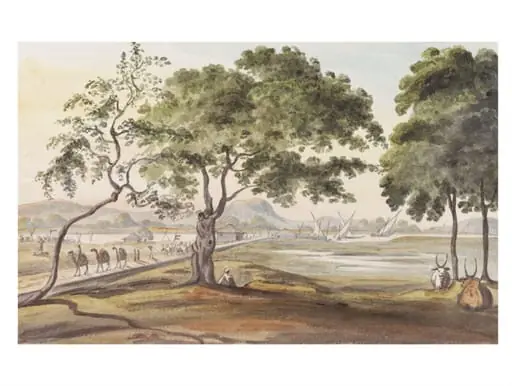 Panvell Bunder
 Landscape with Cattle
 View in Krakatoa Island, near the Straits of Sunda
 The Temple of Isis and Kiosk of Trajan on the Island of Philae
 View of the Nile
 View of the Nile with boat