Artwork
Arrival of the "Southern Barbarians"
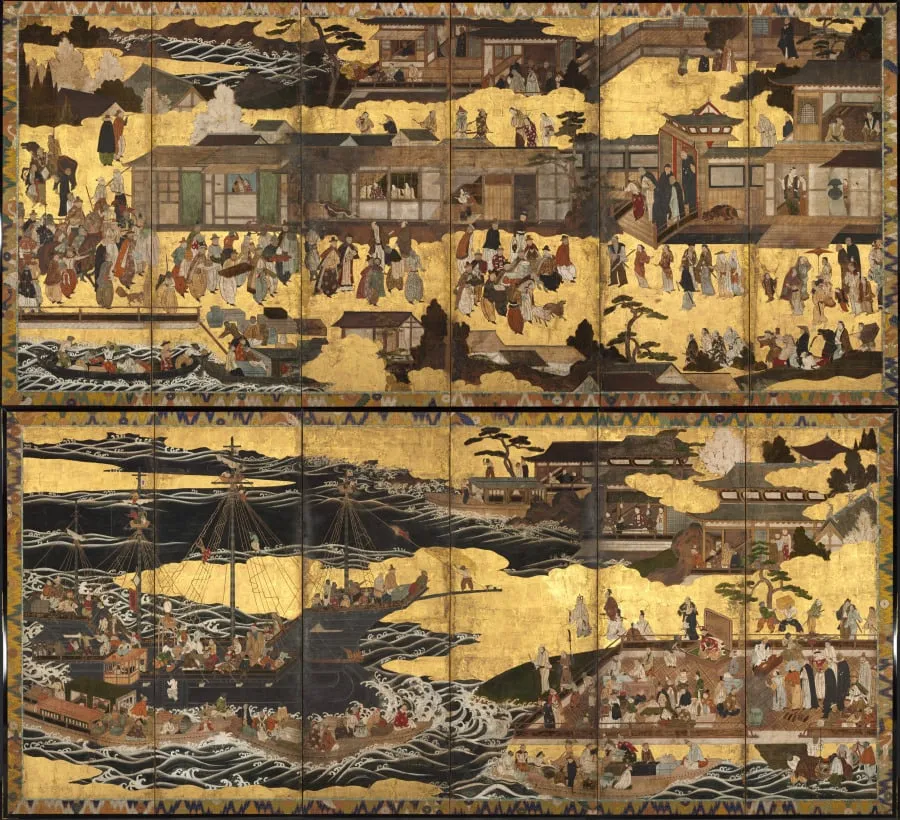
Arrival of the "Southern Barbarians" is an unspecified painting by the Early Baroque Italian artist Unknown. It dates from 1600 and is held in the collection of the Cleveland Museum of Art.
About this work
Look up more works from the momoyama period (1573–1615) to see how Japan pictured its last days of open trade.
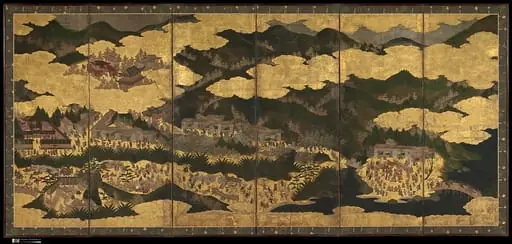
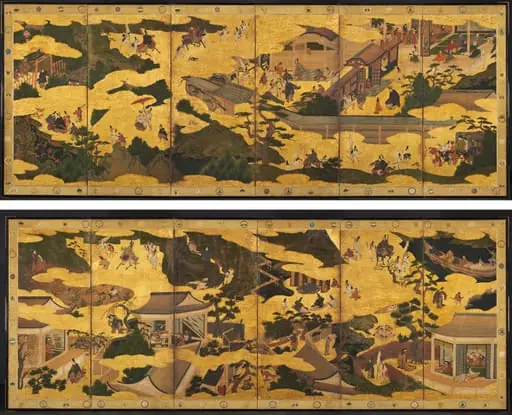
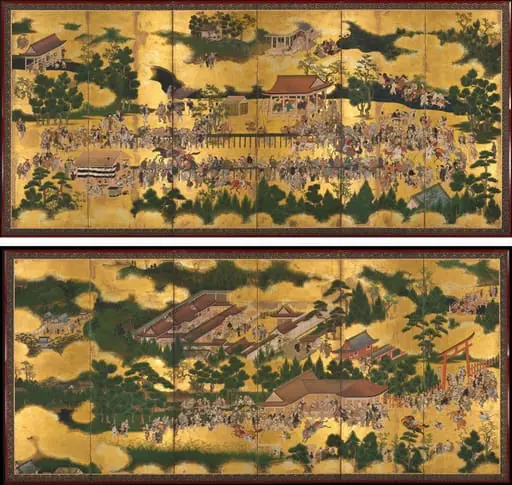
You see two tall folding screens filled with tiny figures: Portuguese traders in wide hats and black robes stepping off a ship, priests in long robes holding crosses, and Japanese officials waiting on shore.
These screens were made just before Japan shut its doors to most Europeans. The Portuguese brought trade—and trouble. Their missionaries caused fights, so Japan pushed them out. The screens show the moment right before that change.
Look up more works from the momoyama period (1573–1615) to see how Japan pictured its last days of open trade.
Overview
The pair of folding screens, titled *Arrival of the "Southern Barbarians,"* depict a maritime landing scene populated by numerous diminutive figures. Portuguese traders in broad-brimmed hats and black garments disembark from a vessel, accompanied by Roman Catholic priests bearing crucifixes, while Japanese officials stand on the shore awaiting their arrival. Executed in the early seventeenth century, the work captures a moment just before Japan’s policy of national seclusion took effect.
Subject & Meaning
The composition records the presence of Portuguese merchants—the primary European contact in Japan at the time—and their accompanying missionaries, whose activities increasingly troubled the Japanese authorities. By illustrating the encounter between foreign traders and domestic officials, the screens convey both the economic allure of foreign goods and the cultural tensions that would soon lead to the expulsion of the Portuguese and the restriction of European access.
Technique & Style
Rendered on two tall byōbu panels, the work employs the vibrant coloration and intricate detailing characteristic of the Momoyama period (1573–1615). Fine brushwork delineates the crowded figures, while the use of perspective creates a sense of depth across the shoreline and ship. The decorative format, intended for display in a reception space, reflects the era’s penchant for elaborate, narrative screen paintings.
History & Provenance
Created shortly before the implementation of Japan’s sakoku (closed‑country) policy, the screens likely originated in a court or merchant setting that sought to document the fleeting era of open trade. After the Portuguese were expelled in the early 1600s, the Dutch became the sole European traders permitted limited access at Nagasaki from 1641 until the mid‑nineteenth century. The panels have since entered museum collections as visual records of this transitional period.
Context
During the late Momoyama period, Japan experienced a surge of foreign contact, especially through Portuguese ships that introduced new commodities and Christianity. The resulting social upheaval prompted the Tokugawa shogunate to curtail missionary activity and, eventually, to isolate the nation. The screens thus serve as a visual testimony to the brief window of cross‑cultural exchange preceding the long era of seclusion.
Artist & collection

 Domestic Scene
 Giacomo and Cardinal Marco, investing Andrea, Abbot of San Zeno, with his Benefice
 The Nymph of Fontainebleau
 Portrait of a Woman
 Madonna and Child with Saints in the Enclosed Garden
 Venus and Minerva
 Family Group of Four on Sofa
 Wall painting from Room H of the Villa of P. Fannius Synistor at Boscoreale