Artwork
'Bacchante' by Jean-August Barré exhibited at Crystal Palace
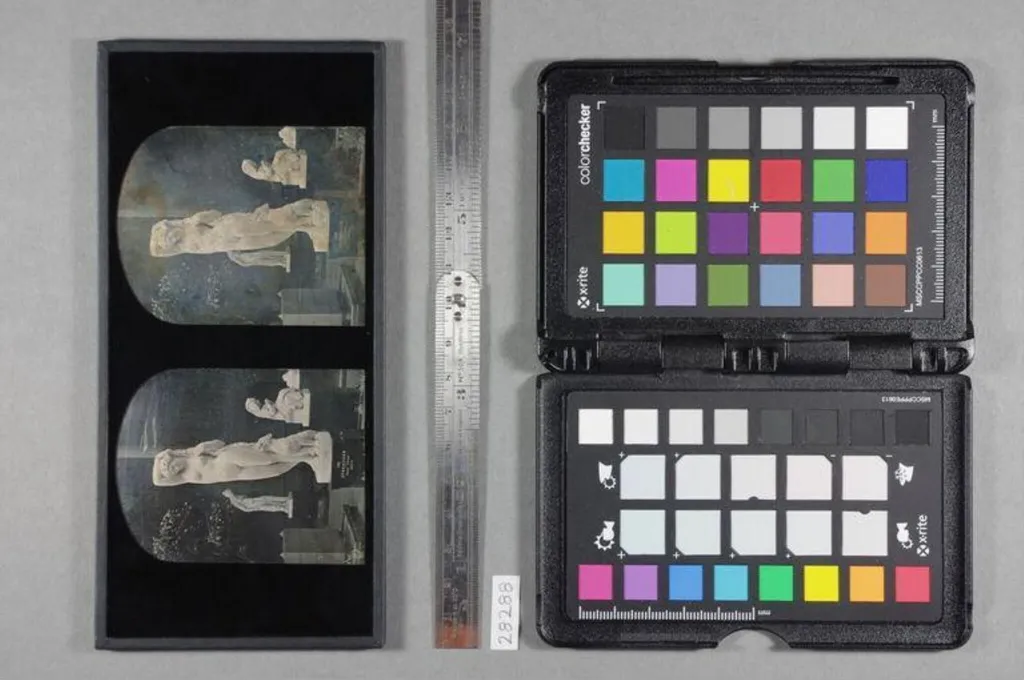
'Bacchante' by Jean-August Barré exhibited at Crystal Palace is a photographic photography by the Impressionist artist Unknown. It dates from 1854 and is held in the collection of the Victoria and Albert Museum.
About this work
Overview
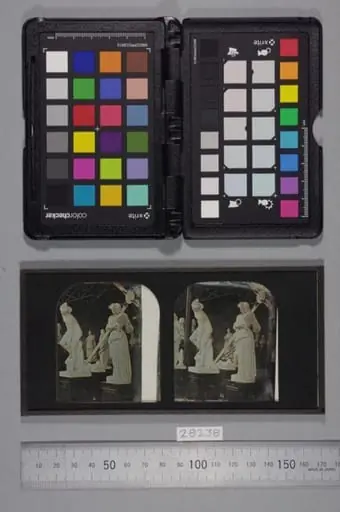
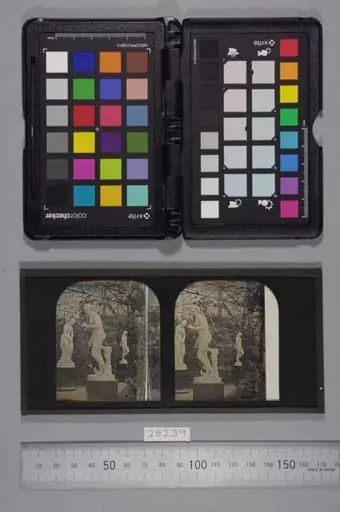
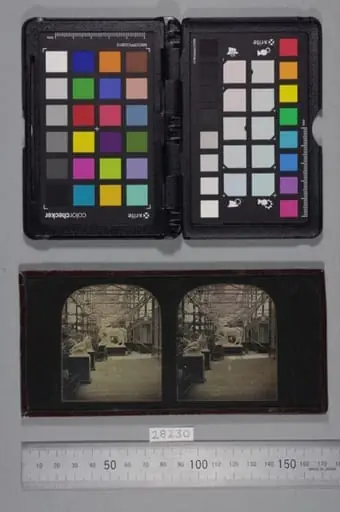
A stereoscopic daguerreotype captures Jean-August Barré’s sculpture *Bacchante*, originally displayed at the Crystal Palace during the 1851 Great Exhibition.
A stereoscopic daguerreotype captures Jean-August Barré’s sculpture *Bacchante*, originally displayed at the Crystal Palace during the 1851 Great Exhibition. The photograph, mounted in a black frame with dual arched openings, was later reassembled in a passe-partout frame in 1981. As a photographic record of a sculptural work, it preserves the form of the figure in the muted tones and fine grain typical of early photographic processes.
Subject & Meaning
The sculpture depicts a female figure in a reclining pose, evoking the mythological bacchante—a follower of Dionysus. Her relaxed posture and partial nudity suggest a state of tranquil ecstasy, aligned with classical themes of revelry and natural grace. The image conveys serenity rather than frenzy, emphasizing the figure’s harmony with her surroundings, consistent with 19th-century interpretations of antiquity.
Technique & Style
The daguerreotype process produced a highly detailed but fragile image, rendered in silver-toned monochrome with subtle gradations. The photograph’s soft focus and muted contrasts reflect both the limitations of early photography and the artist’s intent to capture the sculpture’s contours and surface texture. The dim, shadowed background enhances the figure’s three-dimensionality, isolating her form against an indistinct, atmospheric space.
History & Provenance
Barré’s *Bacchante* was exhibited at the Crystal Palace in 1851 as part of the Great Exhibition’s display of decorative arts. The daguerreotype was likely produced for public dissemination or private collection. The sculpture itself was later installed on the Louvre’s exterior, while the photograph entered the collection of the Victoria and Albert Museum, where it remains as a historical document of 19th-century artistic presentation.
Context
During the mid-19th century, photography emerged as a tool for documenting sculpture, enabling wider access to works displayed at international exhibitions. The Crystal Palace served as a venue for showcasing both industrial innovation and artistic achievement. This daguerreotype reflects the era’s interest in preserving and circulating images of classical-inspired sculpture, bridging public spectacle and private contemplation.
Legacy
The photograph endures as a record of Barré’s sculpture before its permanent placement at the Louvre. It illustrates the role of early photographic technology in shaping public engagement with art, transforming ephemeral exhibition displays into lasting visual archives. Its preservation at the Victoria and Albert Museum underscores its value as a material artifact of Victorian visual culture and the intersection of sculpture and photography.
Artist & collection

 Domestic Scene
 Giacomo and Cardinal Marco, investing Andrea, Abbot of San Zeno, with his Benefice
 The Nymph of Fontainebleau
 Portrait of a Woman
 Madonna and Child with Saints in the Enclosed Garden
 Venus and Minerva
 Family Group of Four on Sofa
 Wall painting from Room H of the Villa of P. Fannius Synistor at Boscoreale
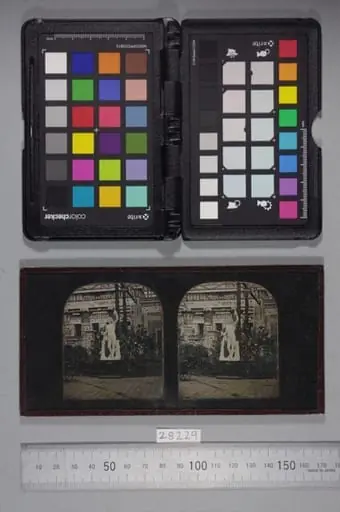 Sculpture of Bacchus at Crystal Palace
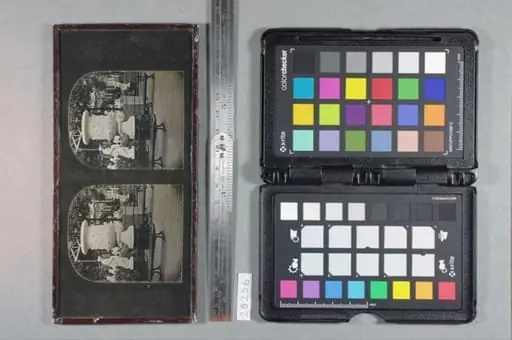 Sculptures at Crystal Palace
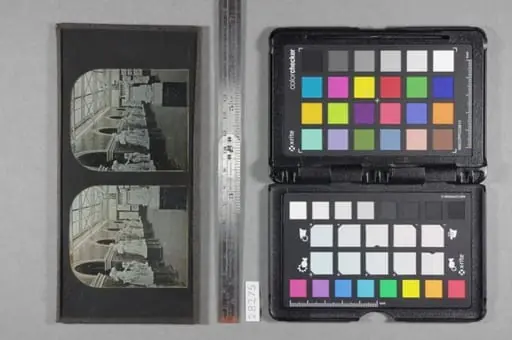 Sculptures on display at Crystal Palace
 Sculptures at the Crystal Palace
 View of Architectural Sculpture Displayed at Crystal Palace
 Medieval Architecture and Sculpture at Crystal Palace
 Sculptures at the Crystal Palace
 Sculptures Displayed at Crystal Palace