Artwork
Balabhadra, Subhadra and Jagannatha
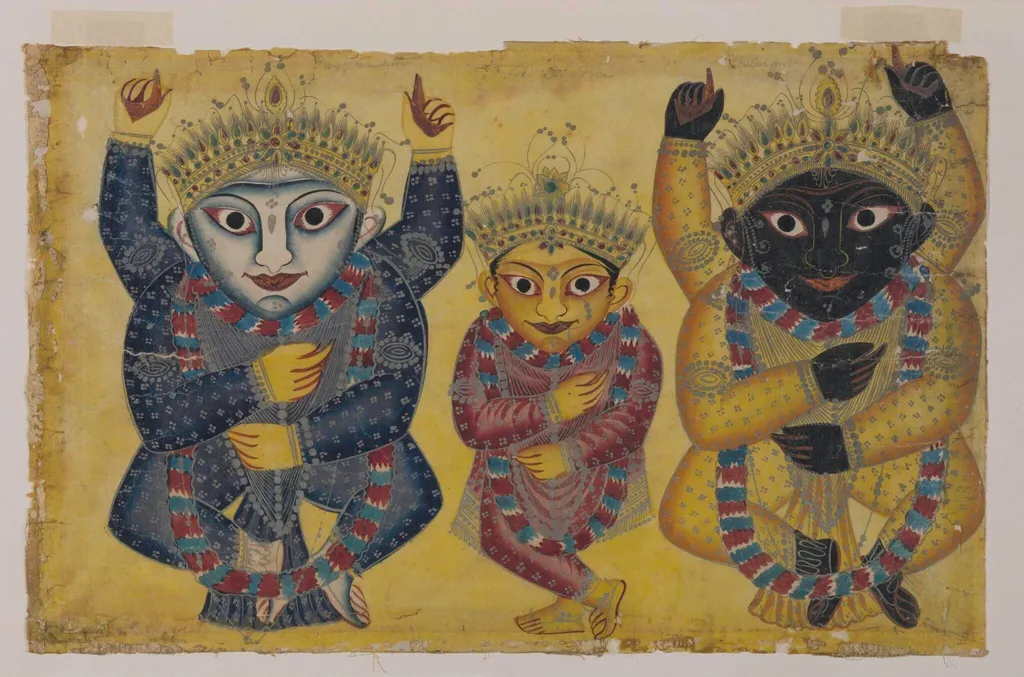
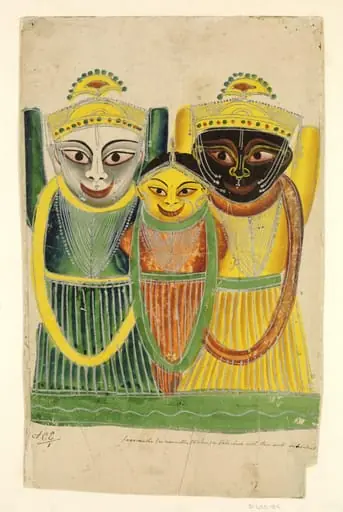
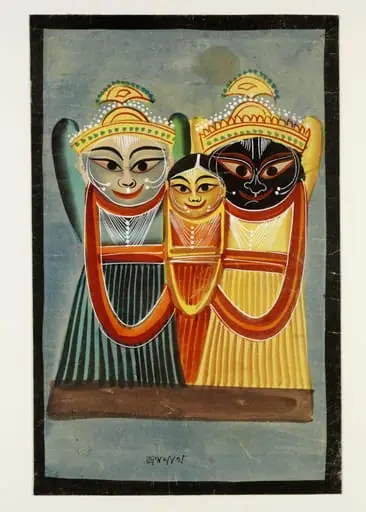
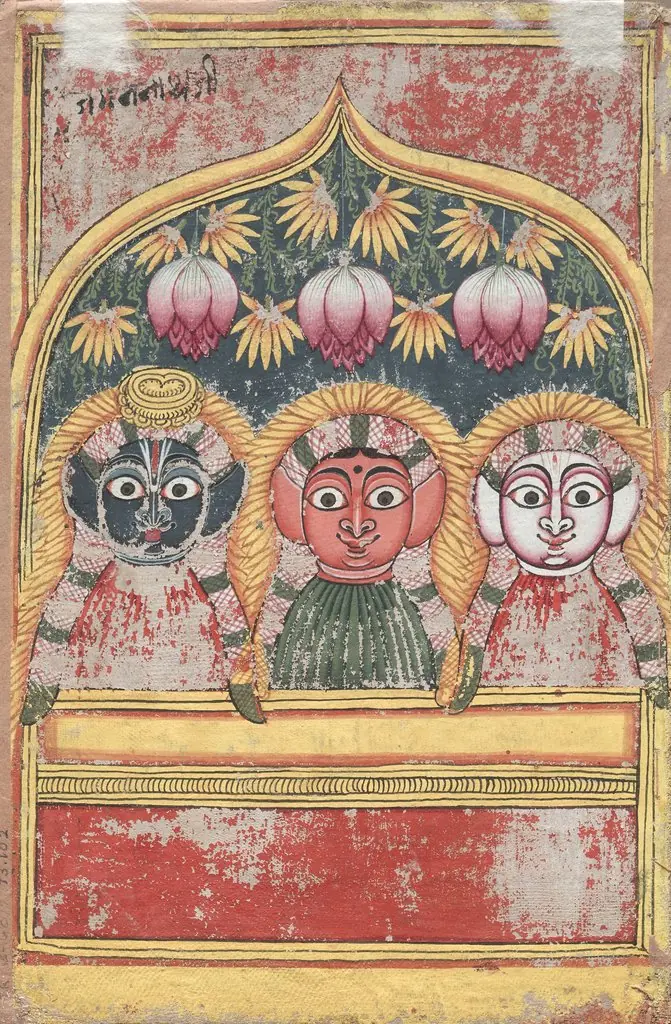
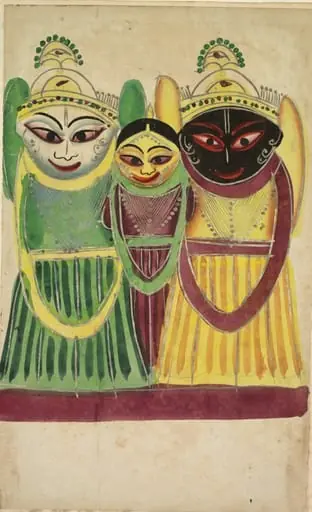
Balabhadra, Subhadra and Jagannatha is a paint painting by the Impressionist artist Unknown. It dates from 1860 and is held in the collection of the Victoria and Albert Museum.
About this work
Overview
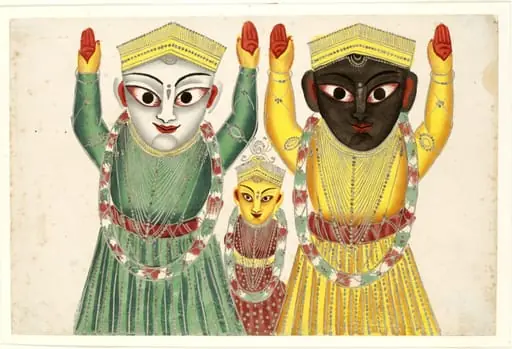
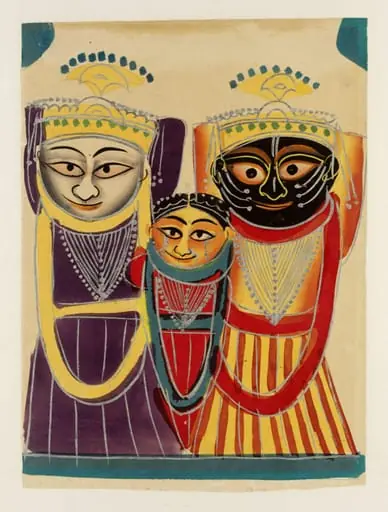
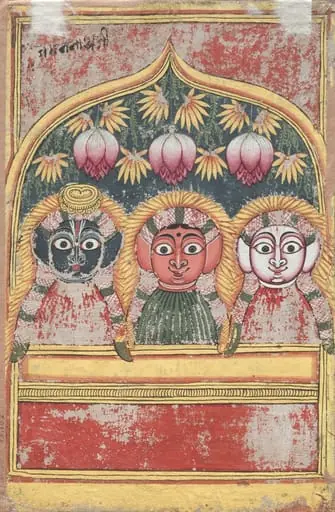
The work is a watercolor and tin‑alloy painting on paper that presents three Hindu deities—Balabhadra, Subhadra and Jagannatha—set against a uniform yellow ground. The central figure, Jagannatha, is depicted with dark skin, a characteristic variant of Krishna, while his brother and sister flank him on either side. All three are dressed in vivid garments and wear elaborate crowns and garlands.
Subject & Meaning
The presence of striped garlands and ornate silver (tin‑alloy) jewelry signals ritual reverence and the celebratory nature of the scene.
The composition illustrates a familial grouping of the divine siblings, a motif common in regional devotional practice. Jagannatha occupies the middle position, emphasizing his primacy, while Balabhadra and Subhadra are positioned symmetrically, underscoring their relational ties. The presence of striped garlands and ornate silver (tin‑alloy) jewelry signals ritual reverence and the celebratory nature of the scene.
Technique & Style
Executed in the Kalighat tradition of 19th‑century Calcutta, the painting employs bold, flat washes of color and simplified, linear figures. The artists used rapid brushstrokes to render large areas of pigment, and the tin‑alloy appliqué adds three‑dimensional detail to the jewelry. Characteristic large, round eyes and stylized crowns convey a folk aesthetic rather than academic realism.
History & Provenance
Kalighat paintings emerged in the bustling environs of the Kalighat temple area, catering to a market of pilgrims and colonial observers. This piece reflects that commercial context, where artists produced affordable devotional images for a diverse audience during British rule in India. Its survival in a museum collection indicates it was likely acquired from a private collector or dealer specializing in South Asian folk art.
Context
The work belongs to a period when Indian artisans adapted traditional iconography to new materials and tastes, integrating watercolor with metal‑foil embellishments. The choice of a yellow background and the vivid palette aligns with the visual language of popular religious prints that circulated among urban and rural devotees alike.
Artist & collection

 Domestic Scene
 Giacomo and Cardinal Marco, investing Andrea, Abbot of San Zeno, with his Benefice
 The Nymph of Fontainebleau
 Portrait of a Woman
 Madonna and Child with Saints in the Enclosed Garden
 Venus and Minerva
 Family Group of Four on Sofa
 Wall painting from Room H of the Villa of P. Fannius Synistor at Boscoreale