Artwork
Jagannatha, Balabhadra and Subhadra
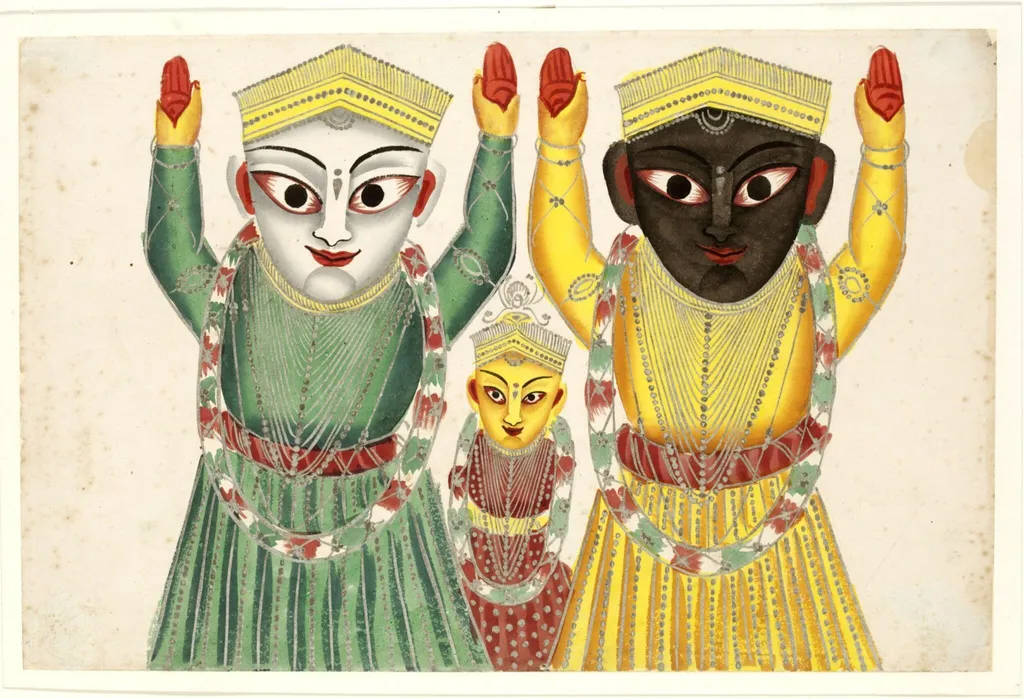
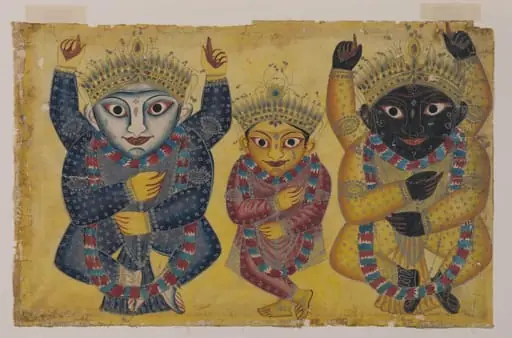
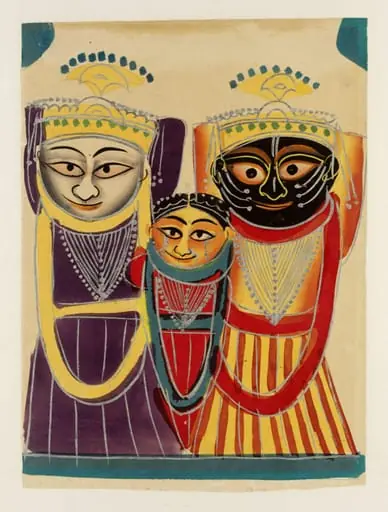
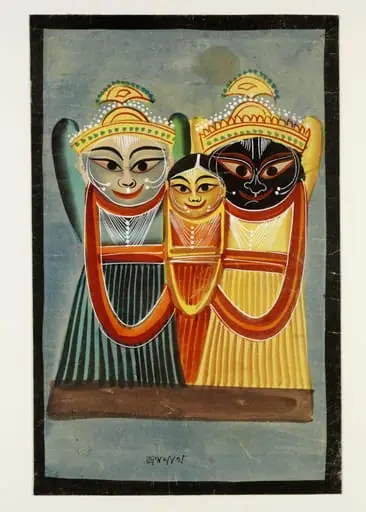
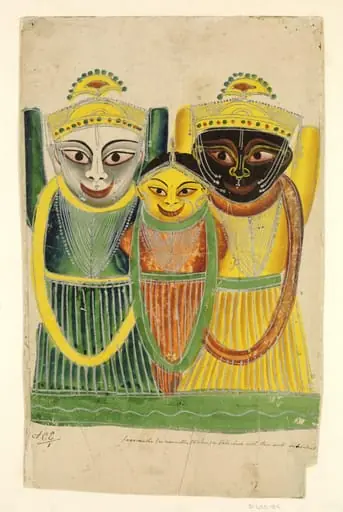
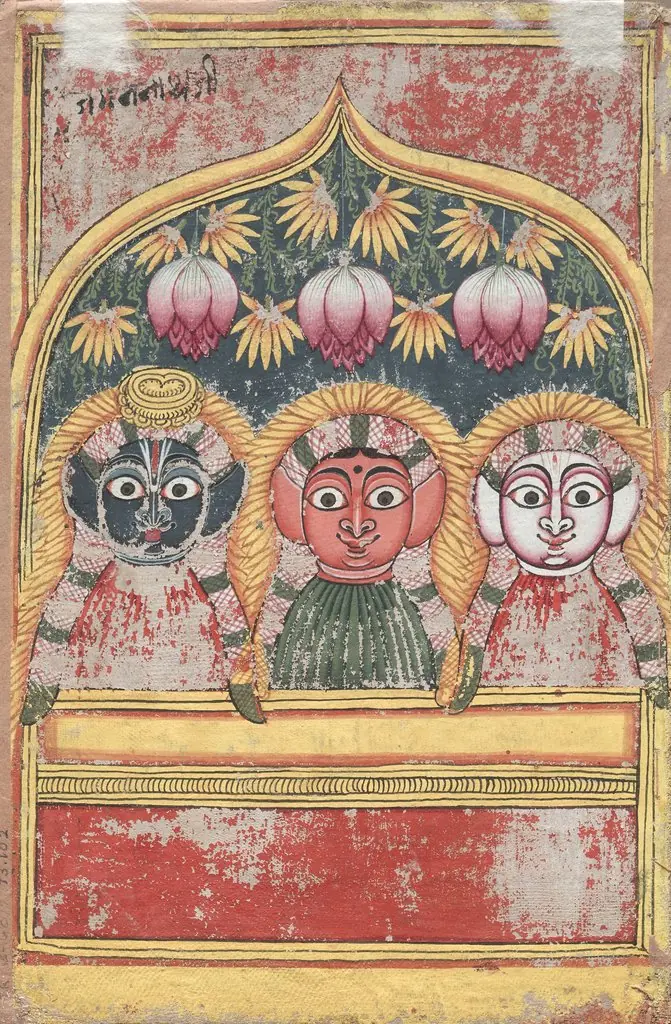
Jagannatha, Balabhadra and Subhadra is a paint painting by the Romanticist artist Unknown. It dates from 1830 and is held in the collection of the Victoria and Albert Museum. This painting depicts the triad of Jagannatha, Balabhadra, and Subhadra, deities central to the temple cult of Puri in Odisha.
About this work
Overview
This painting depicts the triad of Jagannatha, Balabhadra, and Subhadra, deities central to the temple cult of Puri in Odisha.
This painting depicts the triad of Jagannatha, Balabhadra, and Subhadra, deities central to the temple cult of Puri in Odisha. Rendered in the Kalighat style, it emerged in 19th-century Calcutta as a response to urbanization and colonial influence. Artists from rural Bengal adapted traditional iconography with bold outlines, flat colors, and rapid brushwork, making religious imagery accessible to a broader public through affordable, portable artworks.
Subject & Meaning
The three figures represent a divine trio: Jagannatha, a form of Krishna; his brother Balabhadra; and their sister Subhadra. Their abstract, stump-like forms stem from a legend in which the divine carpenter Vishwakarma abandoned the carving after being interrupted, leaving the idols incomplete. This narrative legitimizes their non-naturalistic appearance as sacred rather than flawed, reinforcing devotion through symbolic rather than realistic representation.
Technique & Style
Executed in the Kalighat tradition, the painting employs vivid, unmodulated colors and minimal detail. Forms are simplified into bold silhouettes, with exaggerated eyes and flat planes defining the figures. Brushwork is swift and confident, emphasizing rhythm over precision. The lack of shading or perspective aligns with folk aesthetics, prioritizing spiritual recognition over anatomical accuracy, characteristic of 19th-century Bengali popular art.
History & Provenance
Produced in Calcutta during British rule, this work reflects the rise of a new urban art market catering to pilgrims and middle-class patrons. Artists migrated from rural Bengal, adapting temple iconography for sale near the Kalighat temple. These paintings were often bought as devotional objects or souvenirs, linking religious practice with commercial production. The style flourished between the 1830s and early 1900s before declining with the advent of print media.
Context
In colonial Calcutta, traditional religious imagery was reinterpreted by local artists navigating cultural change. Kalighat paintings responded to shifting social dynamics, blending myth with contemporary commentary. While rooted in Odishan worship, this depiction was shaped by Bengali artistic conventions and urban demand. The style served both devotional and documentary functions, capturing how faith adapted in a colonized, modernizing society.
Legacy
Kalighat paintings like this one preserved and disseminated regional religious narratives at a time of cultural upheaval. Though mass-produced, they maintained symbolic integrity, influencing later Indian modernist movements and ethnographic collections. Today, they are studied as vital records of vernacular artistry, offering insight into how devotion, commerce, and colonialism intersected in 19th-century Bengal.
Artist & collection

 Domestic Scene
 Giacomo and Cardinal Marco, investing Andrea, Abbot of San Zeno, with his Benefice
 The Nymph of Fontainebleau
 Portrait of a Woman
 Madonna and Child with Saints in the Enclosed Garden
 Venus and Minerva
 Family Group of Four on Sofa
 Wall painting from Room H of the Villa of P. Fannius Synistor at Boscoreale